
The Total Loss Trap Why GAP Insurance in Ontario Can Protect You From a Costly Loan Shortfall
The Total Loss Trap Why GAP Insurance in Ontario Can Protect You From a Costly Loan Shortfall
Posted on September 23, 2026
The Total Loss Trap: Why GAP Insurance in Ontario Can Protect You From a Costly Loan Shortfall
A total-loss insurance settlement may be based on what your vehicle is worth today—not what you still owe on the loan. GAP insurance can help protect eligible Ontario drivers from that financial difference.
Winter driving in Southern Ontario can change in minutes. One stretch of the QEW or Highway 403 can be clear, and the next can bring blowing snow, black ice, reduced visibility and sudden braking.
For drivers commuting between Burlington, Hamilton, Oakville and Mississauga, a serious collision can create more than the immediate stress of losing a vehicle.
There can also be a second financial problem hiding behind the accident: your vehicle could be worth less than the amount remaining on your auto loan.
That is where understanding GAP insurance in Ontario becomes important.
Key Takeaways
- Ontario insurers generally consider a vehicle's actual cash value when determining a total-loss settlement under applicable coverage—not simply the amount remaining on your auto loan. FSRA explains how total-loss claims are assessed.
- If you owe more than the insurance settlement, the difference can leave you with a loan balance on a vehicle you can no longer drive.
- This difference is often called a financial gap or negative equity shortfall.
- GAP insurance is optional coverage designed to help address an eligible difference between a vehicle's actual cash value and the remaining loan or lease balance after a covered total loss or theft.
- Coverage limits, deductibles, exclusions and eligibility conditions matter. GAP insurance should never be assumed to cover every dollar in every situation.
- Ontario drivers should confirm that GAP insurance is being provided through properly licensed insurance channels. FSRA issued a consumer warning about this issue in July 2026.
- Before choosing a vehicle or finance structure, compare purchase price, trade equity, loan term, total amount financed and available protection—not only the monthly or bi-weekly payment.
- Financing options are available for many credit situations through Car Nation Canada, O.A.C. — On Approved Credit. Conditions may apply.
What Happens When Your Financed Car Is Totalled in Ontario?
One of the most common misunderstandings about vehicle insurance is that your insurer automatically pays off whatever you owe your lender.
That is not generally how the calculation works.
Ontario's Financial Services Regulatory Authority explains that when deciding whether to repair or write off a vehicle, an insurer compares the repair cost with the vehicle's actual cash value at the time of the loss. The insurer generally will not pay more to repair the vehicle than its actual cash value. FSRA provides more detail in its Ontario auto claims guide.
The current Ontario Automobile Policy also contains examples demonstrating how a total-loss payment can be based on the vehicle's actual cash value, subject to the applicable coverage, responsibility for the collision and deductible.
Your loan balance is a separate number.
And sometimes those two numbers are very different.
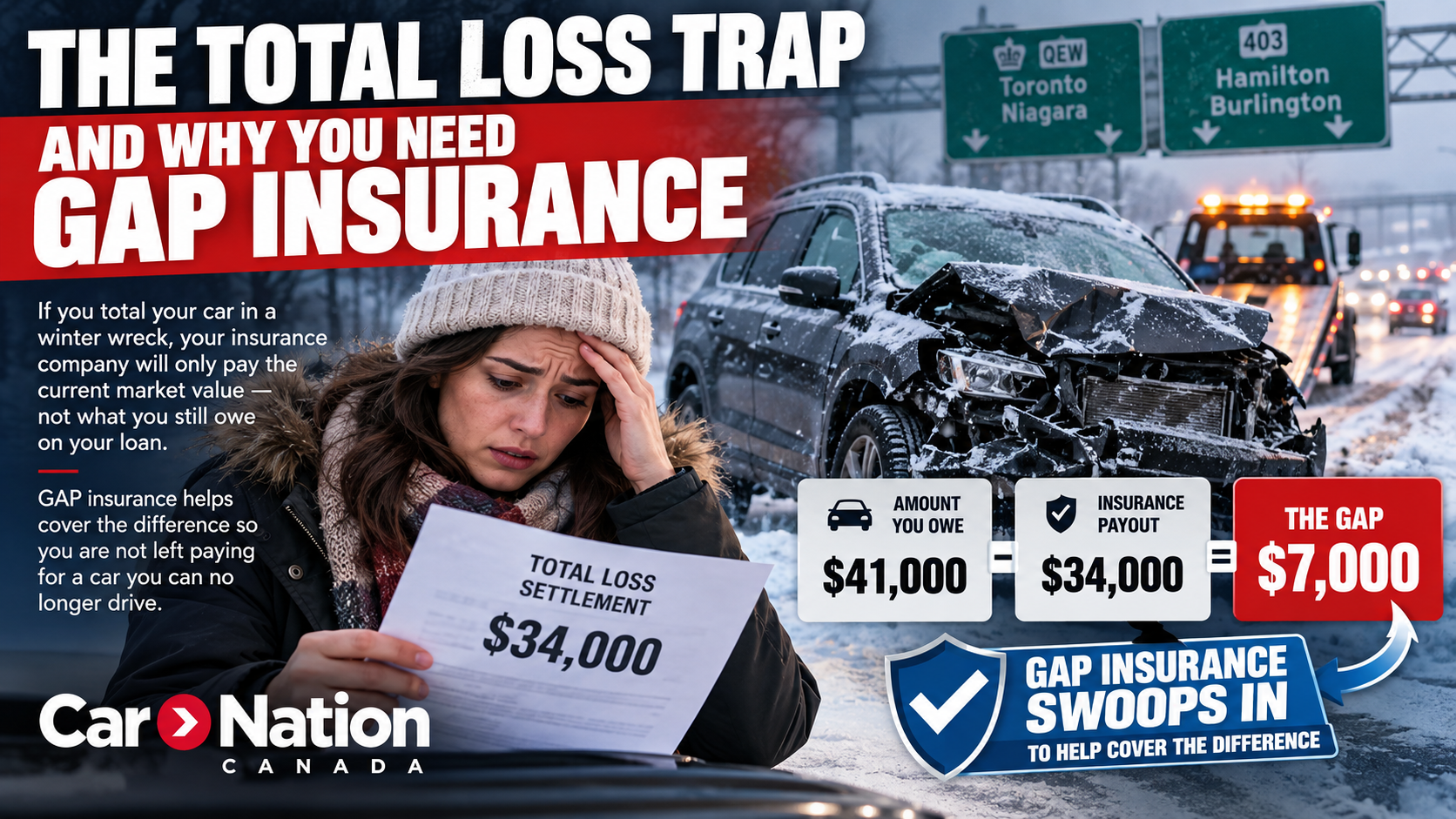
GAP Insurance Ontario Example: The $7,000 Problem
Consider a simplified example.
You finance an SUV for your commute between Burlington and Hamilton.
After factoring in the vehicle purchase, applicable taxes, an existing trade-in shortfall and other amounts included in the financing agreement, suppose your remaining loan payout is:
$41,000
Then, after a serious winter collision on the QEW, the SUV is declared a total loss.
Assume the applicable insurance settlement is:
$34,000
You could potentially have:
$41,000 loan balance - $34,000 insurance settlement = $7,000 shortfall
The exact numbers and settlement would depend on your policy, deductible, fault determination, financing agreement and other circumstances.
But the underlying problem is straightforward.
The vehicle is gone. The debt may not be.
Without applicable additional protection, you may still be responsible for satisfying that outstanding obligation according to your finance contract.
That is precisely the type of financial exposure GAP insurance is designed to address.
Why Negative Equity Can Make a Total Loss More Expensive
Negative equity means you owe more on your vehicle than the vehicle is currently worth.
It can happen for several reasons.
Long Auto Loan Terms
A longer term can make the regular payment more manageable, but it may also mean the principal balance falls more slowly.
Meanwhile, your vehicle is accumulating kilometres and depreciating.
That is why payment-focused shoppers should always compare the term length and total amount financed, rather than treating the payment as the only important number.
High Annual Kilometres
A commuter travelling between Milton, Burlington and Hamilton can accumulate kilometres quickly.
Higher mileage may affect a vehicle's resale value, depending on its age, condition and market demand.
A driver covering 25,000 or 30,000 km annually could therefore experience a different depreciation curve than someone driving 8,000 km a year.
Rolling Negative Equity Into Another Loan
Suppose you owe $24,000 on your current sedan but receive a $20,000 trade value.
There is a $4,000 difference.
If an approved lender permits that amount to be incorporated into the replacement financing structure, that old debt does not magically disappear. It becomes part of the broader financing calculation.
That can increase the possibility that the new loan balance initially exceeds the replacement vehicle's market value.
If you're already dealing with an underwater trade, understanding your financing options before selecting your next vehicle can help you compare the complete transaction rather than chasing a payment alone.
What Does GAP Insurance Actually Cover?
GAP insurance is designed to cover an eligible financial shortfall between a vehicle's actual cash value and the remaining balance on a loan or lease if the vehicle is stolen or written off.
That definition is important because GAP protection should not be interpreted as unlimited debt cancellation.
Depending on the specific product, there may be:
- maximum benefit limits;
- vehicle age or kilometre restrictions;
- requirements regarding the underlying insurance policy;
- excluded amounts or products;
- deductible provisions;
- claim documentation requirements; or
- other eligibility conditions.
Before purchasing coverage, ask what would happen using your actual loan structure, not an idealized example.
You can also discuss available vehicle and finance protection options with our team through the Car Nation Canada finance centre.
Does Regular Car Insurance Cover Negative Equity?
This is the distinction drivers should understand before signing a long-term vehicle loan.
Your auto insurer is insuring the vehicle and covered losses according to the policy.
Your lender is financing the amount agreed to under your loan contract.
Those numbers do not have to match.
FSRA's Ontario claims guidance states that insurers assessing whether to repair or write off a vehicle use its actual cash value at the time it was damaged as part of that decision.
If your vehicle's covered value is $30,000 but your loan payout is $35,000, your ordinary insurance settlement does not automatically become $35,000 merely because that is what you owe.
That's the total loss trap.
Winter Driving on the QEW and Highway 403 Makes the Conversation Real
GAP protection can sound abstract when you're sitting in a dealership signing paperwork.
It feels much less abstract during an Ontario winter.
Drivers from Grimsby through Hamilton, Burlington and Oakville regularly depend on the QEW, while Highway 403 connects commuters throughout Hamilton, Burlington, Mississauga and the surrounding region.
Snow, ice, poor visibility and traffic congestion can turn an ordinary commute into a much more difficult drive.
Nobody finances a vehicle expecting to write it off.
But financial protection is about planning for outcomes you don't expect.
GAP Insurance May Matter Even More After Rolling Negative Equity
Imagine a family replacing a minivan.
Their existing loan has a $5,000 negative-equity position. The lender approves a financing structure that includes that previous obligation with the replacement vehicle purchase.
O.A.C.
Their new loan balance may therefore start significantly higher than the standalone market value of the replacement vehicle.
If that vehicle is later written off, the insurance valuation and the loan payout can diverge considerably.
This is why our team encourages shoppers to look beyond:
"Can I afford this payment?"
and also ask:
"What exactly am I financing, for how long, and what would happen financially if this vehicle disappeared tomorrow?"
That is a much stronger way to evaluate an auto loan.
An Important 2026 Ontario Warning About GAP Insurance
There is another reason Ontario consumers need to examine GAP coverage carefully.
On July 23, 2026, FSRA warned Ontario drivers about GAP insurance being offered through unlicensed businesses or individuals. FSRA advised consumers to confirm the licensed insurer underwriting the product, verify applicable licensing and carefully review the contract and claims process.
You can read FSRA's GAP insurance consumer warning and Ontario guidance directly.
That does not mean GAP protection itself is something to avoid.
It means consumers should understand exactly what they are buying, who is providing it, what it covers and whether the appropriate licensed parties are involved.
Questions to Ask Before Buying GAP Insurance in Ontario
Before adding GAP protection to a financed sedan, truck, SUV or minivan, ask:
- Who is the insurer underwriting the coverage?
- Is the applicable insurer, agent or broker properly licensed in Ontario?
- What is the maximum GAP benefit?
- Does the coverage include my insurance deductible?
- Are amounts from previous negative equity eligible?
- Are there kilometre, age or loan-to-value limits?
- What situations are excluded?
- Does the protection apply to both theft and total loss?
- How long does the coverage remain in force?
- What happens if I pay off or refinance the loan early?
- How is a claim submitted?
The answers should be in the applicable contract or policy documentation.
Never rely solely on the word "GAP."
Look at the Entire Financing Structure Before You Drive Away
A vehicle purchase should work for your real budget—not simply produce an attractive payment.
If you're shopping from Brantford, Grimsby, Hamilton, Burlington or elsewhere in Southern Ontario, compare:
Vehicle price + trade position + amount financed + interest cost + term length + protection products + expected ownership period.
Then compare that entire structure with your monthly budget.
For a payment-focused commuter, newcomer to Canada, budget-conscious family or someone rebuilding credit, our goal is to make the numbers understandable without judgement.
Financing options are available for many credit situations, O.A.C. — On Approved Credit. Conditions may apply.
You can explore available new and used vehicles first and then review your options through the Car Nation Canada finance centre.
Conclusion: Protect the Loan, Not Just the Vehicle
The worst time to discover the difference between your insurance settlement and your loan balance is after your vehicle has already been declared a total loss.
If you finance or lease a vehicle, especially with a longer term or existing negative equity, ask what would happen if the vehicle were written off early in the agreement.
GAP insurance can be one tool designed to protect against an eligible shortfall, but the details of the coverage matter.
Before committing to your next sedan, SUV, truck or minivan, browse Car Nation Canada's current inventory and talk with our finance team about building a vehicle and financing structure that fits your budget.
Financing and eligibility for related products are subject to applicable terms and approval. O.A.C. — On Approved Credit. Conditions may apply.
Frequently Asked Questions About GAP Insurance in Ontario
Is GAP insurance mandatory in Ontario?
No. FSRA describes GAP insurance as optional coverage. Whether it makes financial sense depends on your loan or lease structure, the vehicle, the amount financed and the specific protection being offered.
Does GAP insurance pay off my entire car loan?
Not necessarily. GAP coverage is intended to address an eligible shortfall between an applicable insurance settlement and the remaining loan or lease balance, subject to the policy's limits, exclusions and conditions. Always read the specific coverage documentation.
Do I need GAP insurance if I made a large down payment?
A significant down payment can reduce the likelihood that your loan balance will exceed your vehicle's value, but it does not automatically eliminate the possibility. Compare your actual amount financed with the vehicle's value and review the available protection before deciding.
Can GAP insurance help with negative equity from my old car?
That depends on the specific GAP product and its exclusions or maximum coverage provisions. Do not assume rolled-in negative equity is automatically covered. Ask specifically how prior negative equity would be treated under the policy.
What happens if I total my financed car on the QEW or Highway 403?
Your insurer will handle the claim according to your Ontario automobile policy, applicable coverage, fault determination, deductible and vehicle valuation. If the applicable settlement is less than your remaining finance obligation, a shortfall may remain. Eligible GAP insurance is designed to help address that type of difference, subject to its terms.
With over four decades in the automotive industry, Dealer Principal Rick Paletta is a trusted name across the Hamilton–Burlington region. Born and raised locally, Rick is respected for his integrity, work ethic, and people-first leadership—and he still loves this business because it’s about helping neighbours, building relationships, and matching people with vehicles they’re excited to drive. His commitment to the community shows up in consistent giving, including long-running support of McMaster Children’s Hospital through Car Nation Cares.