
The 84-Month Loan Trap: Why Long Terms Make GAP Coverage Essential
The 84-Month Loan Trap: Why Long Terms Make GAP Coverage Essential
Posted on September 25, 2026
The 84-Month Loan Trap: Why Long Terms Make GAP Coverage Essential
An 84-month car loan can make a vehicle payment look more manageable, but the slower debt payoff can leave you exposed to negative equity for years—making GAP coverage an important protection to evaluate.
For drivers across the Greater Toronto and Hamilton Area, vehicle affordability often comes down to one number: the monthly or bi-weekly payment.
That makes an 84-month car loan—or even a 96-month term—look appealing. Stretching repayment over seven or eight years can reduce the regular payment and help a car, SUV, truck or minivan fit within a household budget.
But there is another number that matters just as much: how much you still owe compared with what the vehicle is worth.
When your loan balance falls more slowly than your vehicle depreciates, you can enter negative equity. And if the vehicle is written off while you are in that position, the insurance settlement may not necessarily eliminate the entire outstanding loan balance. That is where GAP-style protection may become worth serious consideration.
Key Takeaways
- An 84-month car loan lowers the regular payment by spreading repayment over seven years, but it generally increases total interest compared with a shorter term.
- Long terms can keep borrowers in negative equity longer because vehicles often depreciate faster than loan principal is repaid during the early years.
- The Financial Consumer Agency of Canada’s guidance on long-term auto loans identifies loans of 72 months or more as long-term financing and warns consumers about depreciation, negative equity and higher total borrowing costs.
- If a financed vehicle becomes a total loss, the amount paid by an insurer may be less than the outstanding loan balance.
- GAP coverage or another form of loan-balance protection may help address that exposure in some situations, but coverage, exclusions and eligibility vary. It should be evaluated rather than assumed to be necessary for every borrower.
- Before choosing 84 or 96 months simply to reach a payment target, compare the term, interest cost, expected ownership period, down payment and amount financed.
Why an 84-Month Car Loan Can Feel So Affordable
The appeal of a long-term loan is straightforward.
Spread the same amount of money over more payments and each individual payment usually becomes smaller.
For a commuter travelling between Burlington and Hamilton, or a family balancing housing, groceries, childcare and vehicle costs in Oakville or Milton, that lower payment can make a meaningful difference to monthly cash flow.
There is nothing automatically wrong with considering a longer term.
The risk comes when the payment becomes the only affordability test.
The Financial Consumer Agency of Canada recommends looking at total vehicle cost rather than focusing only on the payment or interest rate. Its consumer guidance notes that extending a loan generally lowers the regular payment while increasing the amount of interest paid over the full term.
A better starting point is to compare several structures using the Car Nation Canada car payment calculator. Try the same vehicle price at 60, 72 and 84 months and pay attention to both the estimated payment and the length of time you will remain in debt.
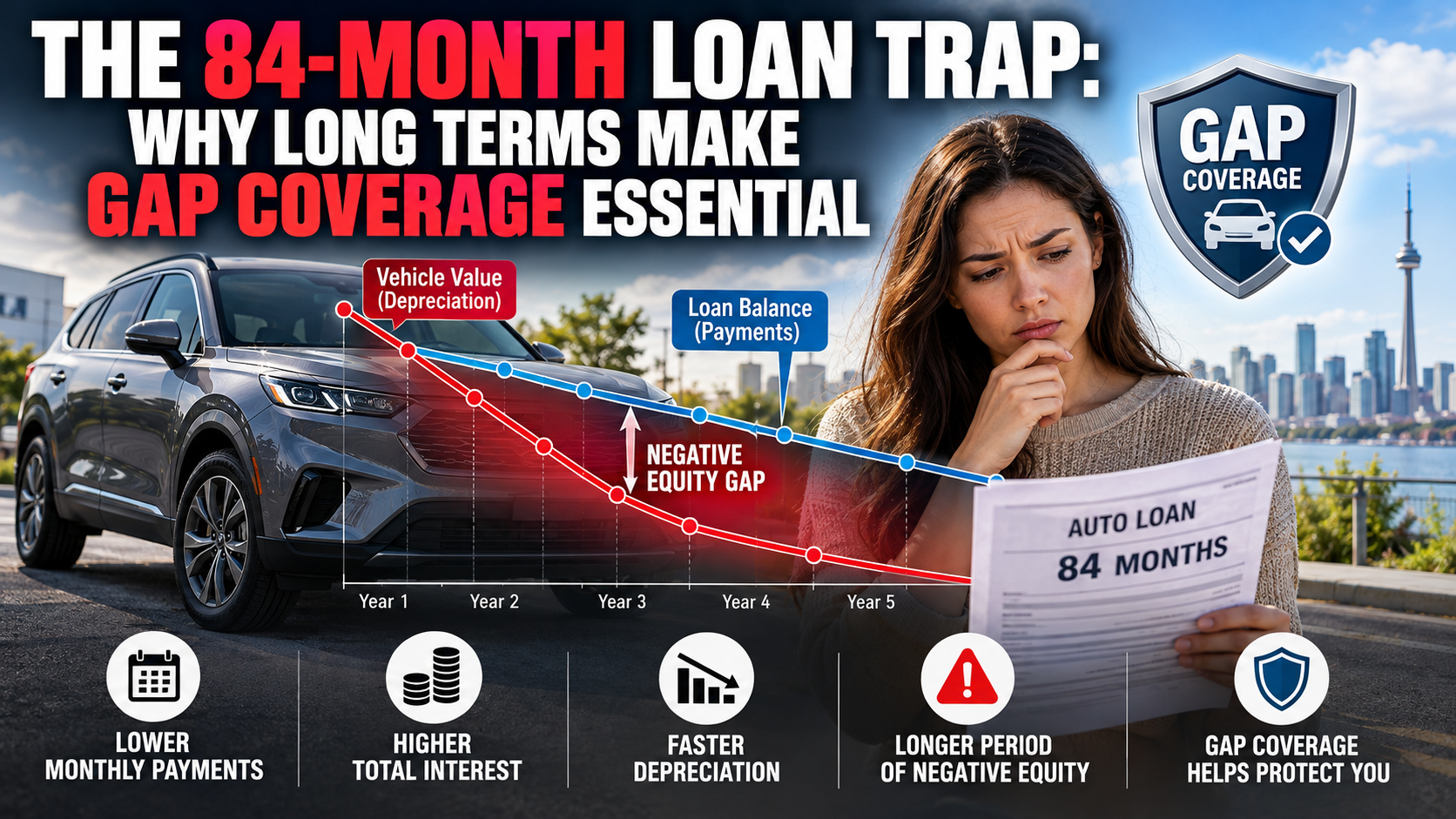
The Real 84-Month Loan Trap Is Negative Equity
Negative equity means you owe more on your vehicle than the vehicle is currently worth.
That can happen because two things are moving at different speeds.
Your vehicle is depreciating.
Your loan balance is declining.
During the early portion of a long-term loan, those lines may not move together.
The Financial Consumer Agency of Canada says a new vehicle may be worth about 25% less after the first year and may continue losing value over subsequent years. Its illustrative example shows how a long-term loan can leave a borrower owing significantly more than the vehicle is worth after two years.
That gap matters even if you have never missed a payment.
You could make every payment exactly as agreed and still have negative equity because the loan is being repaid more slowly than the asset is losing value.
A Canadian Example Shows How Quickly the Gap Can Grow
The Financial Consumer Agency of Canada provides an especially useful illustration.
Its example begins with a new vehicle worth $31,300, with taxes and fees bringing the financed amount to $35,000. The loan carries a 4% interest rate over eight years.
After one year, the example vehicle is valued at approximately $23,475, while the remaining loan balance is about $31,200.
That creates approximately $7,725 in negative equity.
After two years, the example vehicle is valued at about $18,780, while approximately $27,300 remains owing.
The negative-equity position has grown to roughly $8,520.
Those figures are illustrative rather than a prediction for any particular vehicle. Depreciation varies by model, mileage, condition, demand and market conditions.
But the lesson is important: a low monthly payment does not necessarily mean you are building equity quickly.
Why 84- and 96-Month Terms Increase the Exposure Period
With a traditional shorter loan, more principal is generally repaid sooner.
With an 84- or 96-month agreement, the debt is stretched across seven or eight years.
That creates a longer period during which an unexpected event can become financially uncomfortable.
Imagine that three years into an 84-month loan you still owe substantially more than the vehicle's current market value.
If you simply continue driving and making payments, that gap may eventually close.
But life does not always cooperate with the original financing schedule.
You could experience a major collision.
Your vehicle could be stolen and not recovered.
Your household could need a larger SUV or minivan.
A job change could make your current vehicle impractical.
A growing commute between Grimsby, Hamilton and Burlington could change your fuel or mileage needs.
Or you may simply need to sell the vehicle earlier than expected.
The longer you expect to remain in negative equity, the more relevant that exposure becomes.
What Happens If Your Vehicle Is Written Off While You Have Negative Equity?
This is the scenario many borrowers do not think about when choosing a loan term.
A vehicle loan and an auto insurance policy are separate contracts.
Your lender cares about the outstanding debt.
Your insurer determines a covered loss according to the terms of the insurance policy.
If the insurance settlement is less than the remaining loan balance, the loan does not simply disappear.
The Financial Consumer Agency of Canada specifically cautions that when a vehicle is a total loss, an insurance payment may not cover everything still owing on the auto loan.
For example, consider a simplified hypothetical situation:
- Remaining auto loan: $32,000
- Insurance settlement after a covered total loss: $27,000
- Potential shortfall: $5,000
The exact outcome would depend on the insurance contract, loan terms, applicable coverage and other circumstances.
But the financial problem is easy to see.
You could potentially owe money on a vehicle you can no longer drive.
Where GAP Coverage Fits Into an 84-Month Car Loan
GAP generally refers to protection intended to address some or all of the difference between a vehicle-related insurance settlement and the eligible outstanding financing balance after a covered total loss.
That can make it particularly relevant when the risk of negative equity is higher.
Situations worth examining may include:
- financing over 72, 84 or 96 months
- making a relatively small down payment
- financing taxes, fees or other eligible amounts
- purchasing a vehicle expected to depreciate quickly
- entering a loan with existing negative equity rolled into the new financing
- driving significant annual kilometres
- expecting that your household may need to replace the vehicle before the loan ends
However, GAP protection is not automatically the right choice for every borrower.
Products can differ in price, eligibility, exclusions, maximum benefits, cancellation terms and exactly how a claim is calculated.
Ask what is covered, what is excluded and how the benefit would interact with your primary auto insurance before deciding.
An 84-Month Loan Also Costs More in Interest
Negative equity is only one side of the equation.
The other is total borrowing cost.
The Financial Consumer Agency of Canada provides an example using a $25,000 vehicle financed at 5%.
Over 36 months, its example produces approximately $1,974 in total interest.
Stretch the same financing to 84 months and total interest rises to approximately $4,681.
That is about $2,707 more in borrowing cost simply because the debt remains outstanding longer.
An 84-month term can still be appropriate in some budgets.
But the payment should never be viewed in isolation.
Ask four questions:
- What is my payment?
- What is my total cost of borrowing?
- How much will I likely still owe in three or four years?
- How long do I realistically expect to keep this vehicle?
Those four answers provide a much clearer picture than the monthly payment alone.
Long-Term Financing and Trade-In Negative Equity
Another common problem appears when a borrower wants to trade vehicles before the original loan is repaid.
Suppose your vehicle is worth $24,000 as a trade but you still owe $30,000.
That means you have $6,000 in negative equity.
The shortfall must still be dealt with.
In some transactions, eligible negative equity may be included in new financing, subject to lender approval and other conditions. But doing so means you are financing both the next vehicle and debt associated with the previous one.
The federal consumer agency cautions that rolling remaining vehicle debt into another auto loan can lead to a larger loan and additional interest.
If you are already upside down, consider having your current vehicle appraised and your payout amount confirmed before shopping by payment alone.
Our team can also help you review financing scenarios through the Car Nation Canada finance centre. Financing options are available for many credit situations, O.A.C. — On Approved Credit. Conditions may apply.
How GTHA Drivers Can Reduce the Risk Before Signing
For drivers throughout Burlington, Hamilton, Oakville, Milton, Mississauga and the Niagara corridor, reducing negative-equity risk usually starts before the loan is signed.
Choose the Shortest Term Your Budget Can Comfortably Support
A shorter loan generally means a higher regular payment, but it can reduce total interest and help you build vehicle equity sooner.
That does not mean stretching your monthly budget until it becomes uncomfortable.
It means comparing the vehicle price and loan structure together.
If the payment on a 60- or 72-month term is unaffordable, that may be a signal to reconsider the vehicle price instead of automatically extending the repayment period.
Consider a Down Payment
A down payment reduces the amount financed.
That can create a larger equity cushion from the beginning and may reduce the amount of interest paid over the loan.
Compare New and Used Vehicles
A carefully selected used SUV, truck, sedan or minivan may help you reach your transportation needs with a smaller financed amount.
You can compare current options through the Car Nation Canada new and used vehicle inventory.
Know Your Trade-In Position
Before replacing a financed vehicle, confirm both its approximate market value and the current loan payout.
Do not assume the amount showing on an old statement represents today's exact payout.
Evaluate Asset Protection
If your financing structure creates a meaningful negative-equity window, ask about GAP or other eligible asset-protection options.
Review the actual contract rather than relying on the product name alone.
Payment-Focused Does Not Have to Mean Payment-Only
For families already watching every dollar, newcomers establishing Canadian credit, or drivers rebuilding after a difficult financial period, a predictable payment matters.
We understand that.
But affordability is stronger when the payment works and the underlying financing structure makes sense.
Before choosing 84 or 96 months, look at:
- vehicle price
- down payment
- trade-in equity or negative equity
- interest rate
- term length
- total borrowing cost
- expected ownership period
- potential protection against a total-loss shortfall
That is a much more useful conversation than simply asking, “What is the lowest payment?”
Conclusion: Treat the Loan Term as a Risk Decision
An 84-month car loan can improve monthly cash flow, but it can also slow the rate at which you build equity in your vehicle.
That matters because vehicles depreciate while loan balances take time to decline.
The result can be a multi-year period in which you owe more than the vehicle is worth.
For some borrowers, that makes GAP coverage or another form of asset protection an important part of the financing conversation. For others—with a large down payment, strong equity position or short expected payoff period—the exposure may be smaller.
The goal is not to automatically reject long-term financing.
It is to understand what you are trading for the lower payment.
Before deciding, compare different terms with the Car Nation Canada payment calculator, explore current vehicles available across our group and speak with our finance team about a structure that fits your complete budget.
Financing options are available for many credit situations. O.A.C. — On Approved Credit. Conditions may apply.
Frequently Asked Questions
Is an 84-month car loan bad?
Not automatically. An 84-month term can reduce the regular payment, but it normally keeps you in debt longer and can increase total interest. It may also extend the period in which you have negative equity. Compare the complete cost and expected loan balance, not just the payment.
What is negative equity on a car loan?
Negative equity means the amount you owe on your auto loan is greater than the vehicle's current value. For example, if your vehicle is worth $25,000 but your loan payout is $30,000, you have approximately $5,000 in negative equity.
Does regular auto insurance automatically pay off my car loan after a total loss?
Not necessarily. The Financial Consumer Agency of Canada warns that an insurance payment after a total loss may not cover the full amount still owing on the loan. Review your insurance policy and any supplementary protection carefully.
Do I need GAP coverage with an 84-month car loan?
There is no universal answer. It may be especially worth evaluating when your loan balance is likely to remain higher than the vehicle's value for an extended period. Coverage details, exclusions, cost and eligibility should all be reviewed before purchasing.
Should I choose 72 or 84 months?
Compare what each term does to the payment, total interest, expected remaining balance and your household cash flow. The Financial Consumer Agency of Canada recommends choosing the shortest term you can reasonably afford while considering the overall cost of the vehicle.