
Dealership Financing vs. Bank Auto Loan: Why Your Bank May Say No When a Dealer Finds Options
Dealership Financing vs. Bank Auto Loan: Why Your Bank May Say No When a Dealer Finds Options
Posted on September 1, 2026
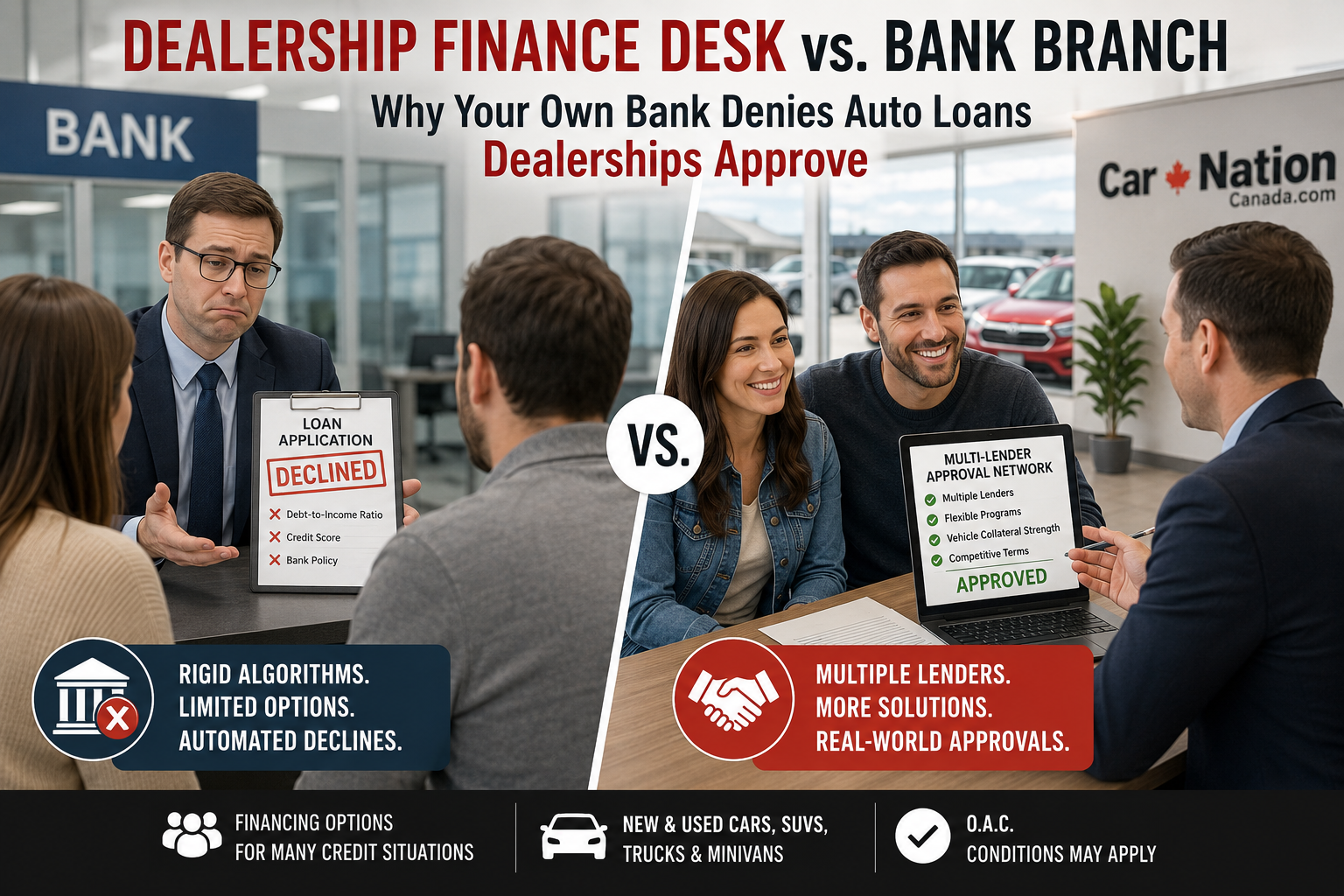
Dealership Financing vs. Bank Auto Loan: Why Your Bank May Say No When a Dealer Finds Options
A bank-branch decline does not necessarily mean you cannot finance a vehicle. Dealership finance desks can work with multiple automotive lenders and loan programs, potentially creating more ways to structure an application around your credit, budget and vehicle choice.
You have banked with the same institution for years. Your paycheque goes there. Your bills come out of the same account. Maybe you even have a credit card or mortgage with them.
So when your own bank declines your car loan application, the answer can feel surprisingly final.
It may not be.
For drivers in Burlington, Hamilton, Oakville, Milton and surrounding Southern Ontario communities, one important thing to understand is that dealership financing vs. a bank auto loan can involve different application channels, different lenders and different underwriting programs.
That does not mean dealership approval is guaranteed. It means your dealership finance team may have more than one door to knock on.
Key Takeaways
- A decline from your primary bank does not automatically mean every automotive lender will reach the same decision.
- A bank branch may offer its own loan or line-of-credit products, while a dealership can arrange vehicle financing with financial institutions and other automotive lenders.
- Different lenders may weigh your credit history, income, existing debts, loan amount, term, down payment and vehicle differently.
- The vehicle itself can matter because automotive financing is structured around a specific purchase rather than simply an unrestricted request for cash.
- Dealership finance teams can potentially match an application with a lender program that better suits the applicant and vehicle.
- Approval is only part of the decision. Always compare the interest rate, term, payment, amount financed and total cost of borrowing.
- Car Nation Canada offers financing options for many credit situations and a broad new and used vehicle inventory, O.A.C. Conditions may apply.
Dealership Financing vs. Bank Auto Loan: Why Can the Answer Be Different?
The simplest explanation is that you may not actually be asking the same lender for the same financial product.
When you apply directly through your financial institution, you are applying for whatever automotive loan, personal loan or line-of-credit products that institution makes available to you.
Its decision is based on its lending policies and the information in your application.
The Financial Consumer Agency of Canada notes that lenders commonly consider information such as your credit report, credit score and existing debts when determining your borrowing options.
A dealership finance office operates differently.
Instead of representing only one lending institution, a dealership may arrange financing with financial institutions, manufacturer financing divisions or independent automotive finance companies. That gives the finance manager an opportunity to determine which available lending program may make sense for the particular application.
Think of it this way.
A bank branch represents one lending door.
A dealership finance desk may have multiple lending doors.
Every lender still makes its own credit decision, and every approval remains subject to the lender's conditions. But having access to multiple potential lending programs can matter when one institution has already said no.
Why Your Own Bank May Deny a Car Loan
Your relationship with your bank can help in some circumstances, but being a long-time customer does not automatically satisfy its lending requirements.
Lenders are trying to determine whether the proposed new debt fits within your overall financial situation.
That can involve reviewing your income, employment, housing obligations, outstanding loans, credit-card balances, repayment history and other information appearing in your credit file.
Higher outstanding debts, missed payments and high credit utilization can negatively affect your credit profile and potentially influence lending decisions.
This becomes especially relevant for someone whose finances have changed recently.
You might have a solid income today but still carry marks from an earlier financial setback.
You may have completed a consumer proposal or bankruptcy and begun rebuilding.
You might be a newcomer to Canada with stable employment but a relatively thin Canadian credit file.
Or you might simply be a family whose housing, childcare and household costs have risen enough that adding another monthly obligation becomes more difficult under a particular lender's criteria.
A decline does not necessarily mean you are irresponsible with money.
It means that the loan you requested did not meet that lender's requirements at that time.
Why a Dealership Finance Desk May Find Another Option
This is where the multi-lender approval network becomes important.
At Car Nation Canada, our finance team can help shoppers explore financing through available automotive lending channels rather than limiting the conversation to a single direct bank application.
That matters because lending programs are not identical.
One lender may place greater emphasis on a certain part of the application. Another may have different acceptable loan amounts, vehicle parameters, terms or credit requirements.
The finance manager can also look at the entire transaction, rather than treating the requested loan amount as completely separate from the vehicle being purchased.
That may include the price of the vehicle, amount financed, available down payment, trade-in position, requested term and the applicant's overall financial profile.
None of those factors guarantees an approval.
They simply provide additional ways to structure an application before it is presented to an appropriate lender.
If you have already received a bank decline, you can start a financing conversation with Car Nation Canada and let our team review what options may be available, O.A.C.
The Vehicle Can Be Part of the Financing Equation
One of the biggest differences between generic borrowing and automotive financing is that the loan is connected to a specific vehicle purchase.
That means changing the vehicle can sometimes change the financing scenario.
Suppose you originally planned to finance a relatively expensive SUV.
If the resulting amount financed creates a difficult payment or loan structure, choosing a more affordable used SUV, sedan, truck or minivan could materially change the application.
The same can be true of the model year, kilometres, purchase price, down payment and term.
This is why our team may sometimes discuss the right vehicle for the financing structure, rather than focusing only on the vehicle you initially selected.
That is not about putting you into something you do not want.
It is about finding the intersection between:
the vehicle you need, the payment your budget can reasonably support and the financing terms a lender is prepared to offer.
With Car Nation Canada's new and used inventory, shoppers can compare vehicles across multiple body styles and price points while exploring financing at the same time.
Why Payment Is Only Half the Story
A lower payment can be attractive, particularly when your monthly budget is tight.
But payment alone should never determine whether a financing offer is good for you.
The Financial Consumer Agency of Canada recommends comparing the interest rate, payment schedule, financing fees, total amount financed and loan length when considering auto financing. It also warns that extending the term can reduce the regular payment while increasing the total interest paid.
That distinction matters.
A $600 payment over a shorter term and a $500 payment over a much longer term are not simply "$100 apart."
They can represent substantially different total borrowing costs.
Our approach is therefore payment-aware, but not payment-only.
You should understand what you are financing, how long you will be financing it, what the borrowing costs are and what you are expected to pay in total before signing an agreement.
Ontario advertising rules also require specific disclosures when vehicle financing advertisements include rates or payments, including information such as APR, term and cash price.
What If You Have Negative Equity in Your Trade-In?
Your existing vehicle can also affect the financing picture.
Negative equity means you owe more on your current auto loan than the vehicle is worth as a trade.
For example, if your remaining loan balance is $24,000 and your vehicle's trade value is $19,000, there is a $5,000 difference that needs to be addressed.
Depending on the circumstances and lender approval, that difference may affect the financing required for your next vehicle.
The Financial Consumer Agency of Canada specifically warns that rolling outstanding debt into another vehicle transaction can produce a larger loan and greater interest costs.
That is why a realistic trade appraisal can be so valuable.
Before assuming you need to replace your vehicle immediately, our team can help you understand the trade position and determine whether changing vehicles now makes financial sense.
What If Your Credit Is Less Than Perfect?
This is where a dealership's broader lending relationships can become particularly useful.
A consumer with excellent credit may qualify through several channels without much difficulty.
Someone rebuilding credit may need a more carefully structured application.
That could include a commuter from Grimsby trying to replace an unreliable vehicle, a family in Brantford managing higher household expenses, or a newcomer working in Mississauga who has good income but limited Canadian credit history.
The objective should not be to judge how you arrived at your current credit situation.
It should be to understand where you are today.
Employment stability, current income, existing debt, down payment, vehicle choice and recent repayment history can all form part of the financing conversation.
Car Nation Canada offers financing options for many credit situations, including shoppers who are rebuilding their credit history.
All applications remain subject to lender approval.
Does a Dealership Automatically Get You a Better Interest Rate?
No.
And any responsible explanation of dealership financing should say that clearly.
A dealership's advantage is access to financing options, not a guarantee that the dealership will always produce the lowest interest rate.
Canada's consumer-finance guidance specifically encourages shoppers to compare multiple financing offers where possible and evaluate the complete terms rather than assuming any single source will automatically be cheapest.
For some borrowers, their bank may produce an excellent offer.
For others, an automotive lender accessed through a dealership may provide a financing structure that better fits their application.
The important question is not simply:
"Who approved me?"
It is:
"What are the complete terms of the approval, and do they make sense for my budget?"
A Bank Decline Is Information — Not Necessarily the End of the Search
Getting declined by your own financial institution can be frustrating, especially when you have been a customer for years.
But one lender's decision does not necessarily represent the entire Canadian auto-finance market.
A dealership finance desk may be able to present your application through different automotive financing channels, pair it with an appropriate vehicle and explore alternative structures based on the available programs.
That is the real difference between dealership financing vs. a bank auto loan.
It is not magic.
It is not a guaranteed approval.
It is access to more potential lending paths.
Conclusion: Give the Application More Than One Place to Go
If your bank has already declined your car loan, do not assume your only choices are paying cash or giving up on replacing your vehicle.
The next step can simply be finding out what other financing options may exist.
Our Car Nation Canada team works with customers across Burlington, Hamilton, Oakville, Milton, Grimsby, Brantford and surrounding Southern Ontario communities.
You can explore our available cars, SUVs, trucks and minivans first, or start with our finance application if understanding your potential financing options is the priority.
Financing options are available for many credit situations. O.A.C. — On Approved Credit. Conditions may apply.
FAQ
Why would my bank decline my car loan but a dealership find financing?
Your bank and the lenders available through a dealership may use different lending programs and underwriting criteria. A dealership may also have access to multiple potential lenders rather than relying on a single institution. Approval is never guaranteed and remains subject to each lender's requirements.
Does dealership financing mean bad-credit financing?
No. Dealership financing can be used by prime, near-prime and credit-rebuilding shoppers. The appropriate lender and terms depend on the applicant, vehicle and available lending programs.
Can I apply after my bank has already declined me?
Yes. A previous bank decline does not prevent you from exploring other legitimate financing options. You can submit a Car Nation Canada finance application to see which options may be available. O.A.C. Conditions may apply.
Will choosing a different vehicle improve my chances of financing?
It can change the application because the vehicle price, amount financed, term, down payment and other transaction details may affect the financing structure. It does not guarantee approval, but choosing a vehicle that better matches your budget may create a more manageable application.
Should I choose the loan with the lowest monthly payment?
Not automatically. Compare the interest rate, term, amount financed, fees and total cost of borrowing as well as the payment. A longer term can reduce the regular payment while increasing the total interest you pay over the life of the loan.