
APR vs. Interest Rate: What Curbside Sellers Aren't Telling You
APR vs. Interest Rate: What Curbside Sellers Aren't Telling You
Posted on October 7, 2026
APR vs. Interest Rate: What Curbside Sellers Aren't Telling You
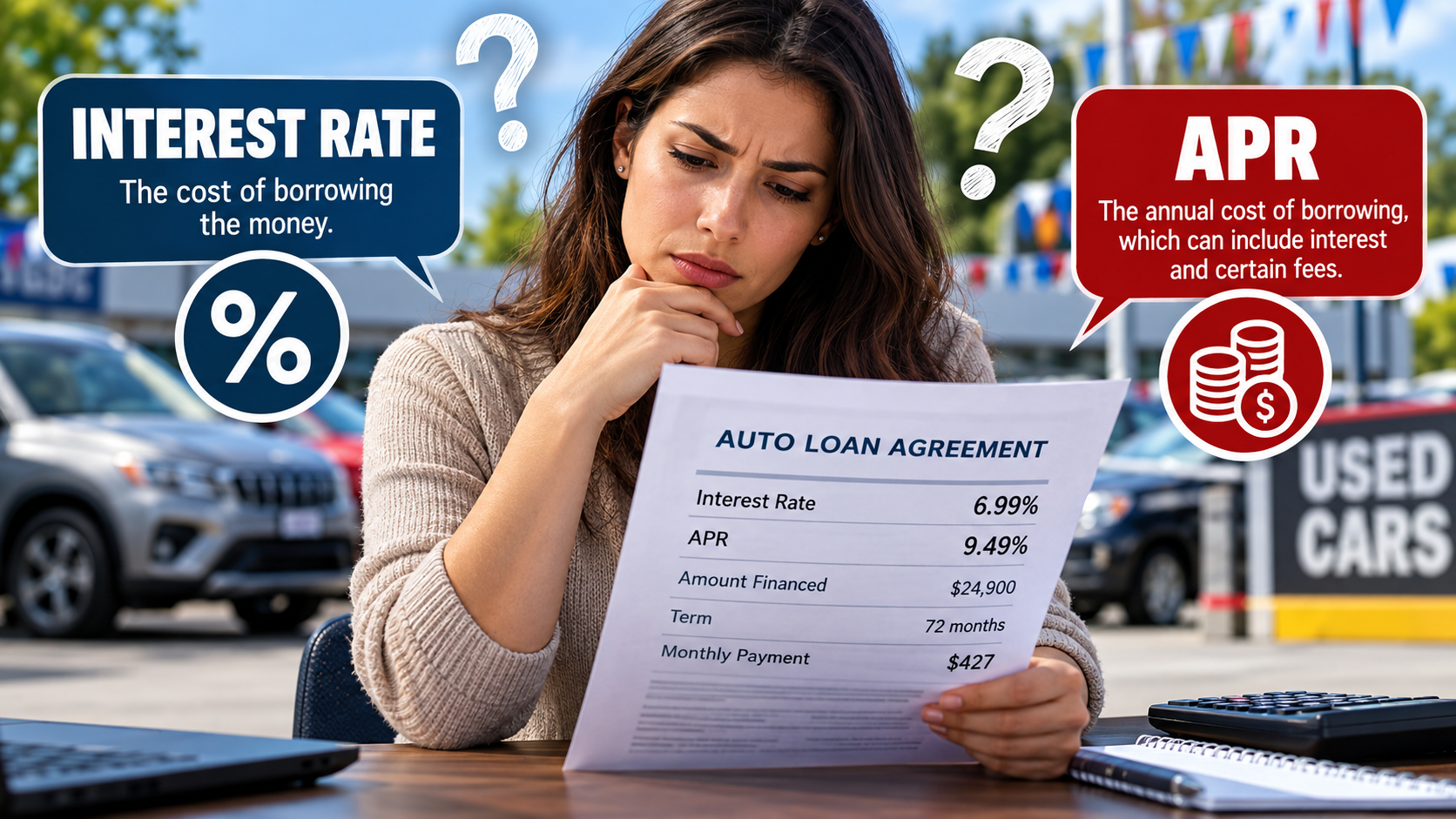
The interest rate tells you what borrowing the money costs. The APR can reveal a broader picture of the financing cost. Ontario car buyers should understand both before signing anything.
Buying a vehicle is already a numbers game. Vehicle price, trade value, down payment, monthly or bi-weekly payment, loan term and financing rate can all compete for your attention at the same time.
That is exactly why two little percentages can cause so much confusion: interest rate and APR.
They may look almost identical on a financing agreement, but they do not necessarily mean the same thing. For drivers in Burlington, Hamilton, Oakville, Milton and communities across Southern Ontario, understanding the difference can help you compare auto loans more intelligently and avoid getting distracted by a payment that looks affordable while the overall borrowing cost tells a different story.
Key Takeaways
- Interest rate and APR are not always the same number.
- Your interest rate generally represents the interest charged for borrowing money.
- APR represents the annualized cost of borrowing and can incorporate certain borrowing charges in addition to interest.
- Not every optional product or charge is automatically represented by the APR, so you should still read the complete financing disclosure.
- A low monthly or bi-weekly payment does not automatically mean a low-cost loan.
- Ontario consumers should distinguish legitimate OMVIC-registered dealers from illegal unregistered sellers known as curbsiders.
- When comparing financing, look at the APR, interest rate, loan term, amount financed and total cost—not one number by itself.
- Financing options are available for many credit situations. O.A.C. — On Approved Credit. Conditions may apply.
Interest Rate vs. APR: What's the Difference?
Let's strip away the finance jargon.
What Is an Auto Loan Interest Rate?
The interest rate is the rate charged for borrowing the lender's money.
If you finance a vehicle instead of paying cash, the lender is providing the money required to complete the purchase. Interest is part of the lender's compensation for providing those funds and taking on the lending risk.
Generally, the higher your interest rate, the more interest you will pay if all other loan details stay the same.
Your approved rate can depend on factors such as:
- Credit history
- Income
- Existing debt obligations
- Loan amount
- Vehicle age and value
- Down payment
- Loan term
- Lender requirements
That means two buyers looking at the exact same SUV, truck, sedan or minivan may receive different financing terms.
What Is APR?
APR stands for Annual Percentage Rate.
APR is designed to give borrowers a broader measure of the annual cost of borrowing.
Depending on the financing structure and applicable disclosure rules, certain costs connected to obtaining the loan may be reflected in the APR in addition to the interest itself.
That is why an APR can sometimes be higher than the stated annual interest rate.
The important word is sometimes.
Do not assume that every warranty, insurance product, accessory, service contract or optional purchase has automatically been rolled into the APR calculation.
Instead, read the financing disclosure and ask exactly what is included.
The Financial Consumer Agency of Canada explains that loan disclosures from federally regulated financial institutions can include the annual interest rate, APR where it differs from the interest rate, and other applicable charges.
Interest Rate vs. APR at a Glance
| Number | What It Helps Tell You |
|---|---|
| Interest Rate | The rate charged for borrowing the principal |
| APR | A broader annualized measure of borrowing cost that may include certain additional borrowing charges |
| Amount Financed | How much money you are actually borrowing |
| Loan Term | How long you will make payments |
| Payment | What you owe each payment period |
| Total Cost | What the financing ultimately costs over the agreed term |
The takeaway?
Never judge an auto loan by one number.
Why a Low Payment Can Distract You From the Real Cost
Imagine somebody tells you:
"Good news. We can get your payment down another $60."
Sounds great.
But how?
Perhaps the loan term was stretched from 60 months to 84 months.
Your regular payment may fall, while the amount of time you are paying interest increases.
Or perhaps additional products have been financed into the loan.
The payment might still fit your monthly budget because that extra cost has been spread across several years.
That is why a payment-focused shopper should ask:
"What is the total amount I am financing, and what will I have paid by the end of the term?"
Those two questions can be much more revealing than simply asking:
"What's my payment?"
What Curbside Sellers Aren't Telling You
There is an important Ontario distinction here.
An independent used-car dealership is not automatically unregulated.
A legitimate independent dealer can be registered with the Ontario Motor Vehicle Industry Council and subject to Ontario's motor vehicle sales rules.
A curbsider, on the other hand, is an illegal, unregistered seller who is effectively in the vehicle-selling business while pretending to be a normal private seller.
According to OMVIC's information for Ontario vehicle buyers, consumers receive protections under the Motor Vehicle Dealers Act when they purchase from an OMVIC-registered dealer.
Curbsiders do not offer those same protections.
They may advertise through online marketplaces, social media or classified sites and present themselves as someone simply selling their personal vehicle.
Watch for warning signs such as:
- The seller regularly has several vehicles for sale.
- The name on the ownership does not match the person selling you the vehicle.
- The seller wants to meet in a parking lot instead of at a home or registered business.
- The vehicle price seems dramatically lower than comparable vehicles.
- The seller avoids providing complete documentation.
- You are pressured to hand over money immediately.
- Financing arrangements are vague or poorly documented.
- The seller avoids direct questions about the total cost of the transaction.
There are legitimate private vehicle sales in Ontario. The issue is not that every private seller is dishonest.
The danger is an unregistered commercial seller pretending to be private.
Registered Dealer Pricing and Financing Are Two Different Things
Ontario shoppers should also understand the difference between the vehicle's advertised price and the cost of borrowing money to buy it.
Ontario's all-in pricing rules generally require an OMVIC-registered dealer's advertised vehicle price to include the mandatory fees the dealer intends to charge, except HST and licensing.
But vehicle pricing and financing cost are not identical concepts.
A vehicle might have a clearly advertised purchase price while the financing agreement contains separate information dealing with:
- Interest
- APR
- Amount financed
- Loan term
- Cost of borrowing
- Lender charges
- Optional protection products
- Payment schedule
That is why you should review both the bill of sale and the financing agreement.
The Six Numbers to Check Before Signing an Auto Loan
Before you sign, find these six numbers.
1. Vehicle Purchase Price
Start with what you are actually paying for the vehicle.
Do not let a conversation about payments make the selling price disappear.
2. Amount Financed
This is one of the most important numbers in the deal.
It can be different from the vehicle's advertised price because your financing may also reflect items such as taxes, negative equity, approved products or other amounts associated with the transaction.
3. Interest Rate
Know the annual interest rate being charged.
Do not rely on what you remember hearing verbally.
Read the paperwork.
4. APR
Look for the APR and determine whether it differs from the interest rate.
If it does, ask why.
A reputable finance professional should be able to explain what the numbers mean in plain language.
5. Loan Term
How many months are you financing?
A 72- or 84-month loan can make an expensive vehicle appear more affordable on a payment basis.
That does not automatically mean a longer loan is wrong. Sometimes a longer term is what makes reliable transportation fit a household budget.
You simply need to understand the trade-off.
6. Total of Your Payments
This is the reality check.
If the payment is $X and there are Y payments, what does that add up to over the complete term?
Compare that figure against the amount being borrowed.
APR Matters Even More When You Are Rebuilding Credit
If your credit has been bruised by missed payments, a consumer proposal, bankruptcy, high balances or an unexpected life event, you may already expect your financing options to be different from those available to someone with excellent credit.
That makes understanding the numbers even more important.
The goal should not simply be:
"Can I get approved?"
A better question is:
"Can I comfortably manage this financing while improving my financial position?"
Our guide to rebuilding credit with a used car in Ontario explains how a manageable vehicle and consistent payment history can become part of a broader credit-rebuilding strategy when the loan is reported to the credit bureaus.
You can also use Equifax Canada's credit education resources to learn more about credit reports, credit scores and the factors that may affect your credit profile.
There is no magic auto loan that instantly fixes a credit score.
Financing is a financial tool. How successfully it works for you depends on the vehicle, loan structure, household budget and your ability to make payments consistently.
Beware of the "What Monthly Payment Do You Want?" Trap
Your monthly budget absolutely matters.
But it should be the starting point, not the only point.
Suppose you walk in saying:
"I need to stay under $650 per month."
There can be many different ways to create a $650 payment.
You might finance:
- A lower-priced vehicle over a shorter term.
- A more expensive vehicle over a longer term.
- A vehicle with a larger down payment.
- A vehicle after rolling negative equity from your existing loan into the new financing.
- A transaction containing additional financed products.
All five scenarios might produce a similar payment.
Financially, however, they can be dramatically different.
Use APR to Compare Apples to Apples
When you have more than one financing option, build a simple comparison.
Ask for:
- Interest rate
- APR
- Amount financed
- Term
- Payment frequency
- Number of payments
- Total amount paid
- Optional products
- Prepayment conditions
Then compare equivalent offers.
Do not compare the interest rate on one loan with the APR on another.
Do not compare a 60-month loan payment directly with an 84-month payment without considering total cost.
And do not assume the lowest payment automatically wins.
Shopping for a Vehicle Across Southern Ontario?
Whether you are commuting along the QEW from Grimsby, working in Mississauga, raising a family in Burlington or travelling between Hamilton and Halton, transportation needs can be very different.
Your financing should reflect your actual life.
A long-distance commuter may prioritize fuel economy.
A tradesperson might need a truck.
A growing family may need a three-row SUV or minivan.
Someone rebuilding credit may be better served by a dependable, reasonably priced used vehicle than by borrowing the absolute maximum available.
You can browse Car Nation Canada's current new and used vehicle inventory first and compare vehicles that fit your needs and budget.
When you are ready to explore the financing side, our Car Nation Canada finance team can help review options available for many credit situations.
O.A.C. — On Approved Credit. Conditions may apply.
The Bottom Line: Read Past the Big Percentage
Interest rate matters.
APR matters.
But neither should be viewed in isolation.
Before financing your next vehicle, look at the complete transaction:
Vehicle price + amount financed + interest rate + APR + term + fees + total payments.
That is how you read an auto loan like a finance professional.
And if a seller will not clearly explain those numbers, refuses to provide proper documentation or cannot prove they are a registered Ontario dealer when they are operating as a dealer, consider that a major warning sign.
An affordable vehicle should come with financing you understand—not financial surprises buried in the paperwork.
Frequently Asked Questions
Is APR always higher than the interest rate on a car loan?
No. They may be the same in some financing arrangements. When certain borrowing costs are included, the APR may be higher. Review the lender's disclosure rather than assuming.
Does APR include every fee on a vehicle purchase?
Not necessarily. APR is intended to represent the cost of borrowing, but not every optional product or transaction expense is automatically included. Review the full loan disclosure and bill of sale.
Is a curbsider the same as an independent used-car dealer?
No. A legitimate independent dealership can be registered with OMVIC. A curbsider is an illegal, unregistered seller operating as a dealer while often pretending to be a private seller.
Should I choose the loan with the lowest monthly payment?
Not automatically. A lower payment may result from a longer term, which can increase the total cost of borrowing. Compare payment, APR, rate, term and total cost together.
Can Car Nation Canada help if my credit isn't perfect?
Financing options are available for many credit situations, including people rebuilding credit or establishing a Canadian credit history. Every application is evaluated individually by lenders. You can explore Car Nation Canada financing options to get started. O.A.C. — On Approved Credit. Conditions may apply.