
With Today’s Gas Prices, Is It Time to Finance an Electric or Hybrid Vehicle?
With Today’s Gas Prices, Is It Time to Finance an Electric or Hybrid Vehicle?
Posted on October 27, 2026
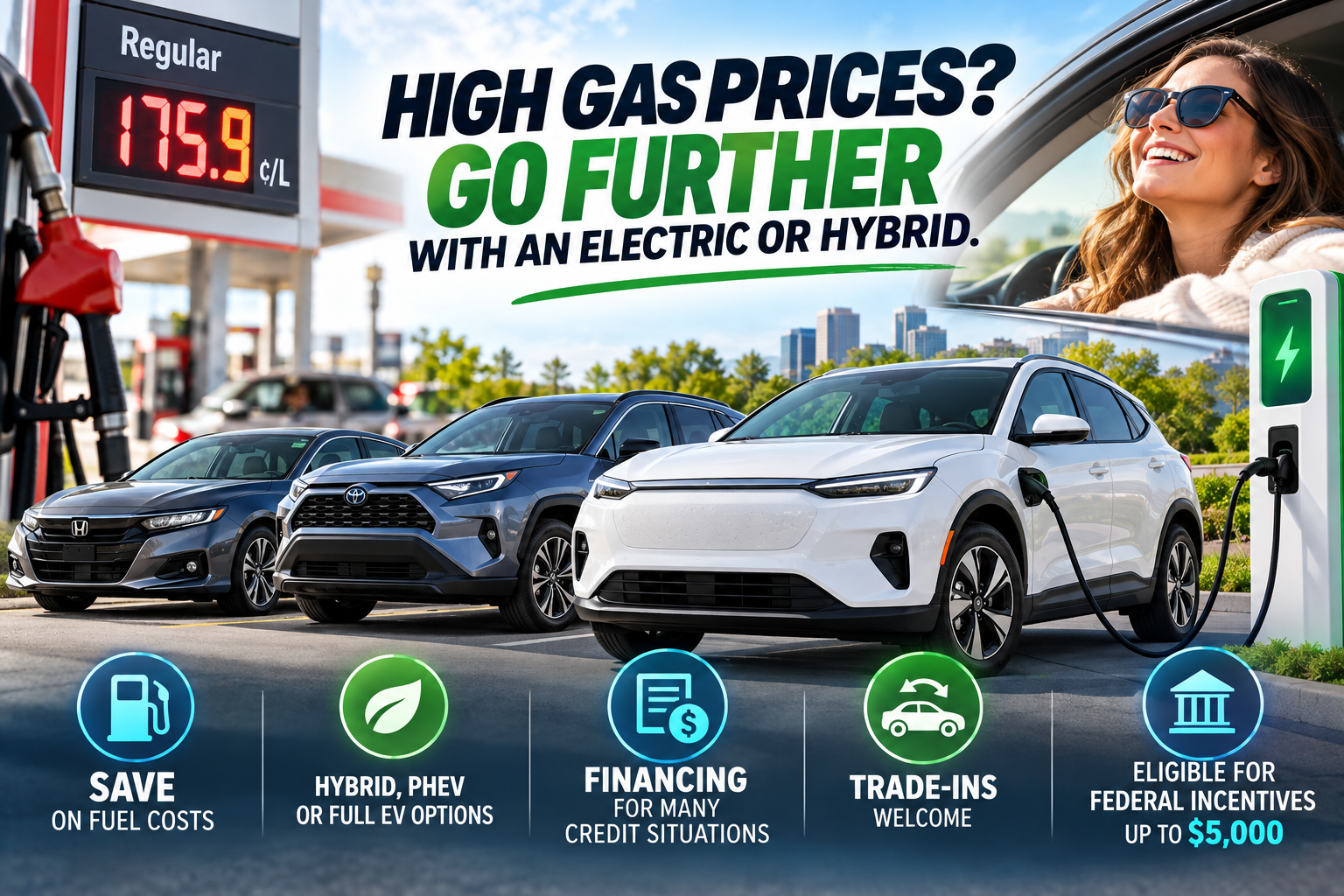
With Today’s Gas Prices, Is It Time to Finance an Electric or Hybrid Vehicle?
With fuel prices putting more pressure on Ontario household budgets, an electric vehicle, hybrid, or plug-in hybrid may be more affordable to get into than you think. Here is how to compare your options and finance the right vehicle for your budget.
If you drive regularly around Burlington, Hamilton, Oakville, Milton or Mississauga, you have probably noticed just how quickly a tank of fuel can eat into your monthly budget.
With gasoline prices remaining a major expense for Ontario drivers, every fill-up can make a noticeable difference to the household budget.
That is why more drivers are looking beyond traditional gasoline vehicles and considering hybrids, plug-in hybrids and fully electric vehicles.
The good news is that you do not necessarily have to pay cash or buy brand new to make the switch.
There are financing options available for many credit situations, and Car Nation Canada offers access to new and pre-owned vehicles across a wide range of powertrains.
Key Takeaways
- High gasoline prices can make the monthly operating cost of an EV or hybrid much more attractive.
- A regular hybrid can reduce fuel consumption without requiring you to plug in.
- A plug-in hybrid can handle many shorter trips on electricity while keeping a gasoline engine for longer drives.
- A battery-electric vehicle can eliminate gasoline use completely.
- New and used electric or hybrid vehicles can generally be financed much like other vehicles, subject to lender approval.
- Some eligible new electric vehicles may qualify for government incentives, depending on current program requirements.
- Your trade-in may help reduce the amount you need to finance.
- Your best choice depends on your commute, charging access, credit profile and total monthly budget.
Why Gas Prices Change the EV and Hybrid Math
When gasoline is inexpensive, buyers sometimes focus almost entirely on the purchase price of the vehicle.
When fuel prices rise, the calculation changes.
Imagine a gasoline vehicle that uses 10 L/100 km.
If you drive 20,000 km per year, that represents roughly 2,000 litres of gasoline annually.
At $1.75 per litre, that would equal approximately $3,500 per year in fuel, or about $292 per month.
That is before maintenance, insurance, financing or any other ownership expenses.
Your actual costs will vary based on the vehicle, how much you drive, weather conditions and fuel prices, but it shows why fuel economy deserves to be considered alongside your vehicle payment.
Natural Resources Canada encourages consumers to compare vehicles using official fuel-consumption ratings because the lowest-priced vehicle is not always the least expensive vehicle to own and operate.
What Type of Electrified Vehicle Makes Sense?
There is no single correct answer.
The best powertrain depends on how and where you drive.
Hybrid Electric Vehicle
A traditional hybrid combines a gasoline engine with an electric motor and battery.
You do not plug it in.
The vehicle recaptures energy while braking and uses the electric motor to reduce how much gasoline the engine needs.
A hybrid can make a lot of sense if you:
- Drive frequently in city traffic
- Cannot install a home charger
- Want better fuel economy
- Regularly take longer highway trips
- Want the ownership experience to remain similar to a traditional gasoline vehicle
For many drivers, this is one of the easiest first steps toward electrification.
Plug-In Hybrid Electric Vehicle
A plug-in hybrid, commonly called a PHEV, gives you a larger battery that can be charged from an electrical outlet or charging station.
You can drive a certain distance using electricity before the gasoline engine becomes necessary.
That combination can work particularly well for commuters.
For example, someone living in Burlington and working in Oakville, Hamilton or Mississauga might complete a significant portion of everyday driving using electric power while still having gasoline available for longer weekend trips.
A PHEV can make sense if you:
- Have somewhere to charge at home or work
- Mostly make shorter daily trips
- Occasionally travel long distances
- Are not ready to depend entirely on charging infrastructure
It provides a practical bridge between a conventional hybrid and a fully electric vehicle.
Battery-Electric Vehicle
A battery-electric vehicle, or BEV, uses electricity exclusively.
There is no gasoline engine.
You charge the vehicle at home, at work or at a public charging station.
Electric motors are considerably more efficient at converting stored energy into movement than traditional internal combustion engines.
EVs also use regenerative braking to recover energy that would otherwise be lost while slowing down.
That can make an EV particularly appealing for someone who drives a lot.
If you have convenient home charging and a predictable commute, waking up every morning with a charged vehicle can also make everyday driving much easier.
How Much Can Electricity Save Compared With Gasoline?
The exact savings depend on the vehicle, electricity rate, charging habits and fuel price.
For many Ontario drivers, the difference in energy cost per kilometre can be substantial.
This does not mean every EV will automatically save every driver money.
You still need to consider:
- Purchase price
- Financing cost
- Insurance
- Charging installation
- Battery range
- Winter range
- Annual kilometres driven
- Expected ownership period
- Trade-in value
The smartest comparison is total monthly transportation cost, not simply sticker price.
Can You Finance an Electric or Hybrid Vehicle?
Yes.
In most cases, financing an EV or hybrid follows a similar process to financing a gasoline vehicle.
The lender may look at factors such as:
- Your credit history
- Income
- Existing financial obligations
- Down payment
- Trade-in
- Vehicle value
- Loan amount
- Loan term
At Car Nation Canada, our team can help explore financing options available for many credit situations, including shoppers rebuilding credit, newcomers establishing Canadian credit, families trying to lower their monthly transportation costs and buyers with strong established credit.
You can begin with the Car Nation Canada finance application here:
Apply for Auto Financing with Car Nation Canada
Financing is O.A.C. — On Approved Credit. Conditions may apply.
What If Your Credit Is Not Perfect?
Do not assume an EV or hybrid is automatically out of reach.
Vehicle financing is based on much more than whether you have a perfect credit score.
Different lenders may consider factors such as your current income, employment, residence history, existing debt and the vehicle being financed.
For buyers rebuilding their credit, the goal should not simply be getting approved for the most expensive vehicle possible.
The goal should be structuring a vehicle purchase that fits your actual budget.
That is particularly important with an EV or hybrid because the fuel savings may give you more room in your monthly transportation budget.
For example, spending $60 or $80 more on a vehicle payment could potentially make sense if the replacement vehicle saves significantly more than that each month in gasoline.
The numbers need to be calculated carefully based on your particular driving habits.
Are Government EV Incentives Available?
Government electric-vehicle incentive programs can change over time, and eligibility depends on the specific vehicle, purchase price and program requirements.
If you are considering a new electric vehicle, it is worth checking the latest federal and provincial programs before purchasing.
You can review current federal information through the Government of Canada.
Not every electric vehicle qualifies, and incentive programs can change or end, so eligibility should always be confirmed at the time of purchase.
What About Used Electric and Hybrid Vehicles?
This is where things can become particularly interesting.
A pre-owned EV, hybrid or PHEV may have already experienced a significant portion of its initial depreciation.
That can potentially give you:
- A lower purchase price
- A smaller amount to finance
- Lower monthly payments
- Reduced fuel expenses
- More equipment for your budget
Car Nation Canada's used inventory changes constantly, which means shoppers may find electrified vehicles from several different manufacturers rather than being limited to one brand.
You can browse current options here:
Browse Car Nation Canada Vehicle Inventory
When comparing used EVs, pay particular attention to battery health, remaining battery warranty, charging capability and expected winter range.
Can You Trade In Your Current Gas Vehicle?
Absolutely.
Your current vehicle's trade-in value can be applied toward an EV or hybrid purchase.
That can reduce the amount you need to finance.
Suppose your current SUV has $8,000 in positive trade equity.
Applying that equity toward your next vehicle can substantially change the financing equation.
Even if you still owe money on your existing vehicle, trading may still be possible.
If the vehicle is worth less than the remaining loan balance, the difference is known as negative equity.
That does not automatically prevent you from changing vehicles, but the numbers need to be structured carefully to avoid creating an unaffordable loan.
Our finance team can review the complete picture rather than looking only at the advertised price of the next vehicle.
Think About Your Entire Monthly Transportation Budget
This is one of the biggest mistakes shoppers make.
They ask:
What is the payment?
A better question is:
What will this vehicle cost me every month to own and operate?
Consider:
- Loan payment
- Gasoline
- Electricity
- Insurance
- Maintenance
- Repairs
- Parking
- Charging
- Expected annual kilometres
A driver spending $700 per month on a vehicle plus $300 in gasoline is already spending approximately $1,000 per month before insurance and maintenance.
If an electrified replacement changes the payment to $780 but dramatically reduces energy costs, the overall household budget could potentially improve.
That is why a proper EV financing conversation should always include your driving habits.
What About Ontario Winters?
Cold weather matters.
Battery-electric vehicles generally experience reduced driving range in winter because batteries perform differently at lower temperatures and energy is also being used to heat the cabin.
That does not mean EVs cannot handle Ontario winters.
It means you should purchase based on realistic winter driving needs rather than simply the maximum advertised range.
If your normal commute is 50 km per day, your requirements are very different from someone driving 250 km per day across Southern Ontario.
A plug-in hybrid may also be attractive for drivers who want electric commuting but frequently make long winter road trips.
Home Charging Can Make a Big Difference
Drivers with access to overnight home charging generally receive the biggest convenience benefit from owning a full EV.
Many EVs and PHEVs can use 240-volt charging equipment similar to the electrical service used for major household appliances.
Some vehicles can also charge from a standard household outlet, although charging takes significantly longer.
If you live in a condo or apartment, investigate the charging situation before buying.
Public charging may work for some drivers, but having reliable home or workplace charging makes EV ownership considerably easier.
Is an Electric or Hybrid Vehicle Right for You?
You may be a good candidate if:
- You spend a substantial amount on gasoline every month
- You commute regularly
- You have access to charging
- You want lower fuel consumption
- You plan to keep the vehicle for several years
- Your current vehicle is becoming expensive to operate
- You want to reduce exposure to changing gasoline prices
A traditional hybrid may make the most sense if you cannot charge.
A PHEV may be ideal if most of your driving is local but you still take longer trips.
A battery-electric vehicle may offer the greatest reduction in gasoline use when your charging setup and driving habits fit.
Start With the Numbers, Not the Technology
You do not need to decide today that you are an “EV person” or a “gas vehicle person.”
Start with your actual budget.
Tell us:
- What you drive now
- How much you owe on it
- How many kilometres you drive
- Approximately how much you spend on gasoline
- Whether you can charge at home
- What monthly payment range feels comfortable
From there, you can compare gasoline, hybrid, plug-in hybrid and fully electric options on equal footing.
Browse the latest Car Nation Canada vehicle inventory and then complete our online financing application to explore available financing options.
Financing is O.A.C. On Approved Credit. Conditions may apply.
Frequently Asked Questions
Can I finance a used electric vehicle?
Yes.
Many used EVs, hybrids and plug-in hybrids can be financed just like other pre-owned vehicles, subject to lender approval and the specific age, mileage and value of the vehicle.
Is an EV cheaper every month than a gasoline vehicle?
Not always, but it can be.
You should compare the vehicle payment plus gasoline or electricity, insurance and other ownership costs rather than looking at the payment alone.
Do I need perfect credit to finance an EV?
No.
Financing options are available for many different credit situations.
Approval, rate, term and down payment requirements depend on the lender and applicant.
O.A.C.
Are EV rebates available in Canada?
Government programs change over time, so current eligibility should always be verified before purchasing.
Certain vehicles may qualify for federal or other incentive programs depending on current rules.
Should I buy a hybrid, PHEV or full EV?
A hybrid works well if you cannot plug in.
A PHEV can be excellent for shorter electric commutes plus longer gasoline-powered trips.
A full EV can provide the greatest reduction in gasoline use when you have reliable charging and suitable driving habits.
Make Your Next Fill-Up Optional
At today's fuel prices, switching to a hybrid or electric vehicle is no longer just an environmental decision.
For many drivers, it is becoming a household-budget decision.
If you are commuting around Burlington, Hamilton, Oakville, Milton, Mississauga, Grimsby or elsewhere across Southern Ontario, compare what you are currently spending on fuel with the complete monthly cost of an electrified vehicle.
You might discover that getting into an EV or hybrid is more realistic than you expected.
Browse available vehicles through Car Nation Canada or start with our online finance application and let our team help you compare the numbers.
Financing is O.A.C. — On Approved Credit. Conditions may apply.