
Why Selling Your Car Privately Is Costing You Money in Ontario
Why Selling Your Car Privately Is Costing You Money in Ontario
Posted on August 26, 2026
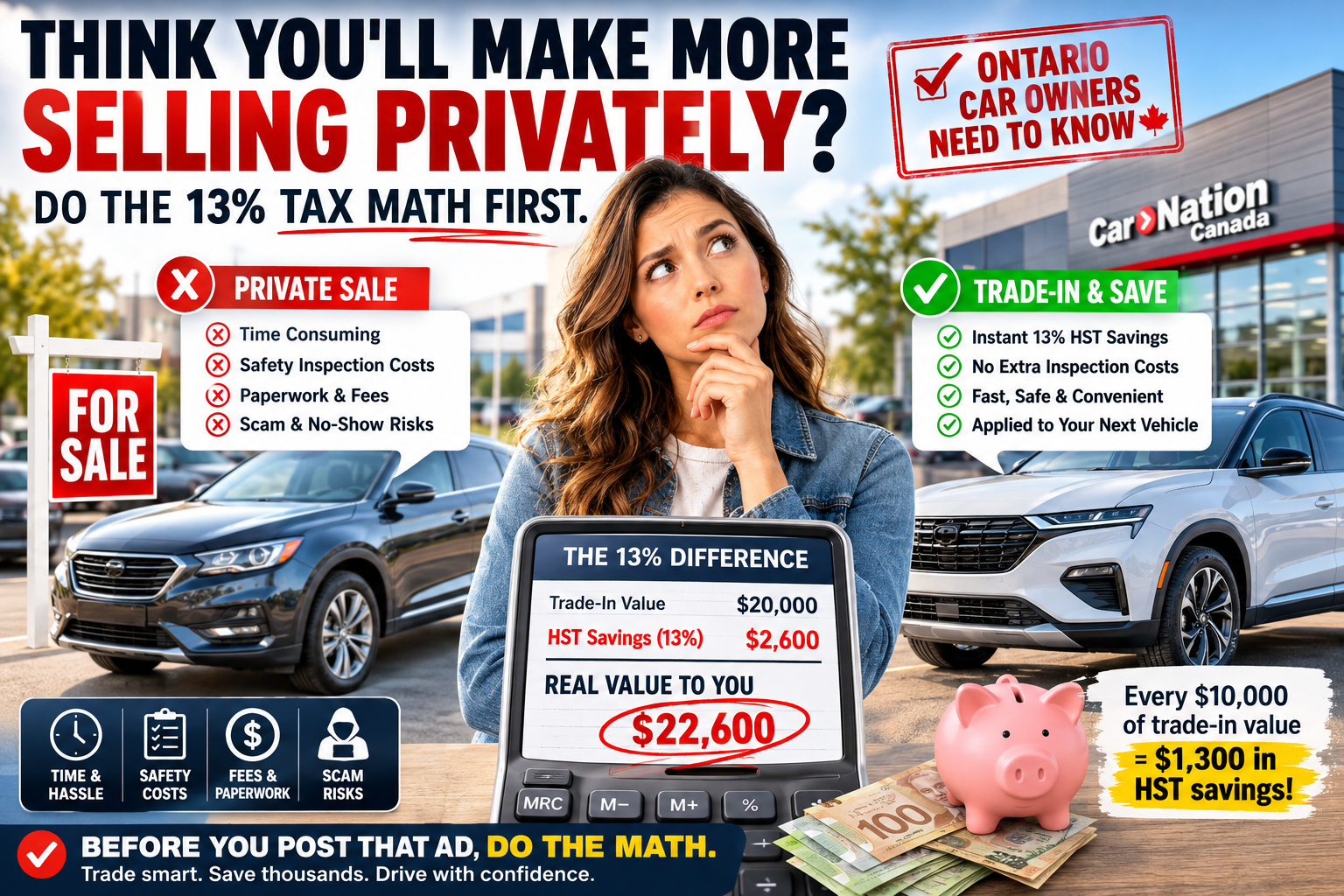
Why Selling Your Car Privately Is Costing You Money in Ontario
Selling your car privately in Ontario may bring a higher asking price, but once you calculate the 13% HST trade-in advantage, paperwork, safety-related costs, time, and transaction risk, the bigger private-sale number does not always mean more money in your pocket.
Introduction
“Just sell it privately. You’ll get more money.”
It is one of the most common pieces of advice Ontario vehicle owners hear before buying their next car, SUV, minivan, or truck. And at first glance, it makes sense: a private buyer may be willing to pay more than a dealership offers as a trade-in.
But the gross selling price is not the number that matters. Your real comparison is the net financial position after taxes, paperwork, vehicle preparation, time, and risk.
For drivers in Burlington, Hamilton, Oakville and the surrounding Golden Horseshoe, one Ontario tax rule can change that calculation dramatically: when an eligible personal-use vehicle is traded to a registered dealer as part of another purchase, HST is generally calculated on the price of the replacement vehicle minus the trade-in allowance.
Key Takeaways
- Ontario's HST rate is 13%, so every $10,000 of eligible trade-in allowance can represent approximately $1,300 in HST savings on the replacement vehicle.
- A $20,000 trade-in can create approximately $2,600 in HST savings, assuming the transaction qualifies.
- A private sale may produce a higher selling price, but it needs to beat the trade-in value plus the tax advantage before it is automatically the better financial decision.
- Ontario private sellers generally must provide a Used Vehicle Information Package, currently priced at $20.
- A Safety Standards Certificate is important for putting a transferred vehicle on the road, but sellers should understand the rule correctly: a vehicle can be sold without the seller supplying a certificate. A valid certificate is generally required before the vehicle can be plated as fit for road use.
- Private sales can also involve advertising, appointments, test drives, negotiations, payment verification and ownership-transfer responsibilities.
- The smartest comparison is net value, not simply “private asking price versus trade-in offer.”
The $20,000 Trade-In Math Most Private Sellers Miss
Suppose you are replacing your current vehicle with one priced at $40,000 before HST.
A dealership values your trade at $20,000.
For a qualifying consumer trade-in, the basic calculation looks like this:
Replacement vehicle: $40,000
Trade-in allowance: -$20,000
Taxable difference: $20,000
13% HST: $2,600
Without a qualifying trade-in applied to that transaction, 13% HST on the full $40,000 vehicle would be $5,200.
The difference is $2,600.
That means your $20,000 trade is not financially equivalent to receiving only $20,000 from a private buyer. In this example, its effective economic value toward the replacement transaction is closer to:
$20,000 trade allowance + $2,600 HST savings = $22,600
CRA guidance confirms that when a consumer who is not required to collect GST/HST trades personal-use property to a registered business, GST/HST is generally calculated on the selling price less the amount allowed for the trade-in.
People often call this an Ontario “trade-in tax credit.” Technically, it is better described as an HST reduction created by taxing the net difference.
Either way, the dollars are real.
How Much More Does a Private Buyer Actually Need to Pay?
This is the comparison that matters.
Imagine your choices are:
Dealer trade-in: $20,000
Private offer: $21,500
Looking only at the selling prices, private selling appears to put an extra $1,500 in your pocket.
But if that $20,000 trade-in reduces your HST by $2,600 on your next purchase, the comparison changes.
Trade-in economic value: approximately $22,600
Private selling price: $21,500
Under those assumptions, the private offer is actually about $1,100 behind.
The private buyer would need to pay more than approximately $22,600 before the higher private-sale price even begins to overcome the trade-in tax advantage — and that is before accounting for your time or other selling costs.
This is why we encourage customers to get an actual appraisal before deciding.
You can compare what your current vehicle may contribute toward one of the cars, SUVs, minivans or trucks in our Car Nation Canada inventory instead of assuming that a private listing will automatically produce the highest net return.
Does Selling Privately Require an Ontario Safety Standards Certificate?
This is one of the most misunderstood parts of selling your car privately in Ontario.
A Safety Standards Certificate confirms that a vehicle met Ontario's minimum safety standards when inspected. Ontario says the vehicle must pass an inspection at a licensed DriveON Vehicle Inspection Centre before the certificate can be issued.
However, the private seller does not necessarily have to obtain the certificate before selling the vehicle.
Ontario specifically states that a vehicle can be bought and registered without a Safety Standards Certificate, but it cannot be plated for road use without meeting the applicable safety requirements. A certificate is generally needed when transferring a used vehicle to a new owner and obtaining fit status, subject to exemptions.
That creates two possible private-sale scenarios.
Selling the Vehicle Without a Safety Certificate
You may sell the vehicle without certifying it, provided the transaction and vehicle condition are represented accurately.
The buyer then assumes responsibility for arranging the inspection and completing the necessary steps before putting the vehicle on the road.
The disadvantage?
Many ordinary buyers prefer a vehicle that is ready to register and drive. An uncertified car may attract lower offers or additional negotiation because the buyer does not yet know what repairs might be necessary.
Certifying the Vehicle Before the Sale
Some private sellers choose to have the vehicle inspected first because it can make the vehicle easier to market.
Ontario does not regulate the price of a Safety Standards inspection. Individual inspection facilities establish their own pricing, and repairs required for the vehicle to pass can create additional costs.
A Safety Standards Certificate is currently valid for 36 calendar days after inspection, so timing matters as well.
That means the meaningful question is not simply, “Do I need a safety?”
It is:
Will getting the vehicle certified increase my private-sale proceeds enough to justify the inspection, possible repairs and effort?
Do Not Forget the Used Vehicle Information Package
Ontario also requires most private sellers of cars, vans, light trucks and certain other vehicles to provide the buyer with a Used Vehicle Information Package, or UVIP.
The package includes information such as the vehicle's Ontario registration history, lien information, vehicle details, average wholesale value and a bill-of-sale section.
The current Ontario fee is $20.
Twenty dollars alone will not determine whether you should trade or sell privately.
But it demonstrates the larger point: private selling involves more than posting photos and collecting a cheque.
There is paperwork to complete correctly.
Private-Sale Risk Has a Value Too
Money is only one side of the decision.
Private sellers may also have to handle:
- messages from people who never show up
- repeated price negotiations
- strangers coming to their home or meeting location
- test drives
- proof of insurance and licence considerations
- verifying payment
- lien and ownership questions
- coordinating the vehicle handover
- ensuring the ownership transfer is completed correctly
Ontario's motor-vehicle regulator also notes that dealership trade-ins can be easier, faster and more secure than selling privately because they avoid issues such as no-shows, ownership-transfer complications and concerns about secure payment.
Your time has value.
So does reducing uncertainty when thousands — or tens of thousands — of dollars are changing hands.
For someone commuting daily from Milton or Grimsby, arranging five evening appointments just to discover that four buyers were not serious can quickly make that extra private-sale margin feel much smaller.
What If You Still Owe Money on Your Current Vehicle?
Having an outstanding loan does not automatically prevent you from trading your vehicle.
The important numbers are:
Trade-in value — what the vehicle is worth to the dealership.
Loan payout — what you still owe the lender.
Equity — the difference between those figures.
If your vehicle is worth $25,000 and your payout is $18,000, you have approximately $7,000 in positive equity.
If it is worth $18,000 and your payout is $22,000, you have approximately $4,000 in negative equity.
CRA's trade-in guidance explains that an outstanding lien does not itself reduce the trade-in allowance used for the applicable GST/HST trade-in calculation.
Financing the replacement vehicle when negative equity is involved is a separate lending decision. Approval, payment, interest rate, term length and the amount a lender is prepared to finance depend on your individual circumstances.
Our team can help you look at the numbers through our vehicle financing options, including options available for many credit situations.
O.A.C. — On Approved Credit. Conditions may apply.
When Does Selling Privately Make Sense?
There absolutely are situations where a private sale can win.
If your vehicle is unusually desirable, you already have a serious buyer, or the private-market premium is substantially higher than the dealership's appraisal plus your tax savings, selling privately may produce the better result.
The point is not that trading in is always better.
The myth is that selling privately is always more profitable simply because the selling price is higher.
Before deciding, calculate:
Expected private-sale proceeds
versus
Trade-in allowance + HST savings + avoided selling costs + value of your time
Then compare the numbers.
That is a much better financial decision than comparing two sticker prices.
Conclusion: Compare Net Value Before You Post the Ad
If you are replacing your vehicle in Ontario, a $20,000 trade-in can potentially reduce the HST on your next eligible vehicle purchase by about $2,600.
That is the number many private sellers overlook.
Once you add Ontario's transfer paperwork, the UVIP, possible inspection or repair expenses if you choose to sell certified, negotiations, payment concerns and the time involved in finding a serious buyer, a private sale needs to command a meaningful premium before it clearly wins.
Drivers from Burlington, Hamilton, Brantford and communities throughout Southern Ontario can start by seeing what comparable replacement vehicles are available in our current Car Nation Canada inventory.
Then have your trade appraised and compare the after-tax numbers, not just the headline offers.
If your next vehicle will be financed, you can also explore our finance application and financing information to understand possible payments, term lengths and budget options.
Financing options are available for many credit situations. O.A.C. — On Approved Credit. Conditions may apply.
FAQ
Is the Ontario trade-in tax saving really 13%?
Ontario's HST rate is currently 13%. For a qualifying consumer trade-in to a registered dealer, GST/HST rules generally allow tax to be calculated on the replacement vehicle price minus the trade-in allowance. A $20,000 eligible trade allowance therefore represents approximately $2,600 of HST savings.
Is a private sale always worth more than a trade-in?
No. A private buyer may pay a higher gross price, but you should compare that amount with the trade-in allowance plus the associated HST savings and any costs or time involved in selling privately.
Do I have to safety my car before selling it privately in Ontario?
Not necessarily. Ontario allows a vehicle to be sold without the seller first providing a Safety Standards Certificate, but the buyer generally needs a valid certificate before the vehicle can receive fit status and be plated for road use.
What paperwork does an Ontario private seller need?
For most private sales of cars, vans and qualifying light trucks, the seller is legally required to provide the buyer with a Used Vehicle Information Package. Ontario currently charges $20 for the UVIP.
Should I get a trade appraisal before listing my vehicle privately?
Yes. An actual appraisal gives you a benchmark. Add approximately 13% of the qualifying trade allowance to account for the potential Ontario HST advantage, then determine how much more a private buyer would have to pay before selling privately becomes worthwhile.