
The Ultimate Used Car Buying Checklist for First-Time Buyers in Canada
The Ultimate Used Car Buying Checklist for First-Time Buyers in Canada
Posted on August 25, 2026
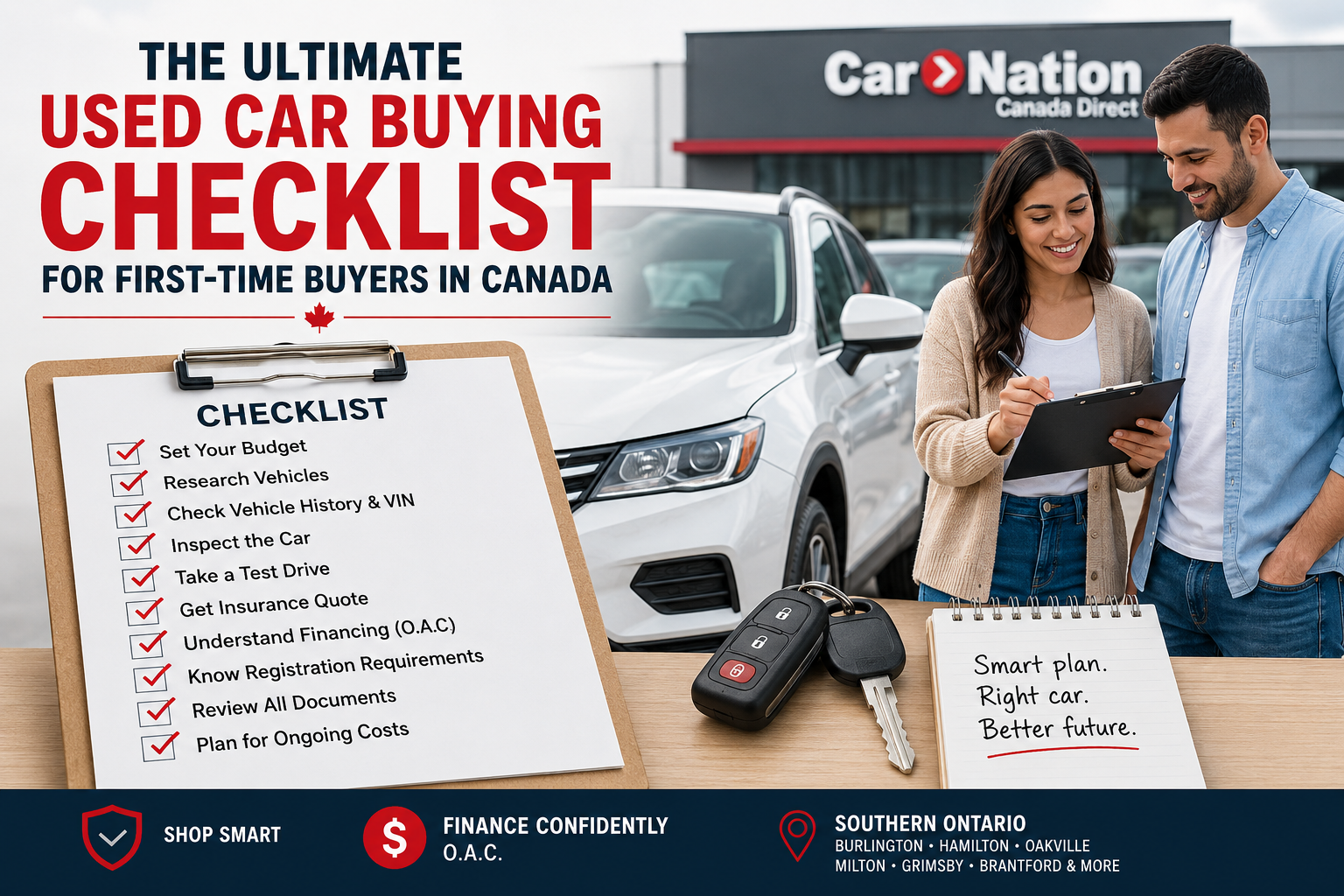
The Ultimate Used Car Buying Checklist for First-Time Buyers in Canada
Buying your first pre-owned vehicle? Use this used car buying checklist for first-time buyers in Canada to compare vehicles, understand financing, inspect the right details and prepare for ownership with confidence.
Buying your first vehicle is exciting, but it can also feel like a lot to figure out at once. You are comparing prices, kilometres, vehicle histories, insurance costs, financing terms and dozens of makes and models—often without having bought a car before.
For first-time buyers around Burlington, Hamilton, Oakville and Milton, the good news is that the process becomes much easier when you break it into clear steps.
At Car Nation Canada Direct, our goal is to help you understand what you are buying and what it will cost before you make a decision. Here is a practical checklist you can save, share or bring with you when shopping.
Key Takeaways
- Set a complete vehicle budget before choosing a specific car.
- Compare the total cost of financing, not just the weekly or monthly payment.
- Check the vehicle's history, VIN, kilometres and maintenance information.
- Inspect the vehicle carefully and take a meaningful test drive.
- Get an insurance estimate before finalizing the purchase.
- Understand Ontario ownership, safety and registration requirements.
- Choose a sedan, SUV, truck or minivan based on how you will actually use it.
- Read every financing and purchase document before signing.
- Leave room in your budget for fuel, maintenance, tires and unexpected repairs.
1. Decide What You Can Actually Afford
Your first question should not be, "What car do I want?"
Start with: What can I comfortably afford?
Your vehicle budget needs to account for more than the advertised purchase price or finance payment. Consider:
- Down payment, if applicable
- Weekly, biweekly or monthly financing payment
- Auto insurance
- Fuel or electricity
- Regular maintenance
- Seasonal tires
- Parking
- Licensing and registration expenses
- A reserve for unexpected repairs
The Financial Consumer Agency of Canada recommends looking at the total cost of a vehicle and loan, rather than judging affordability only by the payment amount. Longer financing terms can reduce individual payments but can also increase the total interest paid. (canada.ca)
That distinction matters for a first-time buyer. A payment that fits your paycheque today is only useful if the overall ownership costs fit your budget too.
If financing will be part of your purchase, you can review Car Nation Canada's financing options and application process before you shop. Financing options are available for many credit situations, including buyers who are building or rebuilding credit. O.A.C. — On Approved Credit. Conditions may apply.
2. Pick the Right Type of Used Vehicle
Before getting attached to a particular model, think about what the vehicle needs to accomplish.
Used sedans
A sedan can make sense for a first-time buyer who mainly commutes, drives in the city and wants something easy to park. Fuel economy and generally manageable ownership costs can make this body style attractive for students, new graduates and commuters.
Used SUVs
An SUV may be a better fit if you regularly carry passengers, sports equipment, groceries or family gear. Compare cargo space, all-wheel-drive availability and fuel consumption in L/100 km rather than assuming every SUV will meet the same needs.
Used trucks
A truck can be useful if towing, hauling or job-site use is part of your routine, but consider fuel, tires and insurance costs before buying more capability than you need.
Used minivans
For families, a used minivan can deliver excellent passenger room and practical cargo space. Sliding doors, flexible seating and easy access can matter far more in everyday life than styling trends.
Not sure where to begin? You can browse Car Nation Canada's current vehicle inventory and compare different body styles before narrowing your shortlist.
3. Research Makes and Models Before Shopping
Once you know your budget and preferred body style, research two or three models rather than relying on one choice.
Compare:
- Typical fuel consumption
- Maintenance requirements
- Reliability history
- Insurance estimates
- Cargo and passenger space
- Available safety features
- Winter-driving suitability
- Replacement tire sizes and costs
For buyers looking for familiar starter-car options, our selection of used Toyota vehicles is a useful place to begin comparing sedans, hatchbacks, SUVs and other practical choices.
The goal is not to find one universally "best" first car. It is to find the vehicle that best matches your commute, your budget and your expected years of ownership.
4. Check the Vehicle History and VIN
A clean-looking vehicle does not tell you everything about its past.
Before purchasing a used car, check the Vehicle Identification Number and available history information. The VIN displayed on the vehicle should match the VIN shown on its paperwork.
Ontario recommends that used-vehicle shoppers review vehicle history and maintenance information, confirm that the seller is legally entitled to sell the vehicle, inspect the VIN and have the vehicle checked for obvious damage. (ontario.ca)
For a private purchase in Ontario, the Used Vehicle Information Package can provide important information such as Ontario registration history, lien information, odometer records and the vehicle's last known status. Ontario notes that the private seller is generally responsible for providing the UVIP in applicable transactions. (ontario.ca)
Your checklist:
- Match the VIN on the vehicle to the paperwork.
- Review available vehicle history information.
- Look for reported collision history.
- Review available service and maintenance records.
- Check the kilometre history for inconsistencies.
- Understand whether any lien applies when purchasing privately.
5. Inspect the Used Car Carefully
Even when a vehicle looks polished, give yourself time to inspect it.
Start outside and work inward.
Exterior
Look for:
- Uneven body-panel gaps
- Significant scratches or dents
- Signs of corrosion
- Cracked lights or glass
- Mismatched paint colours
- Uneven tire wear
Tires
Check the condition of all four tires rather than inspecting only the easiest one to see.
Uneven wear may indicate that the vehicle needs an alignment or additional suspension attention. Also consider whether the vehicle comes with winter tires—an important budgeting consideration for drivers throughout Southern Ontario.
Interior
Check:
- Seat condition
- Windows and locks
- Air conditioning and heat
- Infotainment system
- Backup camera, if equipped
- Dashboard warning lights
- Heated seats and steering wheel, if equipped
- Charging ports and connectivity features
Do not assume a feature works simply because it appears on the equipment list. Try it.
6. Take a Real Test Drive
A five-minute trip around the block may not tell you much.
Whenever possible, drive the vehicle in situations similar to your regular routine. A buyer commuting between Burlington and Hamilton, for example, may want to experience both slower urban driving and higher-speed road behaviour.
During the test drive, pay attention to:
- How easily the engine starts
- Acceleration
- Transmission behaviour
- Steering feel
- Braking
- Suspension noises
- Highway stability
- Visibility
- Seat comfort
- Cabin noise
- Parking and turning radius
Ontario's used-vehicle guidance specifically recommends both having the vehicle inspected and taking a test drive before purchase. (ontario.ca)
7. Understand What an Ontario Safety Certificate Means
This is an important distinction for first-time buyers.
An Ontario Safety Standards Certificate confirms that a vehicle met the province's minimum safety standards when it was inspected. It is not a warranty or guarantee of the overall condition of the vehicle. (ontario.ca)
That means you should still evaluate the vehicle carefully and understand what maintenance may be coming.
Ask about items such as brakes, tires, fluids, battery condition and upcoming manufacturer-recommended service.
8. Get an Insurance Quote Before You Buy
Insurance can materially change whether a vehicle fits your budget.
Two similarly priced cars can have very different insurance premiums based on the model, driver profile, location, coverage and insurer.
Get a quote for the specific vehicle you are considering, ideally using its VIN.
This can be particularly important for younger drivers, newcomers to Canada or anyone purchasing insurance for the first time.
Remember that proof of insurance is also part of Ontario's vehicle-registration requirements. (ontario.ca)
9. Understand Your Financing Before Signing
If you are financing your first used car, make sure you understand the complete agreement.
Review:
- Vehicle selling price
- Down payment
- Amount financed
- Interest rate
- Payment frequency
- Number of payments
- Loan term
- Total cost of borrowing
- Applicable fees
- Optional products you have chosen
Do not focus exclusively on getting the lowest possible payment.
A longer term may make each payment smaller, but the federal government's consumer-finance guidance warns that longer auto loans generally result in more interest being paid over time. (canada.ca)
If you have a trade-in with an outstanding loan, ask whether you have positive equity or negative equity before rolling any balance into another vehicle.
For first-time buyers, newcomers or people rebuilding their credit, our team can also explain potential auto-financing options in plain language. Approval and financing terms depend on the applicant and lender. O.A.C. — On Approved Credit. Conditions may apply.
10. Know What You Need to Register a Used Vehicle in Ontario
Registration rules vary by province, so buyers outside Ontario should confirm the requirements where they live.
For Ontario shoppers, the Ontario Ministry of Transportation is the appropriate official source for current vehicle-registration information.
Ontario currently states that a used vehicle must be registered to its new owner within six days of purchase. Registration requirements can include identification, proof of purchase, proof of insurance, the ownership permit and applicable safety documentation. (ontario.ca)
Because requirements can change, check current provincial guidance rather than relying on an old checklist or social-media post.
11. Think About the Next Three to Five Years
Your first used car should not only work today.
Think about what your life might look like several years from now.
Could your commute change? Will you need more passenger room? Are you planning to move? Could your family grow? Will parking become more limited?
A slightly different vehicle today could save you from needing to trade again sooner than expected.
This is especially relevant when choosing between a compact sedan, SUV and minivan.
12. Do a Final Walk-Around Before Saying Yes
Before making your final decision, run through the checklist one more time.
- The vehicle fits my total budget.
- I have compared insurance costs.
- I understand the vehicle's history.
- The VIN and paperwork match.
- I have inspected and test-driven the vehicle.
- I understand the safety documentation.
- I know what maintenance may be due.
- I understand every financing term.
- I know the total cost—not just the payment.
- I have reviewed registration requirements.
- I feel comfortable with the decision without being rushed.
If one of those answers is "no," ask another question before signing.
Buying Your First Used Car With Confidence
Your first vehicle does not have to be the newest, largest or most expensive vehicle you qualify for.
It should be one that meets your needs, fits your overall budget and makes sense for the driving you actually do.
Whether you are commuting from Grimsby, starting a new job in Brantford, attending school near Hamilton or buying your first family vehicle in Burlington, a disciplined checklist can make the shopping process much easier.
Start by comparing vehicles that fit your needs in our new and used vehicle inventory. If financing is part of your plan, you can also review our finance application and education resources before visiting.
Our team is here to explain the options available for many different credit situations without judgement or unnecessary pressure. Financing O.A.C. — On Approved Credit. Conditions may apply.
Frequently Asked Questions
What should a first-time buyer check when buying a used car?
Check your total budget, vehicle history, VIN, kilometres, maintenance records, tire and brake condition, available safety documentation, insurance cost and financing terms. You should also inspect and test-drive the vehicle before making your decision.
What is a good first used car in Canada?
There is no single model that is best for everyone. A good first vehicle should fit your budget, commute, passenger needs and expected ownership costs. Many shoppers start by comparing practical sedans and compact SUVs, including used Toyota options.
Should I get pre-approved before shopping for a used car?
It can be helpful. A pre-approval process can give you a clearer understanding of potential financing options and help you shop within an appropriate range. Approval and terms depend on the lender and applicant. O.A.C. — On Approved Credit. Conditions may apply.
How quickly do I have to register a used vehicle in Ontario?
Ontario currently requires buyers to register a used vehicle in their name within six days of purchase. Check the Ontario Ministry of Transportation for current provincial information before completing your transaction. (ontario.ca)
Is an Ontario Safety Standards Certificate a warranty?
No. Ontario states that the certificate confirms the vehicle met minimum safety standards when the certificate was issued; it does not guarantee the overall condition of the vehicle. (ontario.ca)