
The 30% Negative Equity Epidemic: How to Trade In a Car With Negative Equity in Ontario Without Wrecking Your Budget
The 30% Negative Equity Epidemic: How to Trade In a Car With Negative Equity in Ontario Without Wrecking Your Budget
Posted on September 11, 2026
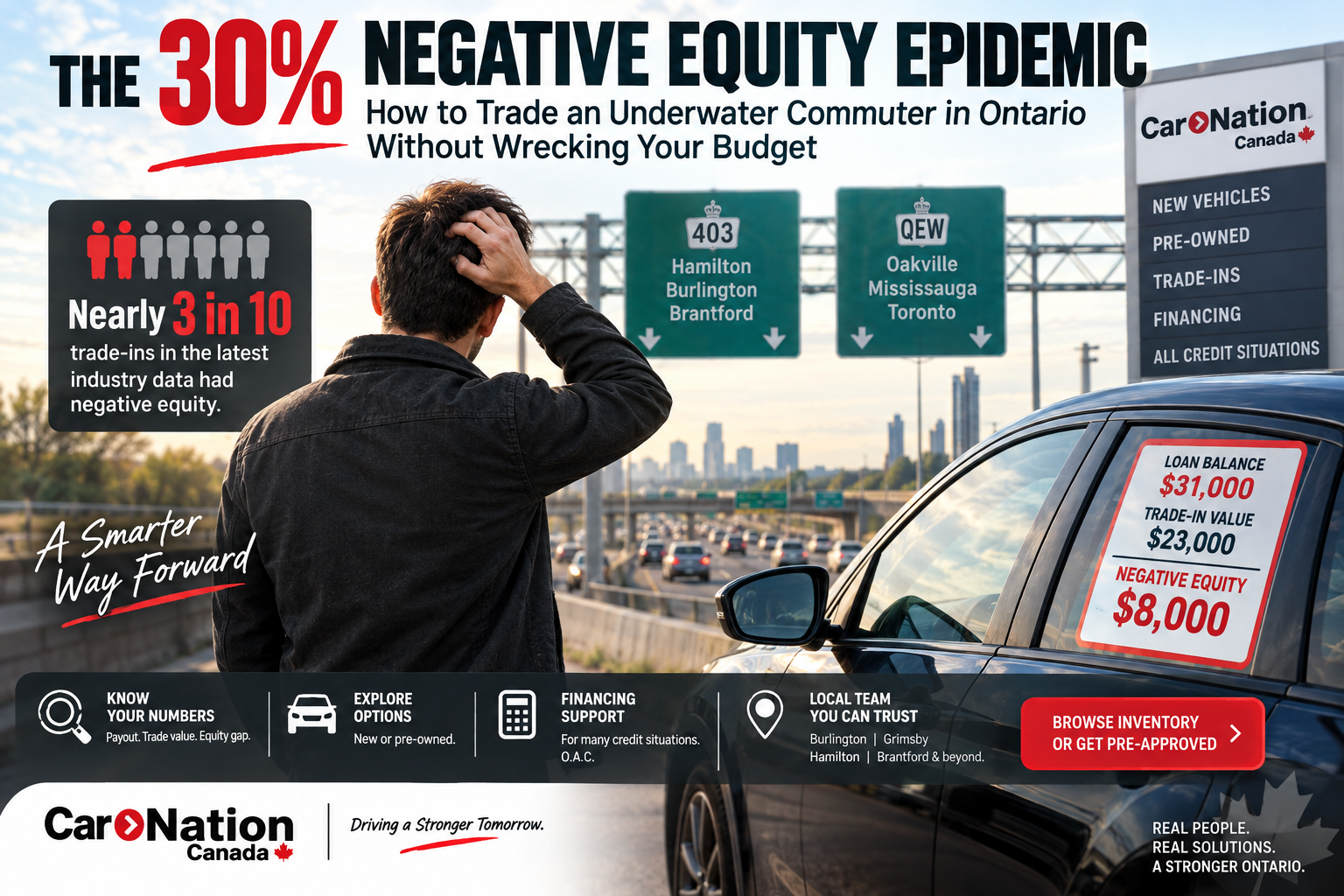
Owe more than your commuter is worth? Learn how to trade in a car with negative equity in Ontario, calculate the real equity gap, compare replacement options, and avoid turning yesterday’s car loan into tomorrow’s budget problem.
If your daily drive takes you along the QEW or Highway 403 between Burlington, Hamilton, Oakville or Mississauga, the kilometres can add up surprisingly fast.
That matters when you still owe money on your vehicle. A perfectly reliable commuter can accumulate 25,000, 30,000 or even more kilometres per year, while its market value may fall faster than the balance on a long-term auto loan.
The result is negative equity: you owe more on the vehicle than it is currently worth.
And it is becoming a much bigger industry issue. In Q2 2026, U.S. transaction data showed 29.6% of trade-ins toward new-vehicle purchases had negative equity. That is an industry benchmark rather than an Ontario-specific statistic, but it illustrates why understanding the math has become increasingly important for Canadian drivers as well.
Key Takeaways
- Negative equity means your loan payout is greater than your vehicle's trade-in value.
- High annual kilometres, depreciation, small down payments and extended loan terms can increase the risk of becoming underwater.
- Trading an underwater vehicle does not automatically make financial sense just because a lender can structure a new payment.
- Manufacturer rebates or incentives on an eligible new vehicle can sometimes reduce the replacement vehicle's effective purchase price, but they do not erase the outstanding debt on your current vehicle.
- A lower-priced pre-owned sedan, SUV, truck or minivan may sometimes create a better transition than moving into another expensive vehicle.
- Compare trade value, payout, negative equity, replacement price, term length and total amount financed before focusing on the monthly or bi-weekly payment.
- Financing options are available for many credit situations through Car Nation Canada, O.A.C. — On Approved Credit. Conditions may apply.
What Does It Mean to Trade In a Car With Negative Equity in Ontario?
The basic calculation is simple:
Current loan payout − actual trade-in value = negative equity
Imagine your lender says it will cost $31,000 to completely pay off your current auto loan.
Your vehicle is assessed at $23,000 as a trade-in.
That leaves:
$31,000 − $23,000 = $8,000 of negative equity
That $8,000 does not disappear when you hand over the keys.
If it is included in the financing for another vehicle, you are effectively borrowing money for both your replacement vehicle and part of the vehicle you no longer own.
Ontario's motor-vehicle regulator describes negative equity the same way: it occurs when a trade-in is worth less than the outstanding loan. If negative equity is included in another vehicle transaction, Ontario dealers are required to represent the true nature of that transaction clearly and transparently.
Understanding that number before shopping is one of the most useful things you can do.
Why QEW and Highway 403 Commuters Can Get Underwater Faster
Mileage matters.
Consider someone living in Grimsby who regularly drives toward Burlington or Hamilton, or a Halton resident commuting toward Mississauga and Peel five days per week.
The odometer keeps moving even while the loan balance declines gradually.
A high-mileage commuter can therefore face two competing curves:
Your loan balance is falling.
Your vehicle's market value is also falling.
The problem appears when depreciation wins the race.
The Financial Consumer Agency of Canada warns consumers that depreciation combined with long-term financing can create negative equity. It also identifies loans of 72 months or longer as long-term auto loans and cautions that extending the term generally means paying more interest overall.
That is especially relevant if you financed a vehicle for seven or eight years but expect to replace it after three or four.
The loan may have been structured around a manageable payment, while your ownership cycle was much shorter than the financing cycle.
The Negative-Equity Math Most Drivers Should Do Before Trading
Suppose you have this situation:
Loan payout: $34,000
Trade-in assessment: $25,000
Negative equity: $9,000
Now suppose you are considering a $30,000 replacement vehicle.
Before taxes, applicable fees, cash down and other transaction details, combining the replacement price and old debt could put the starting amount at roughly:
$30,000 + $9,000 = $39,000
You are not really making a "$30,000 vehicle decision."
You are making a $39,000 debt decision before the remaining transaction costs are considered.
That distinction matters.
The federal government's auto-financing guidance recommends considering the total cost, total amount financed, interest rate, payment schedule and loan length rather than evaluating an offer solely on the size of the regular payment.
Why a Lower Payment Can Still Be the More Expensive Choice
This is where negative-equity trades can become dangerous.
Imagine one financing structure results in a payment you dislike.
Stretching the replacement loan over additional years may reduce that payment.
That may help monthly cash flow, but it does not mean the transaction became cheaper.
It usually means the repayment period became longer.
Federal consumer guidance illustrates the effect with a $25,000 vehicle financed at 5%: its example shows total interest of $1,974 over 36 months compared with $4,681 over 84 months. The specific rate and payment in any real transaction will differ, but the principle remains important: a longer term can reduce the regular payment while increasing total interest paid.
That is why our team prefers to look at several numbers together rather than asking only, "What payment do you want?"
Can Manufacturer Rebates Absorb Negative Equity?
Sometimes an available manufacturer incentive can improve the equation—but the wording matters.
A rebate does not technically pay off your old loan.
Instead, on an eligible new vehicle, an incentive may reduce the effective cost of the replacement purchase. That can potentially create more room in the overall transaction compared with buying the same vehicle without the incentive.
Consider this simplified example:
Replacement vehicle: $36,000
Eligible manufacturer incentive: $4,000
Effective price before other transaction details: $32,000
Negative equity being addressed: $7,000
The incentive improves the replacement-vehicle side of the equation, but you still have to account for that $7,000 equity shortage.
And there is another important comparison to make.
Suppose instead you find a suitable pre-owned commuter for $27,000 in the Car Nation Canada vehicle inventory.
Even without a manufacturer rebate, the lower starting price could make the pre-owned vehicle a more sensible financial transition.
There is no universal answer.
The right comparison is net transaction versus net transaction, not "rebate versus no rebate."
Manufacturer programs change, eligibility conditions apply, and financing approval is always subject to lender requirements.
How to Trade In a Car With Negative Equity in Ontario More Strategically
If your car is underwater, there are several levers worth examining before replacing it.
1. Get the Exact Loan Payout
Do not use the loan balance from an old statement.
Ask your lender for the current payout amount. That gives you the real number required to satisfy the existing loan.
2. Get a Realistic Trade-In Assessment
Your trade-in value is not necessarily the number you saw in an online classified ad for a similar car.
Condition, kilometres, accident history, mechanical needs, tires, reconditioning requirements, model demand and current market conditions can all influence an appraisal.
An actual appraisal lets you compare your real trade value against your real payout.
3. Calculate the Equity Gap
If the payout is $28,500 and the trade is worth $24,000:
$28,500 − $24,000 = $4,500 negative equity
Now you have a decision-making number.
4. Consider Using Cash to Reduce the Gap
If your budget and emergency savings comfortably allow it, cash down can reduce the amount of old debt carried into another transaction.
That does not mean draining your savings account simply to make a vehicle deal work.
The objective is a sustainable transportation budget, not the smallest possible financing number at any cost.
5. Compare Less Expensive Replacement Vehicles
A high-mileage commuter does not necessarily need a more expensive replacement.
A dependable pre-owned sedan may make more financial sense than moving into a new SUV. A family that genuinely needs cargo space might compare used SUVs and minivans rather than automatically choosing a higher-priced new model.
Our online inventory lets you compare cars, SUVs, trucks and minivans across different price points before deciding which direction makes sense.
6. Evaluate Incentives Where They Actually Help
If an eligible new vehicle has a meaningful manufacturer program, include it in your comparison.
Then compare that transaction against appropriate pre-owned alternatives.
Do not choose a $45,000 vehicle merely because it carries a $4,000 incentive if a $28,000 pre-owned vehicle meets your needs better.
7. Consider Keeping the Current Vehicle
Sometimes the financially strongest trade is no trade at all.
If your current vehicle is reliable, safe and still fits your needs, keeping it longer may give you time to reduce the loan balance.
That approach is particularly worth considering when the negative-equity gap is large.
The Financial Consumer Agency of Canada specifically advises consumers to consider avoiding a trade while significantly underwater where possible.
When Trading an Underwater Commuter May Still Make Sense
Negative equity does not automatically mean you must keep the vehicle under every circumstance.
Your life may have changed.
Maybe your sedan no longer works for a growing family.
Maybe a long-distance commuter now needs something better suited to their daily use.
Maybe repair costs on a high-kilometre vehicle are becoming difficult to predict.
Or perhaps your household has changed jobs, moved between Brantford and Hamilton, or needs a different type of vehicle altogether.
The important question is not simply whether you can trade.
It is whether the replacement improves your transportation situation without creating an unreasonable financial burden.
What If Your Credit Has Changed Since You Bought the Car?
Negative equity can feel particularly stressful if your credit circumstances have also changed.
Maybe rising living costs have tightened your budget.
Maybe you are rebuilding after a consumer proposal or bankruptcy.
Maybe you are new to Canada and have a limited Canadian credit history.
Or perhaps your credit is strong but you simply do not want to waste money carrying old vehicle debt longer than necessary.
Our approach is to look at the complete situation: vehicle value, existing payout, household budget, replacement options and available financing structures.
You can explore Car Nation Canada financing options for many credit situations before deciding whether a trade makes sense.
Financing is O.A.C. — On Approved Credit. Conditions may apply. Approval, interest rate, term, amount financed and lender conditions depend on the individual application and transaction.
Trade In a Car With Negative Equity in Ontario Without Repeating the Cycle
The biggest objective is not merely escaping today's underwater loan.
It is avoiding the same problem three years from now.
Before financing your replacement, ask:
- How many kilometres will I drive each year?
- How long do I realistically expect to own this vehicle?
- How much existing negative equity is being included?
- What is the total amount being financed?
- What is the term length?
- What will I pay in total if I keep the loan to maturity?
- Am I choosing this vehicle because it fits my needs—or because a longer term makes the payment look affordable?
- Could a lower-priced pre-owned vehicle accomplish the same job?
Those questions are particularly valuable for QEW and Highway 403 commuters who accumulate kilometres faster than average.
Conclusion: Know Your Equity Number Before You Shop
Being underwater on an auto loan does not mean you have failed financially, and it does not mean there is only one solution.
It means you need better information before making the next move.
Start with three numbers:
Your exact loan payout.
Your realistic trade-in value.
The resulting positive or negative equity.
Then compare replacement vehicles based on the total transaction—not simply the advertised payment.
Available rebates can sometimes improve the numbers on eligible vehicles. Cash down can sometimes reduce the gap. A more affordable pre-owned vehicle can sometimes create the cleaner transition. And in other situations, keeping your current vehicle longer may make the most financial sense.
If you're commuting through Burlington, Hamilton, Oakville, Mississauga, Grimsby, Brantford or elsewhere in Southern Ontario, you can start by browsing Car Nation Canada's current inventory and then explore financing and pre-approval options based on your actual budget and trade situation.
Financing options are available for many credit situations. O.A.C. — On Approved Credit. Conditions may apply.
Frequently Asked Questions
Can I trade in a car if I still owe money on it in Ontario?
Yes. A financed vehicle can be traded before the loan is fully repaid. The outstanding loan must still be satisfied, however. If the payout exceeds the trade-in value, the difference is negative equity. Ontario requires negative equity included in a vehicle transaction to be represented transparently.
What happens to negative equity when I trade my car?
Depending on the transaction and lender approval, you may pay the difference yourself or some negative equity may be included in the financing for the replacement vehicle. Rolling it forward increases the amount being financed and can increase borrowing costs.
How much negative equity is too much to trade?
There is no single dollar amount that applies to everybody. It depends on the value of the replacement vehicle, your down payment, income, credit profile, lender guidelines and overall budget. A larger equity gap deserves especially careful scrutiny before proceeding.
Can a rebate cover negative equity?
An eligible manufacturer rebate can reduce the effective price of a qualifying new vehicle, which may improve the overall transaction. It does not erase the outstanding balance on your previous loan. Compare the complete amount financed against suitable pre-owned alternatives before deciding.
Should I buy used if I have negative equity?
A lower-priced used vehicle can sometimes help keep the next amount financed more manageable, but it depends on the individual numbers. Compare your payout, trade value, equity gap and several new and pre-owned inventory options before choosing.