
The 12-Month Credit Rebound: Rebuilding From Bruised Credit Through Indirect Auto Loans
The 12-Month Credit Rebound: Rebuilding From Bruised Credit Through Indirect Auto Loans
Posted on November 9, 2026
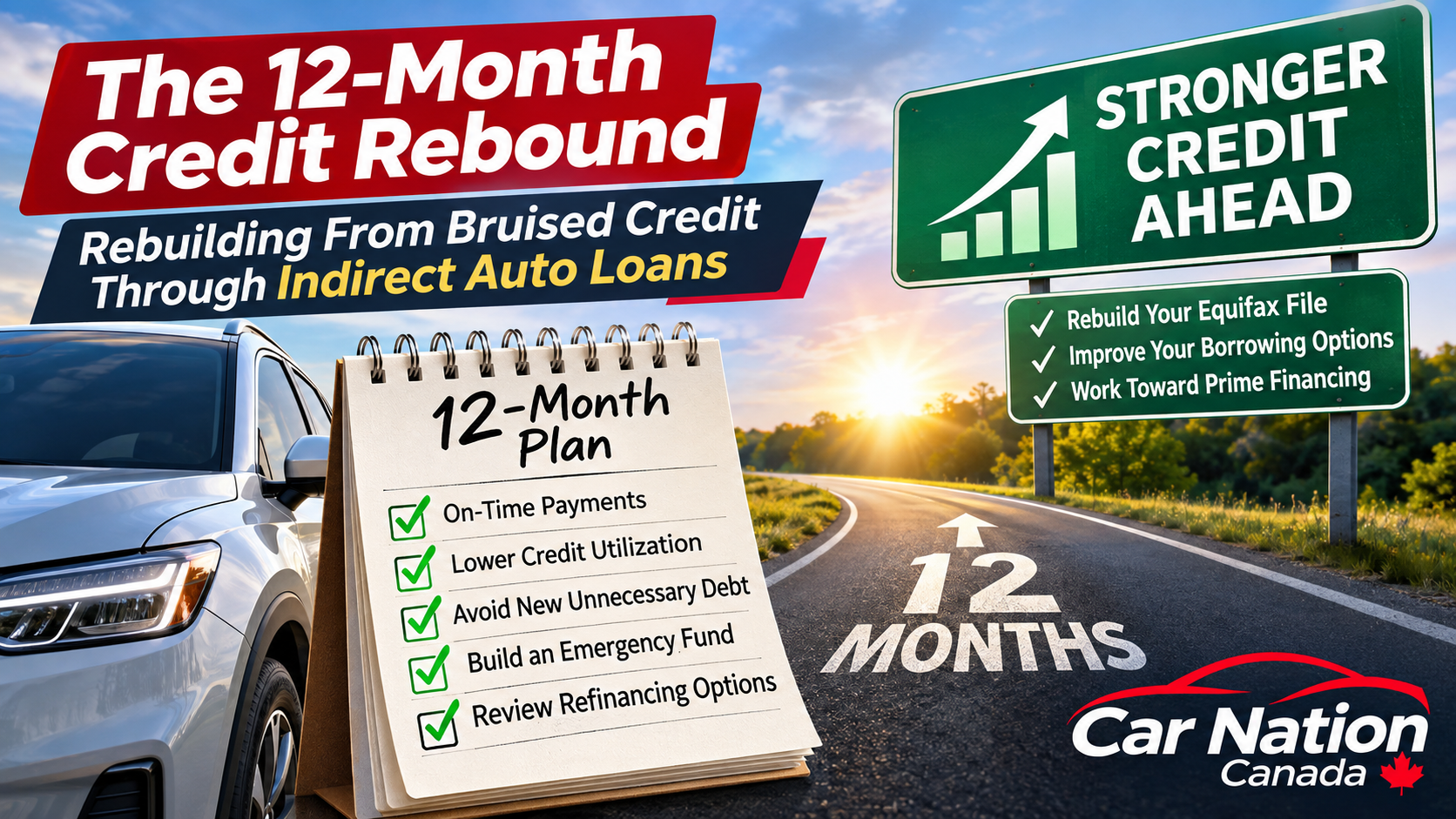
The 12-Month Credit Rebound: Rebuilding From Bruised Credit Through Indirect Auto Loans
A lower credit score or a past consumer proposal does not necessarily mean you have to stay outside the automotive lending system. A carefully structured auto loan, combined with 12 months of disciplined payments and better overall credit habits, can help establish a stronger credit profile for the future.
For Ontario drivers rebuilding their finances after missed payments, collections, a consumer proposal, job loss or another setback, obtaining a traditional bank auto loan can sometimes be difficult.
That does not mean every financing option disappears.
Dealership-arranged financing can provide access to lenders that specialize in borrowers whose credit profiles do not fit conventional prime lending criteria.
For drivers throughout Burlington, Hamilton, Oakville, Milton, Mississauga and surrounding Ontario communities, the objective should not simply be getting approved for another vehicle.
The bigger objective can be using the next auto loan responsibly as part of a longer-term financial recovery strategy.
At Car Nation Canada, our team works with customers dealing with many different credit situations. You can learn more through our credit rebuilding and bad-credit car loan resources or explore our broader automotive financing options.
Key Takeaways
- A credit score below 600 does not automatically prevent you from qualifying for automotive financing.
- Dealerships may work with specialized or non-prime lenders in addition to traditional financial institutions.
- Your income, employment stability, existing debts, vehicle choice and overall ability to repay can influence an application.
- Payment history is one of the most important components of your credit profile.
- Twelve months of flawless auto loan payments may help strengthen your credit history, but there is no guaranteed number of points your score will increase.
- Someone recovering from a consumer proposal may still have the proposal reported on their credit file while simultaneously establishing new positive credit history.
- Refinancing after 12 months is a possibility for some borrowers, not a guarantee.
- The correct goal is not simply a lower monthly payment. You should consider interest rate, term length, remaining balance and total borrowing cost.
What Is an Indirect Auto Loan?
Most drivers are familiar with walking into their bank and applying directly for a car loan.
Dealership financing works somewhat differently.
A dealership's finance department may submit an application to financial institutions and automotive lenders that work through dealership networks.
These arrangements are commonly called indirect auto financing because the customer typically arranges the loan through the dealership rather than approaching the lender directly.
The advantage for someone rebuilding credit is access to a broader lending marketplace.
Certain lenders specialize in borrowers who fall outside traditional prime-credit requirements.
For example, Eden Park says it works through automotive dealer partners and specifically identifies credit rebuilding as part of its vehicle-financing business.
Rifco National Auto Finance similarly describes itself as a Canadian non-prime automotive finance company working with dealership partners.
That does not mean approval is automatic.
Every application is evaluated individually, and financing remains O.A.C. — On Approved Credit. Conditions may apply.
Why a Credit Score Under 600 Doesn't Tell the Whole Story
Your credit score matters, but it is not the only information a lender may review.
Depending on the lender and application, other considerations can include:
- How long you have been employed
- Your gross monthly income
- Your existing monthly debt obligations
- Housing expenses
- Recent payment history
- Previous automotive loans
- Down payment
- Trade-in equity or negative equity
- The price and age of the vehicle
- Requested loan amount
- Length of the financing term
A person with damaged credit but stable employment and manageable monthly obligations may look different to a lender than someone with the same credit score who is already carrying unsustainable debt.
This is one reason working through an experienced dealership finance department can be valuable.
The goal should be finding a loan structure that fits the customer's actual budget, rather than stretching someone into the most expensive vehicle they can technically qualify for.
Why Payment History Matters So Much
If you're trying to rebuild credit, your payment schedule becomes extremely important.
The Financial Consumer Agency of Canada identifies payment history as the most important component of a credit score and recommends consistently making payments on time.
That is why an automotive loan can potentially become part of a credit rebuilding strategy.
Every successful payment contributes to the history showing how you manage borrowed money, assuming the lender reports the account to the credit bureaus.
But there is an important distinction:
Taking out an auto loan does not automatically rebuild your credit. Managing it properly does.
Missing payments on a credit-rebuilding loan can make the situation worse.
The vehicle therefore needs to fit your income comfortably enough that you can continue making payments even when normal life expenses appear.
The 12-Month Credit Rebound Strategy
There is nothing magical about exactly 12 months.
Credit scores are calculated using multiple factors, and nobody can legitimately promise that making 12 car payments will increase your score by a specific number of points.
What 12 months provides is something valuable:
time to establish a meaningful pattern of responsible financial behaviour.
Here's how we would approach it.
Month 1: Build the System Before the First Payment
Your first priority is making it almost impossible to accidentally miss your payment.
Set up automatic payments if available.
Record the payment date in your calendar.
Keep enough money in the account before the withdrawal occurs.
Then build a small buffer.
If your vehicle payment is $300 bi-weekly, for example, don't operate your bank account with exactly $300 available on payment day.
Unexpected subscriptions, insurance withdrawals or other expenses can create an accidental returned payment.
Your first objective is simple:
Never miss the payment.
Month 2: Review Your Entire Credit File
Pull your credit report and check it carefully.
Look for incorrect balances, unfamiliar accounts, duplicate collections or old information that should have been updated.
Checking your own credit report is considered a soft inquiry and does not affect your credit score.
You can use Equifax Canada's consumer credit resources to learn more about your credit report and credit score.
Do not obsess over the score every few days.
You are building a trend, not chasing daily movements.
Month 3: Attack Credit Card Utilization
Auto payments are only one part of your credit profile.
If your credit cards are constantly near their limits, reducing those balances can become another important part of the rebuilding process.
The Financial Consumer Agency of Canada recommends trying to use less than 30% of your available revolving credit.
For example:
A $3,000 credit card with a $2,900 balance is heavily utilized.
A $3,000 credit card with a $600 balance represents a dramatically different utilization level.
Don't open several new accounts trying to manufacture a better score.
Focus on responsibly managing what you already have.
Month 4: Protect the Payment Streak
By month four, the excitement of the new vehicle has worn off.
This is when rebuilding becomes routine.
Keep your automotive payment flawless.
Pay your other bills on time.
Don't start applying for multiple credit cards simply because your financial situation feels slightly better.
Too many credit applications over a short period can affect your credit profile. The federal government recommends limiting unnecessary credit inquiries.
Month 5: Build an Emergency Vehicle Fund
One overlooked credit rebuilding tool has nothing to do with the credit bureaus.
It's cash.
Start building a dedicated emergency reserve for:
- Vehicle repairs
- Insurance deductibles
- Tires
- Maintenance
- Unexpected household expenses
Why?
Because a $900 repair should not force you to choose between fixing your vehicle and making your loan payment.
Even a modest emergency fund can help protect the payment history you're working so hard to establish.
Month 6: Perform the Halfway Review
Six months is a good point to evaluate your financial progress.
Ask yourself:
- Have all six months of payments been made on time?
- Have credit card balances declined?
- Has your income remained stable?
- Have you avoided unnecessary new debt?
- Is the vehicle payment still comfortable?
- Do you have at least a small emergency fund?
If yes, you're building exactly the behaviour lenders want to see.
Don't rush to refinance just because six months have passed.
Building additional history may strengthen your financial position further.
Month 7: Avoid Lifestyle Inflation
One of the biggest dangers during financial recovery is increasing spending the moment cash flow improves.
You receive a raise.
A credit card company increases your limit.
Your credit score moves higher.
Suddenly the temptation is to spend more.
Don't.
Credit recovery works best when improved income creates more financial breathing room, not larger obligations.
Month 8: Keep Utilization Moving Down
Continue reducing revolving balances wherever practical.
If you have a credit limit increase that does not require additional borrowing, resist treating the extra limit as spending money.
The purpose of rebuilding credit is increasing your flexibility — not increasing your debt.
Month 9: Review the Auto Loan Balance
Now start examining the loan itself.
Find out:
- Current payout balance
- Remaining term
- Current interest rate
- Remaining estimated interest cost
- Current vehicle value
- Whether you have positive or negative equity
This information becomes important when deciding whether refinancing eventually makes sense.
A lower rate sounds attractive, but refinancing is only worthwhile when the entire transaction improves your situation.
Month 10: Start Thinking Like a Prime Borrower
By now, your financial habits should look very different from month one.
Don't ask:
“How much can I borrow?”
Ask:
“How little do I need to borrow to accomplish my goal?”
That mindset can dramatically change your long-term financial position.
Month 11: Prepare for a Credit Review
Gather:
- Recent pay stubs
- Employment information
- Current loan payout
- Proof of residence
- Updated monthly budget
- Trade-in information if applicable
- Documentation relating to a completed consumer proposal if relevant
This doesn't mean you need to refinance immediately.
It means you're prepared to evaluate your options intelligently.
Month 12: Evaluate — Don't Automatically Refinance
At the one-year mark, you may have built twelve months of successful automotive payments alongside better overall financial habits.
Now you can review your situation.
Depending on your updated credit profile, income, debt ratios, vehicle value and lender requirements, you may qualify for better financing terms.
But refinancing is never automatic.
Before moving forward, compare:
Current loan balance + remaining interest
versus
New loan rate + new term + total borrowing cost.
Stretching a loan back out over another long term simply to reduce the monthly payment can sometimes cost more overall.
Our Car Nation Canada finance team can review available financing possibilities based on your individual situation.
Financing is O.A.C. Conditions may apply.
What If You Previously Had a Consumer Proposal?
A consumer proposal does not disappear from your credit report the moment it is completed.
The Financial Consumer Agency of Canada states that Equifax and TransUnion remove consumer proposal information either three years after the included debts have been paid or six years after the proposal was signed, depending on the bureau and applicable timing rules.
The Office of the Superintendent of Bankruptcy also stresses that there are no guarantees a lender will extend new credit after a proposal.
But negative historical information and new positive behaviour can exist on the same credit file.
That is why rebuilding involves demonstrating responsible financial behaviour over time.
The government specifically recommends making payments on time and keeping revolving credit utilization below approximately 30% when rebuilding following insolvency.
Don't Buy Too Much Vehicle During a Credit Rebound
This might be the most important section of the entire strategy.
A credit rebuilding vehicle should solve your transportation problem without creating another financial problem.
You may want the $55,000 SUV.
But if a dependable $25,000 vehicle leaves hundreds of dollars more breathing room in your monthly budget, the less expensive vehicle may be the smarter financial tool.
Browse our current Car Nation Canada vehicle inventory and compare vehicles based not only on purchase price but also:
- Insurance
- Fuel consumption
- Maintenance
- Financing cost
- Expected depreciation
- Monthly cash flow
- Total cost of ownership
Sometimes the vehicle that helps rebuild your finances fastest isn't the vehicle with the most features.
It's the one you can comfortably afford every single month.
From Burlington to Hamilton: A Fresh Start Doesn't Happen Overnight
Ontario workers experience financial setbacks for countless reasons.
Job losses happen.
Relationships change.
Businesses fail.
Medical and family expenses appear.
Interest costs accumulate.
Consumer proposals happen.
None of those events mean your financial position has to remain frozen forever.
For drivers commuting between Burlington, Hamilton, Oakville, Milton, Mississauga, Brantford and the surrounding GTHA, dependable transportation may also be essential for maintaining the employment income that supports the recovery process.
The objective should therefore be sustainable financing.
Not maximum financing.
The Real Goal: Make Your Next Loan Your Last Non-Prime Loan
If your credit has been bruised, you shouldn't view a higher-cost automotive loan as your permanent financial situation.
Think of it as a bridge.
During that bridge period:
Make every payment.
Reduce unnecessary debt.
Keep revolving balances low.
Avoid unnecessary credit applications.
Build emergency savings.
Maintain stable employment whenever possible.
Track your credit report for accuracy.
Then periodically evaluate whether your improved financial profile qualifies you for better borrowing options.
Twelve months can represent meaningful progress.
Eighteen months can create even more history.
Twenty-four months can create more again.
Credit rebuilding is not an overnight trick.
It is a pattern.
And patterns become histories.
Frequently Asked Questions
Can I finance a vehicle with a credit score below 600?
Possibly. Some lenders specialize in non-prime automotive financing. Approval depends on the complete application, including income, debt obligations, vehicle selection and other lending criteria. Financing is O.A.C.
Can I get a car loan after a consumer proposal?
Some borrowers may qualify for automotive financing during or after a consumer proposal, depending on lender requirements and individual circumstances. There is no guaranteed approval.
Will 12 months of car payments increase my credit score?
Consistent on-time payments may help strengthen your payment history, but nobody can legitimately guarantee a specific credit-score increase. Your score is influenced by several factors.
Can I refinance my auto loan after one year?
Potentially. Your eligibility will depend on your credit profile at that time, employment, income, outstanding balance, vehicle value and lender requirements. Compare the total cost before refinancing rather than focusing only on the monthly payment.
Should I finance an expensive vehicle to rebuild credit faster?
No. Borrowing more money does not automatically rebuild credit faster. A comfortably affordable vehicle may actually make the strategy safer because you're more likely to consistently meet every obligation.
Build the Next 12 Months, Not Just the Next Car Payment
The best credit rebuilding strategy isn't complicated.
It requires consistency.
One payment.
Then another.
Then another.
Combine that payment history with lower revolving debt, careful budgeting, limited unnecessary credit applications and an affordable vehicle, and twelve months from today your overall financial profile may look very different.
If you're recovering from damaged credit, a consumer proposal or another financial setback, start by exploring our credit rebuilding options, completing a Car Nation Canada finance application or browsing our current vehicle inventory for something that fits your actual monthly budget.
The goal isn't simply getting approved today.
It's putting yourself in a stronger financial position tomorrow.
O.A.C. — On Approved Credit. Conditions may apply. Financing availability, rates, terms and lender requirements vary by applicant. This article is general educational information and is not financial or credit counselling advice.