
The 12-Month Credit Rebound: How to Rebuild Credit Through Indirect Auto Loans in Ontario
The 12-Month Credit Rebound: How to Rebuild Credit Through Indirect Auto Loans in Ontario
Posted on October 14, 2026
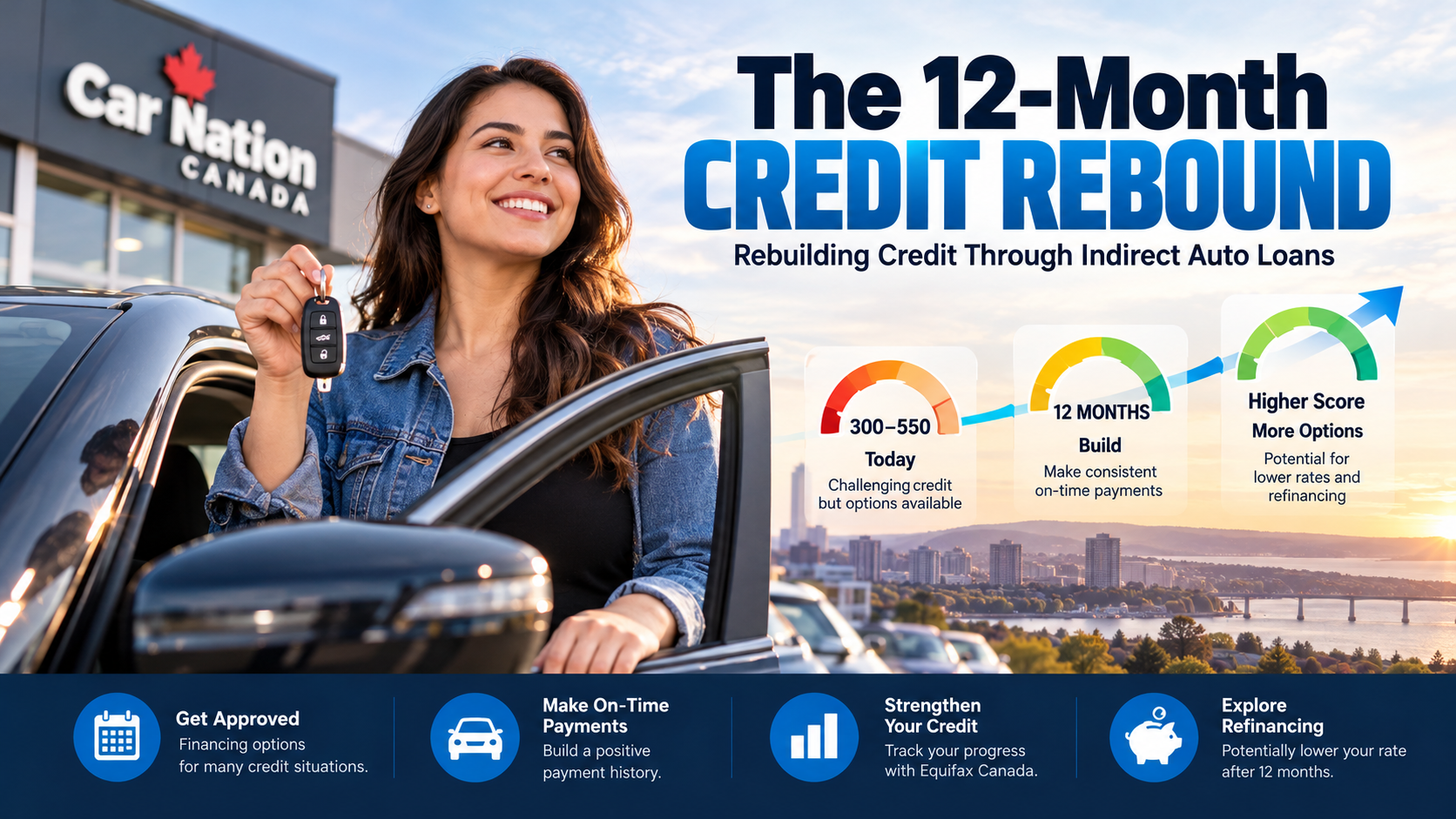
The 12-Month Credit Rebound: How to Rebuild Credit Through Indirect Auto Loans in Ontario
Can a car loan help rebuild your credit in just 12 months? Discover how dealership-arranged auto financing, consistent payments, and a smart refinancing strategy can help Ontario drivers work toward better credit and lower borrowing costs.
A bad credit score today does not have to define your financial future.
For thousands of Ontario residents dealing with rising living costs, job changes, unexpected bills, or past financial difficulties, securing affordable vehicle financing can feel like an uphill battle. When your credit score falls between 300 and 550, traditional financing options may become limited, and the interest rates offered can be significantly higher.
But what if the auto loan you need today could also help you build a stronger financial foundation for tomorrow?
That's the idea behind the 12-Month Credit Rebound: using a responsibly managed, credit-reporting auto loan to establish a positive payment history, improve your overall credit profile, and potentially qualify for better financing opportunities in the future.
At Car Nation Canada, we believe understanding how financing works is just as important as finding the right vehicle.
Key Takeaways
- A credit score between 300 and 550 can make borrowing more expensive, but financing options may still be available.
- Indirect auto financing allows dealerships to arrange loans through banks, credit unions, and specialized automotive lenders.
- Consistent on-time payments may help strengthen your credit history when the lender reports them to credit bureaus.
- Your overall credit behaviour matters, including credit card balances, outstanding debts, and recent applications.
- A 12-month repayment history can provide a useful opportunity to review your progress and explore refinancing.
- Refinancing into a lower interest rate may reduce your borrowing costs, but approval and better rates are never guaranteed.
- The goal is to find a reliable vehicle with a payment you can comfortably maintain.
What Is Indirect Auto Financing, and How Can It Help Rebuild Credit?
Most Canadians are familiar with applying for a vehicle loan through their bank. However, there's another common option called indirect auto financing.
Indirect financing happens when a dealership helps arrange financing between a customer and a third-party lender.
Rather than approaching a single financial institution, you work with the dealership's financing team to explore options from participating lenders.
These may include traditional banks, credit unions, manufacturer financing companies, and specialized automotive lenders that consider applicants with different credit histories.
The lender evaluates factors such as your credit history, income, existing debt obligations, employment situation, and the vehicle being financed.
If approved, you sign a financing agreement identifying the lender and outlining the loan conditions.
You then make payments according to that agreement.
Why Credit Reporting Matters
Here's an important detail that many buyers overlook.
Not every auto lender reports repayment activity to both major Canadian credit bureaus.
When a lender reports your account to Equifax or TransUnion, your payment history may become part of your credit file.
Making payments consistently and on time can contribute positively to that history.
However, reporting practices vary between lenders, and an auto loan does not automatically guarantee a higher credit score.
Before accepting financing, ask:
- Does this lender report payment history to Equifax, TransUnion, or both?
- How frequently is repayment information reported?
- Will the loan appear as an instalment account?
- Are there conditions or penalties associated with early repayment?
- Can the balance be refinanced or paid out through another lender?
These questions can help you understand whether the financing arrangement supports your longer-term credit goals.
Why a Credit Score Between 300 and 550 Can Make Auto Financing Difficult
Canadian credit scores generally range from 300 to 900.
A score near the lower end of that range may reflect previous late payments, collections, high credit utilization, limited credit history, or other financial difficulties.
However, your credit score is not the only factor lenders consider.
Someone with a score of 540, stable employment, manageable debt, and consistent income may present a different lending profile than someone with the same score and substantial outstanding obligations.
A consumer proposal, past bankruptcy, or recent missed payments may also affect eligibility.
For drivers commuting between Burlington and Hamilton, or supporting families in Oakville and Milton, reliable transportation is often essential.
Waiting indefinitely for perfect credit may not be practical.
That's why exploring Car Nation Canada's credit-focused auto financing options can be a reasonable starting point when a vehicle is genuinely needed.
The important thing is to avoid taking on a payment that creates additional financial pressure.
The 12-Month Credit Rebuilding Strategy: Your Roadmap
Rebuilding credit isn't about finding a shortcut.
It's about creating a pattern of responsible financial behaviour that lenders can evaluate over time.
Here's how a practical 12-month strategy might work.
Month 1: Choose the Right Loan and Establish Your Payment Routine
Your first objective should be choosing a reliable vehicle and financing arrangement that fits your budget.
Don't focus exclusively on the payment advertised by the lender.
Consider the total amount financed, annual interest rate, financing fees, term length, insurance premiums, fuel expenses, and expected maintenance costs.
Once your loan begins:
- Set up automatic payments where available.
- Confirm your first payment date.
- Keep enough money in your account to cover each withdrawal.
- Save copies of your financing agreement and payment schedule.
- Establish a small emergency fund for unexpected vehicle expenses.
The goal is straightforward: make every required payment on time.
Months 2–3: Build Consistency and Control Other Debts
Your auto loan is only one component of your credit profile.
During these months, focus on making all your payments on time, including credit cards, personal loans, and other reported obligations.
According to the Financial Consumer Agency of Canada, payment history is the most important factor in your credit score.
The agency also recommends keeping credit utilization below 30% of your available credit limits.
For example, if you have a credit card with a $3,000 limit, try to keep the reported balance below $900.
Avoid using additional credit simply because your available limit increases.
Consistent repayment habits matter more than trying to manipulate your score with unnecessary borrowing.
Months 4–6: Check Your Credit Reports
By this stage, review whether the lender is reporting your auto loan as expected.
You can access credit-reporting information through Equifax Canada and Canada's other major credit bureau.
Checking your own credit report does not damage your credit score.
Review the following:
- Is the auto loan appearing on your credit report?
- Are the account details accurate?
- Are payments being recorded correctly?
- Have any incorrect late payments appeared?
- Are there unfamiliar accounts or inquiries?
If information appears incorrect, contact the lender and follow the credit bureau's dispute process.
Remember that different credit bureaus may receive different account information, and scores can vary between providers.
Some borrowers may notice improvement during this period. Others may see little movement or even temporary fluctuations.
There is no universal credit-score improvement schedule.
Months 7–9: Strengthen Your Financial Position
At this stage, resist the temptation to take on additional debt simply because your credit profile appears healthier.
Instead, focus on improving your overall financial picture.
Continue making every payment on time.
If possible, reduce revolving credit card balances, maintain stable employment, and increase your emergency savings.
Avoid unnecessary credit applications.
Keep track of your outstanding auto loan balance and compare it with the estimated current value of your vehicle.
This is particularly important because a high-interest, long-term loan may result in negative equity, where you owe more than your vehicle is worth.
For someone driving regularly between Mississauga and Burlington, or working throughout the Grimsby and Niagara area, choosing economical transportation and maintaining a manageable payment can create greater financial stability.
Months 10–12: Review Your Credit and Investigate Refinancing
After approximately 12 months, you may have established a year of recent payment history.
This makes it a sensible time to review your loan.
It does not mean that your credit score will automatically have improved by a specific amount or that you now qualify for prime financing.
Ask your existing lender or another participating financial institution whether a refinancing review makes sense.
Before applying, gather:
- Your current credit reports and available scores.
- Your auto loan's outstanding payout balance.
- Your existing interest rate and remaining term.
- Recent proof of income and employment.
- Your vehicle's approximate market value.
- Details of any early repayment charges or financing fees.
If your credit profile and financial situation have improved, a different lender may be willing to consider a lower rate.
If the available options aren't better, continuing to pay down your existing loan may be the smarter decision.
The Money Math: How Much Could Refinancing Actually Save?
Let's look at a hypothetical Ontario borrower who finances a vehicle when their credit history is challenged.
Suppose the original agreement looks like this:
| Original Loan | Example |
|---|---|
| Amount financed | $20,000 |
| Annual interest rate | 18.99% |
| Loan term | 60 months |
| Approximate monthly payment | $518.70 |
After 12 consecutive monthly payments, the estimated remaining balance would be approximately $17,351.
Now imagine the borrower's financial circumstances improve and a lender approves refinancing that balance at 9.99%, with the original 48 months remaining.
| After 12 Months | Original Loan | Refinanced Loan |
|---|---|---|
| Remaining balance | $17,351 | $17,351 |
| Annual interest rate | 18.99% | 9.99% |
| Remaining term | 48 months | 48 months |
| Monthly payment | $518.70 | $439.98 |
| Future interest | $7,547 | $3,768 |
Under these assumptions, the borrower could save approximately:
$79 per month and $3,779 in remaining interest costs.
That's money that could instead support household expenses, emergency savings, or other financial goals.
These calculations are hypothetical illustrations using monthly amortization, with no additional refinancing fees or other charges. They are not advertised Car Nation Canada rates or offers. Actual savings depend on your agreement, lender approval, borrowing costs, and refinancing terms.
Most importantly, nobody should assume that a 9.99% rate—or any particular reduction—will become available after 12 months.
Five Costly Mistakes That Can Derail Your Credit Rebound
1. Financing More Vehicle Than You Can Afford
A larger SUV or truck might be appealing, but an excessively high payment can compromise your entire credit-building strategy.
Start with practical transportation needs, not the maximum amount a lender might approve.
2. Stretching the Loan to 84 or 96 Months
Longer repayment periods can reduce individual payments while significantly increasing total interest costs.
They may also keep you in negative equity longer.
3. Missing Payments Because of Banking Problems
An overlooked withdrawal, insufficient funds, or changed banking information can create avoidable problems.
Contact your lender immediately if you anticipate difficulty making a payment.
4. Applying for Too Much Credit
Multiple unnecessary credit applications may affect your credit score.
If you are comparing auto loan offers, the Financial Consumer Agency of Canada recommends collecting quotes within a two-week period to limit the potential impact of multiple inquiries.
5. Refinancing Without Comparing Total Costs
A lower monthly payment does not automatically mean a cheaper loan.
If refinancing extends your repayment period significantly, you may pay more interest overall, even at a lower rate.
Always compare your remaining borrowing costs, not just the advertised monthly payment.
Choosing a Vehicle That Supports Your Credit Rebuilding Plan
The right vehicle can make a meaningful difference when you're rebuilding your finances.
At Car Nation Canada, our group inventory includes new and pre-owned vehicles across different makes, models, and body styles.
Depending on your transportation needs, that might mean:
Fuel-Efficient Sedans: A practical option for drivers focused on affordable commuting and operating costs.
Compact SUVs: Useful for families that need additional passenger and cargo space without moving into a larger vehicle.
Minivans: Worth considering for families prioritizing seating capacity and everyday practicality.
Pickup Trucks: An option for tradespeople and business owners whose employment genuinely requires hauling or towing capabilities.
Explore our available new and used cars, trucks, SUVs, and minivans to compare vehicles that match your lifestyle and budget.
Remember that no specific make or model guarantees financing approval, and choosing a more expensive vehicle will not automatically improve your credit faster.
Your Next Step: Build a Stronger Financial Future
A lower credit score doesn't have to prevent you from making thoughtful financial decisions.
Whether you're rebuilding after job disruption, recovering from a consumer proposal, managing past missed payments, or establishing your Canadian credit history, progress starts with a realistic plan.
For Ontario drivers in Burlington, Hamilton, Oakville, Milton, Brantford, and surrounding communities, responsible indirect auto financing may provide an opportunity to meet essential transportation needs while building a stronger repayment history.
The 12-month milestone isn't a guaranteed transformation. It's a checkpoint to measure your progress, review your credit, and determine whether better financing options are available.
At Car Nation Canada, we understand that financial circumstances change. Our approach is to help you explore vehicle and financing options that make sense for where you are today.
Ready to explore your options?
Start with Car Nation Canada's online auto financing application and take the next step toward reliable transportation and a more manageable financial future.
Financing options are available for many credit situations. All financing is O.A.C. — On Approved Credit. Conditions may apply.
Frequently Asked Questions
Can I rebuild my credit with a car loan in 12 months?
An auto loan may contribute to stronger credit history when your lender reports the account and you make payments consistently and on time. However, there is no guarantee of a specific credit-score increase within 12 months.
Can I get an auto loan in Ontario with a credit score of 300 to 550?
Financing options may be available through participating lenders, depending on your income, debts, credit history, and the vehicle you choose. Approval is not guaranteed, and rates and terms vary.
Will my car payments automatically improve my Equifax credit score?
No. The lender must report relevant account information, and your overall credit profile determines how your score changes. Other factors, including missed payments and high credit card balances, can offset positive repayment activity.
Can I refinance my car loan after 12 months?
Potentially. Some lenders will consider refinancing based on your current creditworthiness, remaining loan balance, vehicle value, and lending requirements. A lower rate is not guaranteed, and all fees and terms should be compared before proceeding.
Does a consumer proposal or past bankruptcy prevent me from rebuilding credit?
Not necessarily. Responsible repayment activity may help establish a stronger history, but formal insolvency records can remain on your credit report for years under applicable reporting rules. Lenders may continue considering that information when evaluating financing applications.