
Rebuilding Your Credit Fast: The 18-Month Auto Loan Strategy
Rebuilding Your Credit Fast: The 18-Month Auto Loan Strategy
Posted on November 6, 2026
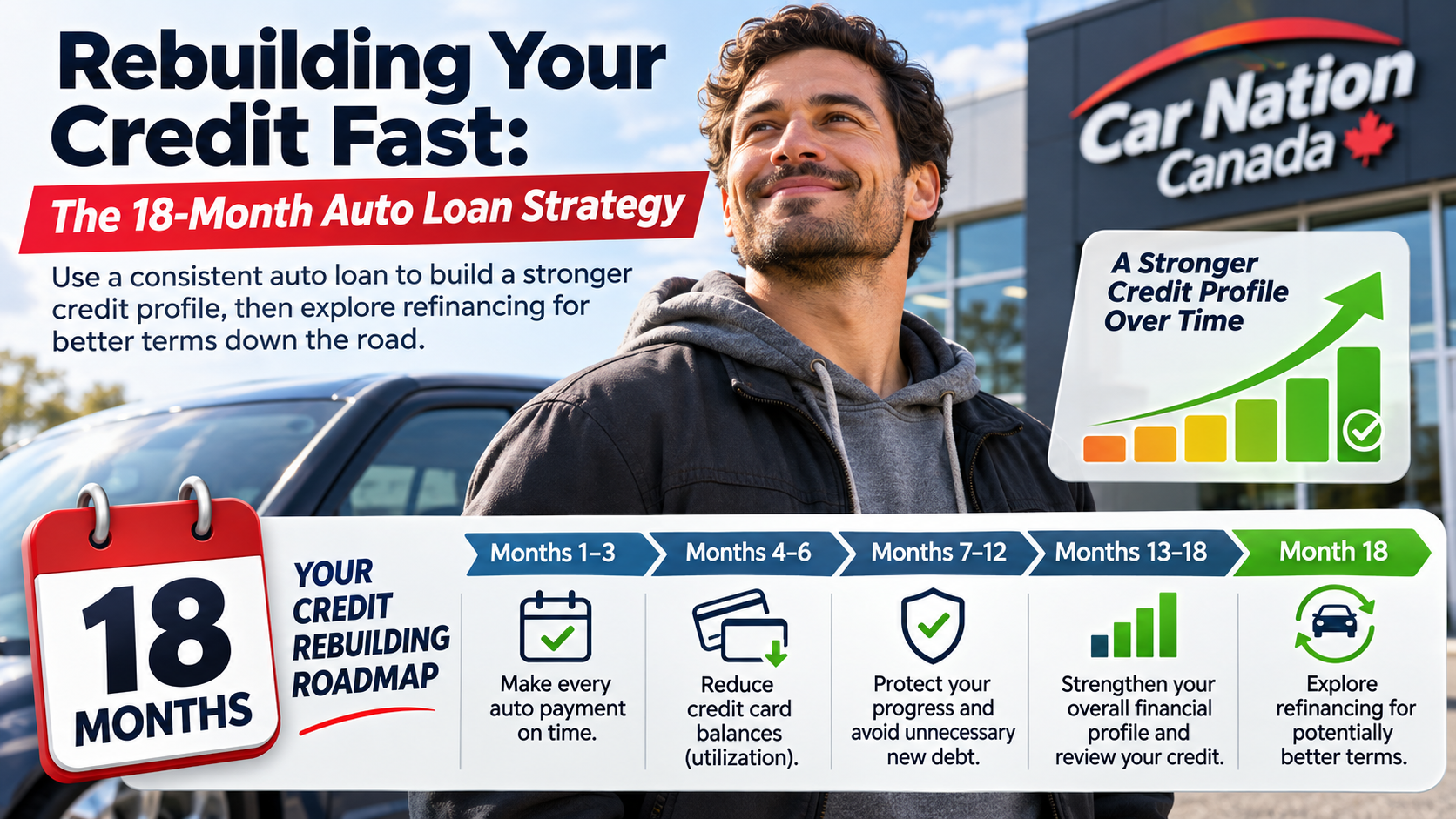
Rebuilding Your Credit Fast: The 18-Month Auto Loan Strategy
A higher-interest car loan does not necessarily have to be your forever loan. With 18 months of disciplined payments and responsible credit management, you may be able to strengthen your credit profile and put yourself in a better position to explore refinancing or improved borrowing terms.
If your credit score took a hit because of missed payments, collections, a consumer proposal, bankruptcy, high balances or simply a lack of established credit, getting approved for an auto loan may come with a higher interest rate.
That can be frustrating.
But getting approved can also become the beginning of your credit rebuilding strategy rather than the end of it.
For drivers in Burlington, Hamilton, Oakville, Milton, Mississauga, Grimsby and communities across Southern Ontario, one potential approach is what we call the 18-Month Auto Loan Strategy.
The goal is simple: finance a vehicle that comfortably fits your budget, make every payment on time, improve the rest of your credit profile at the same time, and then review your financing options once you have established a stronger track record.
There are no guaranteed credit-score increases or guaranteed refinancing approvals. But consistent payment history matters. Equifax Canada identifies payment history as one of the major factors used in calculating credit scores, with payment history generally representing about 35% in its example breakdown.
Key Takeaways
- An auto loan can contribute positive payment history when payments are reported to a credit bureau.
- Making every payment on time is one of the most important parts of rebuilding credit.
- Do not deliberately borrow more money than you need simply to build credit.
- Your credit card utilization, outstanding collections, new inquiries and overall debt also matter.
- Months 12 through 18 can be a logical time to review your progress.
- A stronger credit profile may help you qualify for better financing terms, but a lower rate is never guaranteed.
- Refinancing should be based on the total cost of borrowing, not simply getting a lower monthly payment.
- Car Nation Canada can help you review auto financing options for a wide range of credit situations. Financing is O.A.C. and conditions may apply.
Why an Auto Loan Can Help Rebuild Credit
Credit scores are designed to help lenders predict how likely a borrower is to repay future obligations.
One of the strongest pieces of information lenders can review is how you handled credit in the past.
Equifax Canada identifies several major factors that can influence credit scores, including:
- Payment history
- Used credit versus available credit
- Length of credit history
- Credit mix
- Credit inquiries
An auto loan is an instalment loan. If your lender reports your account and you continuously make payments as agreed, those payments can become part of your credit history.
Equifax specifically notes that paying debts on time is one of the best things consumers can do to help improve their credit scores.
That is why an affordable auto loan can potentially serve two purposes.
First, it gets you into reliable transportation.
Second, it gives you an opportunity to establish a consistent record of meeting a significant financial obligation.
But the word affordable is critical.
Month 0: Start With the Right Vehicle and Loan
The 18-month strategy begins before you sign anything.
If your objective is rebuilding credit, buying the most expensive vehicle you can possibly qualify for is usually the wrong approach.
You want a payment you can comfortably make even when life gets expensive.
Before shopping, calculate what you can realistically afford after accounting for:
- Rent or mortgage
- Utilities
- Groceries
- Insurance
- Fuel
- Childcare
- Existing debt payments
- Emergency savings
- Vehicle maintenance
Then explore the current Car Nation Canada inventory with that budget in mind.
A reliable used sedan, SUV, minivan or truck that comfortably fits your finances may be more useful to your long-term financial position than stretching your budget for a more expensive vehicle.
If credit rebuilding is the goal, sustainability wins.
Months 1–3: Your First Job Is Simple — Never Be Late
During your first three months, your biggest objective should be boring consistency.
Make the payment.
Then make the next one.
Then the next one.
Set up automatic payments if possible and make sure enough money is in the account before each withdrawal.
Equifax says payment history is generally one of the most important factors affecting credit scores and recommends paying debts on time.
A single late payment can work against the exact history you are trying to establish.
One practical strategy is to maintain a separate buffer in your bank account equal to at least one car payment.
That way an unexpected expense does not immediately put your auto payment at risk.
Months 4–6: Attack Credit Card Utilization
Your auto loan should not be the only part of your credit strategy.
If you have revolving credit such as credit cards or lines of credit, pay close attention to the balances you are carrying compared with your available limits.
Equifax identifies used credit versus available credit as another major component considered by credit scoring models.
For example, somebody with a $5,000 credit limit who continually carries a $4,700 balance is using a very large percentage of their available revolving credit.
Even if they make the minimum payment every month, that high utilization can affect their credit profile.
During months four through six, direct extra cash toward reducing revolving balances where practical.
Do not max your cards back out after paying them down.
The objective is to demonstrate that you can manage both an instalment obligation and revolving credit responsibly.
Months 7–12: Protect the Progress You Have Made
Once you have established six months of consistent payments, keep going.
This is where some borrowers make a mistake.
They see an improving credit score and immediately start applying for:
- New credit cards
- Personal loans
- Store financing
- Another vehicle
- Increased credit limits
Be selective.
Applying for new credit can result in hard inquiries. Equifax notes that hard inquiries may affect credit scores, although scoring models may treat multiple auto-loan inquiries made within a defined shopping period differently.
Your goal during this stage is not to collect more credit.
Your goal is to demonstrate stability.
Continue making every auto payment on time, keep revolving balances controlled and avoid unnecessary new debt.
What If Your Credit Was Damaged by a Consumer Proposal or Bankruptcy?
Credit recovery does not happen overnight.
If you have recently completed or are working through a consumer proposal, bankruptcy or another major financial setback, your credit report may continue reflecting that history for a period of time.
That does not mean you cannot begin building positive information alongside it.
The important part is establishing new habits and sticking with them.
At Car Nation Canada, our approach is not about judging why somebody experienced credit problems.
Job loss happens.
Divorce happens.
Illness happens.
Businesses fail.
Bills pile up.
People move to Canada without an established Canadian credit file.
Financial situations change.
What matters when rebuilding is what happens next.
Our finance team can help shoppers understand financing options that may be available for many different credit situations.
All financing is O.A.C. Conditions may apply.
Months 13–18: Start Preparing for Your Credit Review
After a year of consistent payments, you may have considerably more positive payment history than you had when the loan began.
That does not mean your credit score will automatically increase by a certain number of points.
There are many credit scoring models, and Equifax explains that scores can differ depending on the bureau, scoring model and information being reported.
Instead of obsessing over one exact number, look at the overall picture.
Ask yourself:
- Have all 12 to 18 auto payments been made on time?
- Have I eliminated any past-due accounts?
- Have my credit card balances decreased?
- Have I avoided unnecessary new credit applications?
- Has my employment remained stable?
- Has my income increased?
- Do I have money saved?
- Is my current vehicle worth a reasonable amount relative to the remaining loan balance?
Those questions matter when determining whether it makes sense to investigate refinancing.
Month 18: Should You Refinance Your Car Loan?
This is where the strategy can potentially pay off.
Suppose you originally needed a higher-rate auto loan because your credit profile was weak.
You have now spent approximately 18 months:
- Making every payment on time
- Reducing other debt
- Avoiding late payments
- Keeping credit card balances manageable
- Maintaining stable employment
- Building positive credit history
It may be worth reviewing whether you qualify for different financing terms.
The important word is reviewing.
Eighteen months is not a magical refinancing deadline.
Some borrowers may become eligible for improved terms sooner.
Others may need considerably longer.
And some borrowers may already have a loan where refinancing would provide little or no financial advantage.
A Lower Payment Does Not Always Mean a Better Loan
This is one of the biggest refinancing traps.
Imagine you have four years remaining on your existing loan.
Someone offers to refinance that balance over seven years.
Your monthly or bi-weekly payment may become significantly lower.
That sounds attractive.
But stretching the debt over several additional years can increase your total borrowing cost and keep you in debt much longer.
When evaluating refinancing, compare:
- Current interest rate
- Proposed interest rate
- Current balance
- Remaining term
- New term
- Total interest remaining
- Total interest under the proposed loan
- Fees, if applicable
Do not judge a refinance solely by the payment.
Look at what the loan will cost from beginning to end.
Can You Refinance Into a Prime Auto Loan After 18 Months?
Possibly.
But nobody can responsibly promise that.
A stronger credit score may improve your likelihood of receiving favourable lending terms, but lenders can consider much more than the score itself.
Equifax notes that lenders may also consider factors such as employment, income and other financial information when making lending decisions.
Auto lenders may also evaluate factors such as:
- Vehicle age
- Vehicle mileage
- Current loan balance
- Vehicle value
- Income
- Employment history
- Debt obligations
- Payment history
That is why we prefer thinking of month 18 as a financial checkpoint, not a guaranteed prime-rate date.
The Auto Loan Alone Is Not Enough
This is another important point.
You cannot make your car payment perfectly for 18 months while ignoring every other account and expect the auto loan to fix everything.
Your entire credit profile matters.
Equifax lists factors including payment history, utilization, length of credit history, credit mix and inquiries as components credit scoring models may consider.
Think of the auto loan as one piece of a larger credit rebuilding plan.
The strongest strategy generally looks more like this:
Auto loan: Paid on time every time.
Credit cards: Balances controlled and payments made on schedule.
Utilities and other obligations: Paid consistently.
New credit: Applied for selectively.
Old debts: Addressed where possible.
Budget: Maintained realistically.
Savings: Gradually rebuilt.
There is no shortcut that replaces responsible financial behaviour.
Should You Take Out a Car Loan Just to Build Credit?
Generally, you should not borrow money you do not need simply because you want a higher credit score.
Interest costs real money.
If you already need reliable transportation and financing is necessary, responsible management of that financing can become part of your credit rebuilding strategy.
That is very different from deliberately taking on unnecessary debt.
Your vehicle should first solve a transportation need.
Credit rebuilding is a potential secondary benefit.
Start With a Vehicle You Can Actually Afford
The best 18-month credit rebuilding strategy falls apart if the payment is too high from day one.
Start by browsing Car Nation Canada's current vehicle inventory and focus on vehicles that realistically fit your budget.
If financing is required, our Car Nation Canada finance team can review options available for many different credit situations and help you understand the terms before making a decision.
Whether you are shopping from Burlington, Hamilton, Oakville, Milton, Mississauga, Grimsby, Brantford or elsewhere in Southern Ontario, the objective should be the same:
Get the right vehicle. Get a manageable payment. Build a flawless payment history. Then review your options once your financial position has improved.
Financing is O.A.C. Conditions may apply.
Conclusion: Think Beyond Today's Interest Rate
A bad credit score today does not necessarily mean you will always pay higher borrowing costs.
Your financial history continues to develop.
Every month represents another opportunity to demonstrate responsible credit management.
If an auto loan is part of your rebuilding strategy, think in stages:
Months 1–3: Establish perfect payment habits.
Months 4–6: Reduce revolving debt.
Months 7–12: Protect your progress.
Months 13–18: Strengthen the rest of your financial profile.
Month 18: Review your credit and determine whether better financing options may now be available.
No lender or dealership can guarantee exactly how much your credit score will increase or promise that refinancing will result in a prime interest rate.
But responsible credit behaviour can move you in the right direction.
For additional education on how payment history, utilization and other factors affect Canadian credit scores, visit Equifax Canada's credit education centre.
And when you are ready to explore your next vehicle or financing options, Car Nation Canada can help you understand what may be available based on your individual situation.
Frequently Asked Questions
Can an auto loan help rebuild my credit?
It can contribute to your credit history when the lender reports the account to a credit bureau and you make payments as agreed. Payment history is an important component of credit scoring models. However, your overall credit profile also matters.
How much can my credit score increase after 18 months of car payments?
There is no reliable way to predict an exact increase. Credit scores depend on numerous factors, and different lenders and credit bureaus may use different scoring models.
Can I refinance my car after 18 months?
You may be able to apply for refinancing at that point, but approval and the terms offered depend on your credit profile, income, vehicle, loan balance and lender requirements. Refinancing is subject to approval.
Will I automatically qualify for a prime interest rate?
No. Eighteen months of perfect payments does not guarantee prime financing. The purpose of the strategy is to build a stronger borrowing profile so that you may have better options to explore later.
What should I do first if I have bad credit and need a vehicle?
Start with your budget rather than the vehicle. Determine what payment you can comfortably afford, review available vehicles within that range and speak with the Car Nation Canada finance team about financing options that may fit your situation.
O.A.C. — On Approved Credit. Conditions may apply.