
PHEV vs. Gas in Ontario Winters: The Real Fuel Cost of the Wrangler 4xe at -15°C
PHEV vs. Gas in Ontario Winters: The Real Fuel Cost of the Wrangler 4xe at -15°C
Posted on August 28, 2026
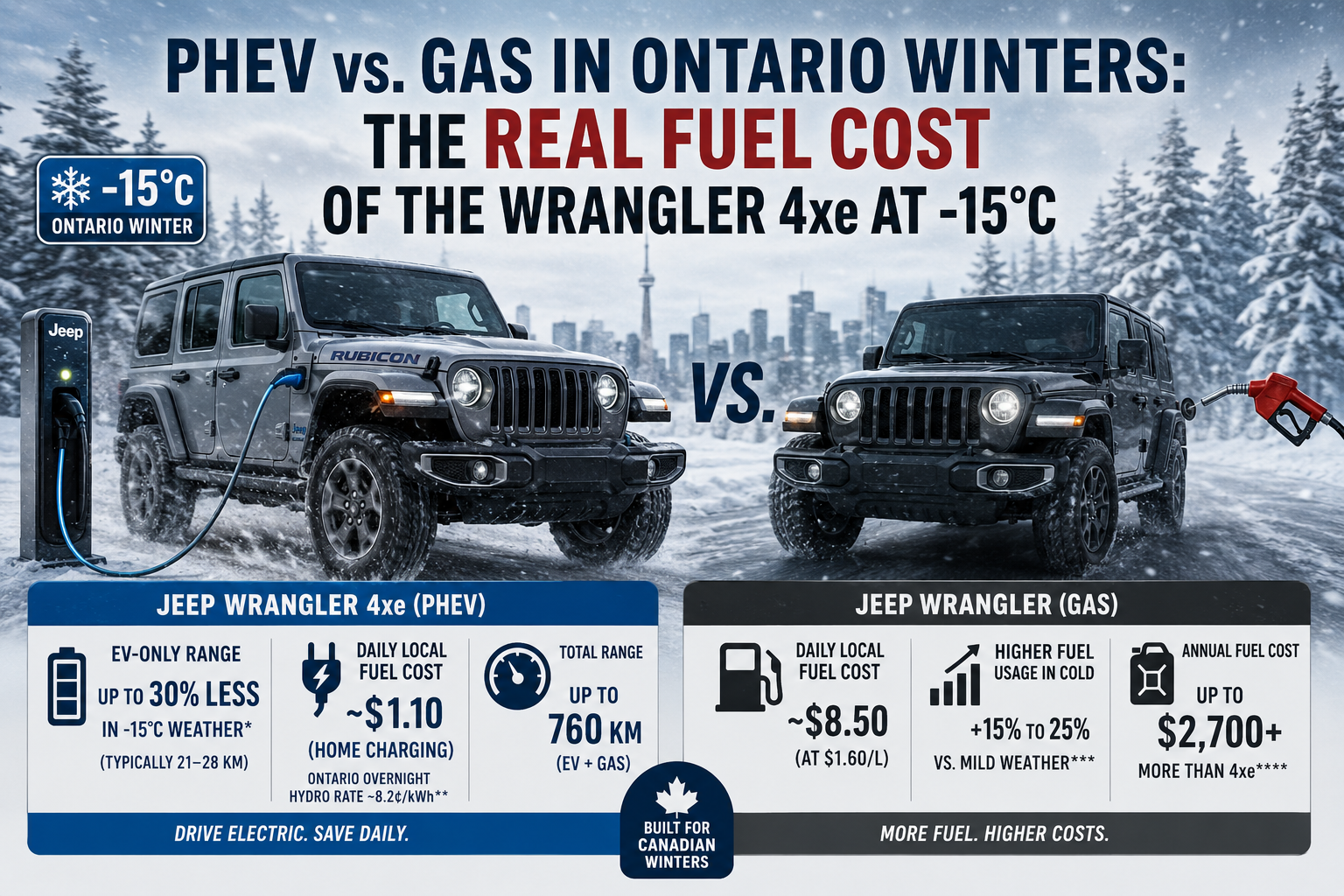
PHEV vs. Gas in Ontario Winters: The Real Fuel Cost of the Wrangler 4xe at -15°C
Does a Jeep Wrangler 4xe still save money when an Ontario cold snap cuts electric range? The answer depends less on headline EV range and more on how far you drive, when you charge, and how often the gasoline engine actually needs to run.
Ontario drivers hear the same criticism every winter: plug-in hybrids are great in September, but once the temperature drops to -15°C, the battery range disappears and you might as well have bought a gasoline SUV.
There is some truth behind the concern. Batteries are less efficient in extreme cold, cabin heating consumes energy, winter tires increase rolling resistance, and snowy roads demand more power. But that does not automatically make a plug-in hybrid such as the Wrangler 4xe more expensive to operate than a gas-only Wrangler.
For commuters around Burlington, Hamilton, Oakville, and Milton, the more useful question is this:
How much of your normal winter driving can still be powered by inexpensive overnight electricity before gasoline takes over?
Key Takeaways
- Extreme cold can reduce EV range by roughly 25% to 30%, and Canadian winter testing has recorded even larger losses depending on the vehicle and conditions.
- A 30% winter range loss does not mean operating costs automatically increase by 30%.
- Ontario's Ultra-Low Overnight electricity plan currently prices the electricity commodity at 3.9¢/kWh from 11 p.m. to 7 a.m., although delivery, regulatory charges and taxes still apply.
- Jeep's 2025 Wrangler 4xe specifications cite roughly 40 km of pure-electric operation and a 17-kWh battery pack, depending on test cycle, conditions and market.
- At -15°C, the Wrangler 4xe's gasoline engine may operate for thermal protection or cabin heating, so drivers should not expect guaranteed gasoline-free operation.
- The biggest winter savings generally go to drivers who plug in consistently and make frequent local trips rather than relying primarily on long highway drives.
How Much Wrangler 4xe Range Can You Lose at -15°C?
Cold-weather EV range loss is real.
Natural Resources Canada says electric vehicles can lose approximately 25% to 30% of their range in extreme cold. CAA's Canadian winter test, conducted in temperatures between roughly -7°C and -15°C, found vehicles travelled 14% to 39% less than their official range, depending on the model.
The Wrangler 4xe was not part of that CAA battery-electric test, so applying an exact 30% reduction to the 4xe should be treated as an illustration rather than a measured Wrangler-specific result.
Still, it gives Ontario shoppers a useful scenario.
If we start with approximately 40 km of nominal electric operation, a 30% reduction would leave:
40 km × 70% = approximately 28 km
That is substantially less electric range.
But 28 km is not zero.
For someone driving from home to work, school, shopping, appointments or errands within Burlington and nearby communities, that remaining electric distance can still cover a significant portion of the day's driving.
PHEV vs. Gas in an Ontario Winter: What Does 28 km Actually Cost?
This is where the debate becomes more interesting.
The 2025 Wrangler 4xe uses a roughly 17-kWh high-voltage battery pack.
Ontario's Ultra-Low Overnight electricity pricing information currently lists an electricity commodity rate of 3.9¢/kWh between 11 p.m. and 7 a.m.
At that commodity rate, 17 kWh represents roughly:
17 kWh × $0.039 = $0.66
That is not your complete charging bill. Electricity delivery, regulatory charges, taxes, charging losses and your household's specific rate plan matter.
So $0.66 should not be advertised as the final cost of a charge.
For a more conservative comparison, Natural Resources Canada uses $0.18/kWh when calculating estimated vehicle energy costs.
Using that higher benchmark:
17 kWh × $0.18 = approximately $3.06
Now compare that with a gas-only four-door Wrangler.
Jeep Canada currently lists a 2.0-litre automatic four-door Wrangler configuration at approximately 11.3 L/100 km combined.
Over 28 km:
28 km × 11.3 L/100 km = approximately 3.16 L of gasoline
Using NRCan's illustrative regular-gasoline benchmark of $1.50/L:
3.16 L × $1.50 = approximately $4.75
That creates a simplified comparison of approximately $3.06 in electrical energy versus $4.75 in gasoline over the same 28 km.
And remember: the $3.06 electricity figure uses a much higher 18¢/kWh benchmark rather than Ontario's 3.9¢/kWh Ultra-Low Overnight commodity price.
Actual results will vary.
The Important Catch: At -15°C, Your Wrangler 4xe May Start the Engine
This is one detail that should not be buried.
A Wrangler 4xe is a plug-in hybrid, not a battery-electric vehicle.
According to the Wrangler 4xe owner's information, Electric Mode can temporarily become unavailable for several reasons. Cold powertrain components can require warm-up, and the vehicle may use engine heat when outside temperatures are low enough that electric cabin heating reaches its limits.
At -15°C, therefore, you should not assume that every kilometre within the theoretical winter battery range will be gasoline-free.
The engine may run.
That does not mean the battery is useless. It means winter operation becomes blended.
Electricity can still provide propulsion and reduce the amount of work demanded from the gasoline engine while the PHEV system manages temperature, cabin comfort and available battery power.
For an Ontario shopper comparing PHEV vs. gas, that distinction matters more than an advertised EV-range number.
Gas Vehicles Lose Efficiency in Ontario Winters Too
Cold weather is not an EV-only problem.
Natural Resources Canada notes that colder weather increases fuel consumption in internal-combustion vehicles as well. A drop from 24°C to 7°C can increase fuel consumption on urban trips by an estimated 12% to 28%. Snow, ice and poor winter road surfaces can increase consumption further because of added rolling resistance and wheel slip.
Winter also brings:
- denser air and greater aerodynamic resistance;
- winter tires and softer rubber compounds;
- longer warm-up periods;
- heated seats and mirrors;
- defrosting;
- headlights operating more often; and
- snow, slush and standing water.
So the fair comparison is not a cold Wrangler 4xe against a gasoline Wrangler operating under perfect summer conditions.
Both vehicles pay a winter efficiency penalty.
The 4xe simply has two energy sources available to manage it.
Where the Wrangler 4xe Winter Fuel-Cost Advantage Is Strongest
Consider a commuter living in Grimsby who drives mostly around town during the week.
They charge overnight.
Their weekday driving consists of a commute, school pickup and local shopping. Most days are relatively short. Once or twice a month, they drive farther along the QEW toward Hamilton, Burlington or Niagara.
That pattern is where a PHEV makes the most sense.
Local kilometres can use a large share of the available battery energy, while the gasoline engine remains available for longer trips, exceptionally cold starts or situations where additional power and heat are needed.
Contrast that with a driver commuting 100 km or more every day at highway speeds without charging at work.
Once the usable battery energy is consumed, the 4xe carries its battery and hybrid hardware while operating largely on gasoline. Its fuel-cost advantage can shrink considerably.
A PHEV rewards charging frequency and trip matching.
Is Highway Driving Different?
Yes.
Winter highway driving is one of the tougher situations for electric efficiency.
At higher speeds, aerodynamic drag becomes increasingly important. Cold air is denser, cabin heat remains active and there are fewer opportunities for regenerative braking than on a stop-and-go urban route.
If your typical winter day involves a long highway run between Brantford and Burlington, for example, you should not evaluate a Wrangler 4xe solely on its local EV range.
Look at your entire trip.
For some drivers, strategically preserving battery energy for slower urban portions of the route can make more sense than consuming it all at highway speed. Jeep's E-Selec system includes Hybrid, Electric and eSave operation specifically to give drivers more control over how battery energy is used.
How to Get More Value From a Wrangler 4xe in Winter
Charging regularly is the biggest factor.
A PHEV that is rarely plugged in loses much of the reason for carrying a large rechargeable battery in the first place.
Whenever practical, charging overnight can allow Ontario households enrolled in the ULO price plan to shift charging into the lowest commodity-price period.
Preconditioning while connected to power can also help. Natural Resources Canada notes that warming an electrified vehicle while it is plugged in can reduce the amount of stored battery energy needed for cabin heating after departure.
And don't overlook basic winter efficiency habits. Correct tire pressure matters because tire pressure drops as temperatures fall. Snow-covered vehicles also carry extra weight and aerodynamic drag.
None of these tricks eliminates the impact of -15°C.
They simply help you use the energy you already purchased more effectively.
So, Is the Wrangler 4xe Useless in an Ontario Winter?
No.
But neither is it a magic loophole that guarantees gasoline-free driving through every Southern Ontario cold snap.
At -15°C, you should expect less electric range. You should also expect that the gasoline engine may occasionally run even when battery charge remains.
The more important financial question is how many kilometres you can still shift away from gasoline over an entire week, month or winter.
A driver regularly charging at home and covering short local trips around Burlington, Oakville, Hamilton, Milton or Grimsby can still make meaningful use of inexpensive electricity.
Someone doing predominantly long-distance highway driving may see a smaller advantage.
That's why we recommend comparing the vehicle with your actual commute, not someone else's fuel-economy screenshot.
If the Wrangler 4xe fits your driving pattern, you can browse Car Nation Canada's current new and used vehicle inventory and compare your options based on daily kilometres, charging access, trade-in value and total ownership budget.
If monthly payment is part of the decision, our team can also walk you through financing and pre-approval options for many credit situations. Financing is O.A.C. — On Approved Credit. Conditions may apply.
Find Jeep Wrangler 4xe's for sale here at Unique Chrysler
Frequently Asked Questions
How much EV range can a Wrangler 4xe lose at -15°C?
There is no single guaranteed percentage for every Wrangler 4xe. Natural Resources Canada says EVs can lose approximately 25% to 30% of range in extreme cold, while CAA testing of battery-electric vehicles at roughly -7°C to -15°C found losses ranging from 14% to 39%. Driving speed, cabin heat, wind, snow and battery temperature all affect the result.
Will a Wrangler 4xe stay in Electric Mode at -15°C?
Not necessarily. Jeep's owner information says Electric Mode can become temporarily unavailable when components are too cold or when additional cabin heat is required. The gasoline engine may therefore start even with battery charge remaining.
Is charging a PHEV cheaper overnight in Ontario?
It can be. Ontario's Ultra-Low Overnight plan currently lists a 3.9¢/kWh commodity rate from 11 p.m. to 7 a.m. Your total electricity bill also includes other charges, so the commodity price alone should not be treated as the final cost of charging.
Is a Wrangler 4xe better for short trips or highway commuting?
Its fuel-cost advantage is generally easier to maximize when regular trips fit within a meaningful portion of the available electric range and the vehicle is recharged frequently. Long highway commutes can consume the battery relatively quickly, after which gasoline plays a larger role.
Should I buy a Wrangler 4xe purely to save money on fuel?
Fuel cost should be one part of the decision, not the only part. Compare purchase price, financing, insurance, charging access, annual kilometres, trade-in value and how often your normal driving fits within electric range. Our team can help you compare those numbers before you decide.