
Making the Right Call Between Fixed and Variable Auto Loans in Ontario
Making the Right Call Between Fixed and Variable Auto Loans in Ontario
Posted on October 19, 2026
Making the Right Call Between Fixed and Variable Auto Loans in Ontario
The Dealership Insider | Car Nation Canada
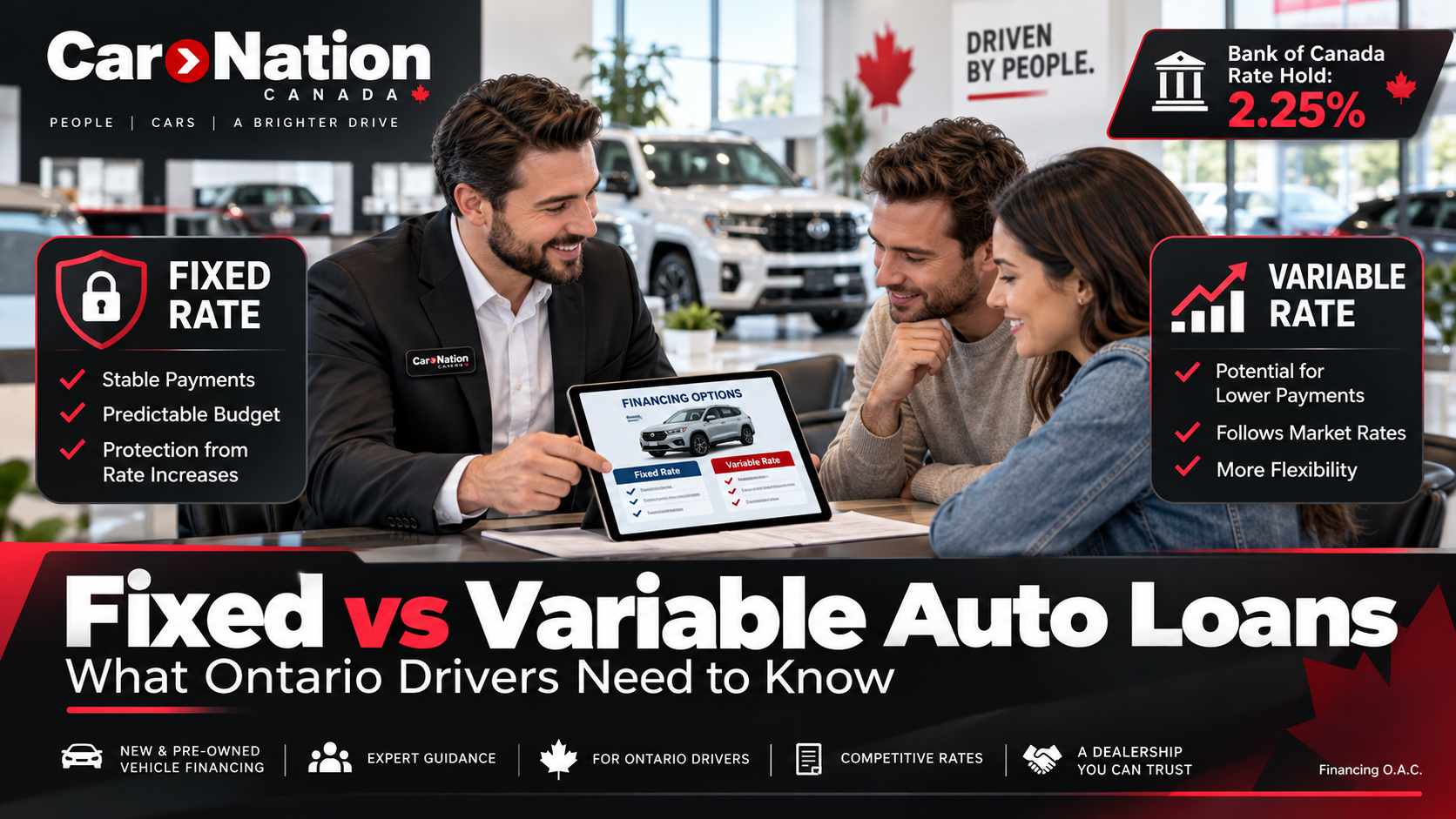
With the Bank of Canada holding its key interest rate at 2.25%, Ontario drivers have an important financing decision to make. Should you lock in a fixed-rate auto loan or explore a variable-rate option? Let's break down the differences and help you make a smarter financial decision.
Understanding Your Auto Financing Options in 2026
Buying a vehicle is exciting. Whether you're upgrading your family SUV, replacing an older commuter car, or finally purchasing that pickup truck you've been eyeing, there's one decision that deserves just as much attention as the vehicle itself: how you're going to finance it.
For drivers across Burlington, Oakville, Hamilton, Milton, Mississauga, and the Greater Toronto Area, choosing between fixed and variable interest rates can make a significant difference in monthly affordability and long-term borrowing costs.
With interest rates frequently making headlines, understanding your options is more important than ever.
The good news? You don't need to be a financial expert to make an informed decision.
The Bank of Canada Is Holding at 2.25%. What Does That Mean?
As of October 19, 2026, the Bank of Canada's target overnight interest rate stands at 2.25%, following its September decision to maintain the rate.
For Ontario consumers considering vehicle financing, this period of stability creates an opportunity to review available borrowing options and evaluate long-term affordability.
But here's something many drivers don't realize.
The Bank of Canada's 2.25% policy rate is NOT the interest rate you'll automatically receive on your car loan.
The central bank's overnight rate influences the lending environment, including financial institutions' borrowing costs and prime lending rates.
Your actual auto financing rate depends on several factors, including your credit history, income, lender, financing term, the vehicle you're purchasing, and any available manufacturer incentives.
And while the Bank of Canada influences borrowing costs, the relationship between its policy rate and individual vehicle loans isn't always immediate or straightforward.
That's why understanding the difference between fixed and variable financing is so important.
For official updates, visit the Bank of Canada Key Interest Rate Announcements.
Fixed-Rate Auto Loans: Stability and Peace of Mind
A fixed-rate auto loan is exactly what it sounds like.
Your interest rate remains unchanged throughout the entire financing agreement.
For example, if you finance a vehicle at 6.99% for 72 months, your contractual interest rate remains at 6.99%, even if the Bank of Canada raises interest rates next year.
With a conventional fixed-rate installment loan, your regularly scheduled payment generally remains the same from beginning to end.
Advantages of Fixed-Rate Auto Financing
1. Predictable Monthly Payments
You know exactly what your vehicle payment will be, making it easier to manage your household budget.
2. Protection Against Rising Interest Rates
If market interest rates increase, your existing fixed-rate loan remains protected from those increases.
3. Easier Financial Planning
For Ontario households managing mortgage payments, rent, groceries, insurance, and everyday living expenses, having one predictable payment can provide valuable peace of mind.
4. Less Financial Uncertainty
You won't need to monitor every Bank of Canada announcement to determine whether your existing vehicle payment is about to increase.
The Potential Downside
If interest rates drop significantly, your fixed-rate loan won't automatically become cheaper.
You may have the option to refinance, but refinancing depends on lender approval, your remaining balance, vehicle value, and the terms of the replacement loan.
For many Ontario drivers, however, the predictability of fixed-rate financing is a major advantage.
Variable-Rate Auto Loans: Potential Savings With Added Risk
A variable-rate auto loan works differently.
Instead of keeping the same interest rate throughout your financing term, a variable rate can change according to a lender's benchmark, such as its prime lending rate.
If the benchmark decreases, your interest costs may also decrease.
However, if interest rates increase, your borrowing costs can rise.
It's important to understand that variable-rate auto loans are less common than fixed-rate loans in Canada's mainstream dealership financing market.
Availability varies by lender, and some variable-rate financing products may operate differently from conventional installment loans.
Potential Advantages of Variable-Rate Financing
1. Opportunity to Benefit From Falling Rates
If your lender's benchmark rate decreases, you may pay less interest.
2. Potentially Lower Starting Rates
Some variable-rate financing products may initially offer lower rates than comparable fixed-rate alternatives.
3. Financing Flexibility
Depending on the lender, some variable-rate products may include flexible repayment features.
The Potential Disadvantages
1. Interest Rates Could Rise
If the applicable benchmark rate increases, so could your borrowing costs.
2. Less Predictable Payments
Depending on the agreement, your required payment or repayment schedule may change as interest rates fluctuate.
3. More Difficult Long-Term Budgeting
Estimating total borrowing costs becomes harder when future interest rates are uncertain.
Variable-rate financing isn't necessarily a bad choice, but borrowers should understand the terms and ensure their budgets can accommodate potential changes.
Fixed vs. Variable Auto Loans: What's the Difference?
| Feature | Fixed-Rate Loan | Variable-Rate Loan |
|---|---|---|
| Interest rate | Remains unchanged | Can increase or decrease |
| Payment stability | Generally predictable | Depends on agreement |
| Protection from rate increases | Yes | No |
| Benefit from falling rates | Not automatic | Potentially |
| Budgeting | Easier | More uncertainty |
| Canadian dealership availability | Common | Less common |
| Best for | Stability and certainty | Borrowers comfortable with rate changes |
The bottom line: Neither option is automatically better for every borrower. The right financing choice depends on availability, interest rates, loan terms, and your individual financial situation.
How Much Can Interest Rates Affect Your Car Payment?
Let's look at a hypothetical Ontario vehicle purchase.
Imagine you're financing $30,000 over 60 months, with no down payment and no additional financed fees.
Here's how different interest rates would affect your monthly payment if each rate remained unchanged for the entire loan.
| Interest Rate | Approx. Monthly Payment |
|---|---|
| 4.99% | $566 |
| 5.99% | $580 |
| 6.99% | $594 |
| 7.99% | $608 |
| 8.99% | $623 |
These figures are illustrative, not current lender offers. They exclude taxes, insurance, and other fees.
As you can see, even modest differences in interest rates affect monthly payments.
Over five, six, or seven years, those differences can add up to thousands of dollars in total borrowing costs.
This is why comparing financing offers based only on the advertised monthly or biweekly payment can be misleading.
Always examine the total cost of borrowing before signing a financing agreement.
🇨🇦 Does a Stable Bank of Canada Rate Mean Fixed Financing Is Better?
Not necessarily.
While a stable interest rate environment provides some reassurance, it doesn't guarantee that borrowing costs will remain unchanged over the entire length of your vehicle loan.
Canada's economy continues to face uncertainties, including inflation pressures, energy costs, international trade developments, and changes in consumer spending.
For drivers across Southern Ontario, these factors reinforce the importance of choosing a financing arrangement that fits both current and future household budgets.
Ask Yourself These Three Questions
1. Could I comfortably afford a higher payment?
If an unexpected increase in your monthly expenses would create financial stress, predictable fixed-rate financing may be appealing.
2. How long do I intend to keep the vehicle?
If you're planning to drive your SUV, pickup truck, or sedan for many years, knowing your financing costs in advance can simplify long-term financial planning.
3. Am I comparing the complete financing offers?
A competitive fixed rate with a manufacturer incentive may ultimately cost less than a variable-rate product with a slightly lower initial rate.
The interest rate matters, but so do the loan term, fees, repayment conditions, and total financing costs.
What If You Have Bad Credit or Are Rebuilding Your Credit?
For Ontario drivers with less-than-perfect credit, choosing the right auto financing arrangement can be especially important.
If you've experienced missed payments, collections, bankruptcy, or other financial challenges, you may already be facing higher borrowing costs.
Adding interest rate uncertainty to an already tight budget could make repayment more difficult.
A fixed-rate loan with manageable payments may provide a more predictable path forward.
Making consistent, on-time payments can also help establish positive payment history when your lender reports the account to credit bureaus.
However, no auto loan can guarantee a specific credit score improvement, refinancing opportunity, or future financing approval.
At Car Nation Canada, we believe vehicle financing should reflect what you can comfortably afford, not simply the maximum amount a lender is willing to approve.
Whether you're purchasing your first vehicle, rebuilding your credit, or upgrading your current ride, understanding your financing options is an important first step.
Five Questions Every Ontario Car Buyer Should Ask
Before signing your next auto financing agreement, ask these five questions.
1. Is my interest rate fixed for the entire financing term?
Never assume an advertised financing rate works the same way as every other loan.
2. What is my total cost of borrowing?
Request a clear breakdown of the loan amount, interest costs, fees, and total repayment amount.
3. Can I pay off my auto loan early without penalties?
Understand your lender's prepayment conditions and whether you can make additional payments.
4. What happens if interest rates change?
If you're considering variable-rate financing, ask exactly how interest rate changes affect your payments or repayment schedule.
5. Are there any manufacturer financing incentives available?
Some new vehicles qualify for special promotional financing programs that may provide savings compared with conventional borrowing options.
Always confirm the eligibility requirements and the full terms of any advertised offer.
The Bottom Line: Choose the Auto Loan That Fits Your Life
For many Ontario drivers, fixed-rate auto financing offers a practical combination of stability, predictability, and peace of mind.
When you're already managing rising everyday expenses, knowing exactly what your vehicle payment will be can make budgeting easier.
Variable-rate financing may appeal to borrowers who are comfortable with changing borrowing costs and can access a competitive product.
But remember, the best financing decision isn't necessarily about predicting what the Bank of Canada will do next month.
It's about finding a payment and financing arrangement that remains affordable throughout your ownership experience.
A vehicle purchase should help move your life forward, not create unnecessary financial pressure.
Explore Your Auto Financing Options at Car Nation Canada
Whether you have excellent credit, are rebuilding your credit history, or simply want to understand your vehicle financing options, the team at Car Nation Canada is here to help.
We work with Ontario drivers throughout Burlington, Hamilton, Oakville, Milton, Mississauga, and the Greater Toronto Area to explore financing solutions suited to their individual circumstances.
From family-friendly SUVs and dependable commuter cars to hardworking pickup trucks and commercial vehicles, we're committed to helping drivers make informed decisions.
Ready to Get Started?
🚗 Find your next vehicle. Explore your financing options. Drive with confidence.
👉 Explore Auto Financing at Car Nation Canada
🏦 View the Latest Bank of Canada Interest Rate Announcements