
How to Use an Auto Loan Calculator in Canada: A Step-by-Step Guide to Smarter Car Financing
How to Use an Auto Loan Calculator in Canada: A Step-by-Step Guide to Smarter Car Financing
Posted on November 23, 2026
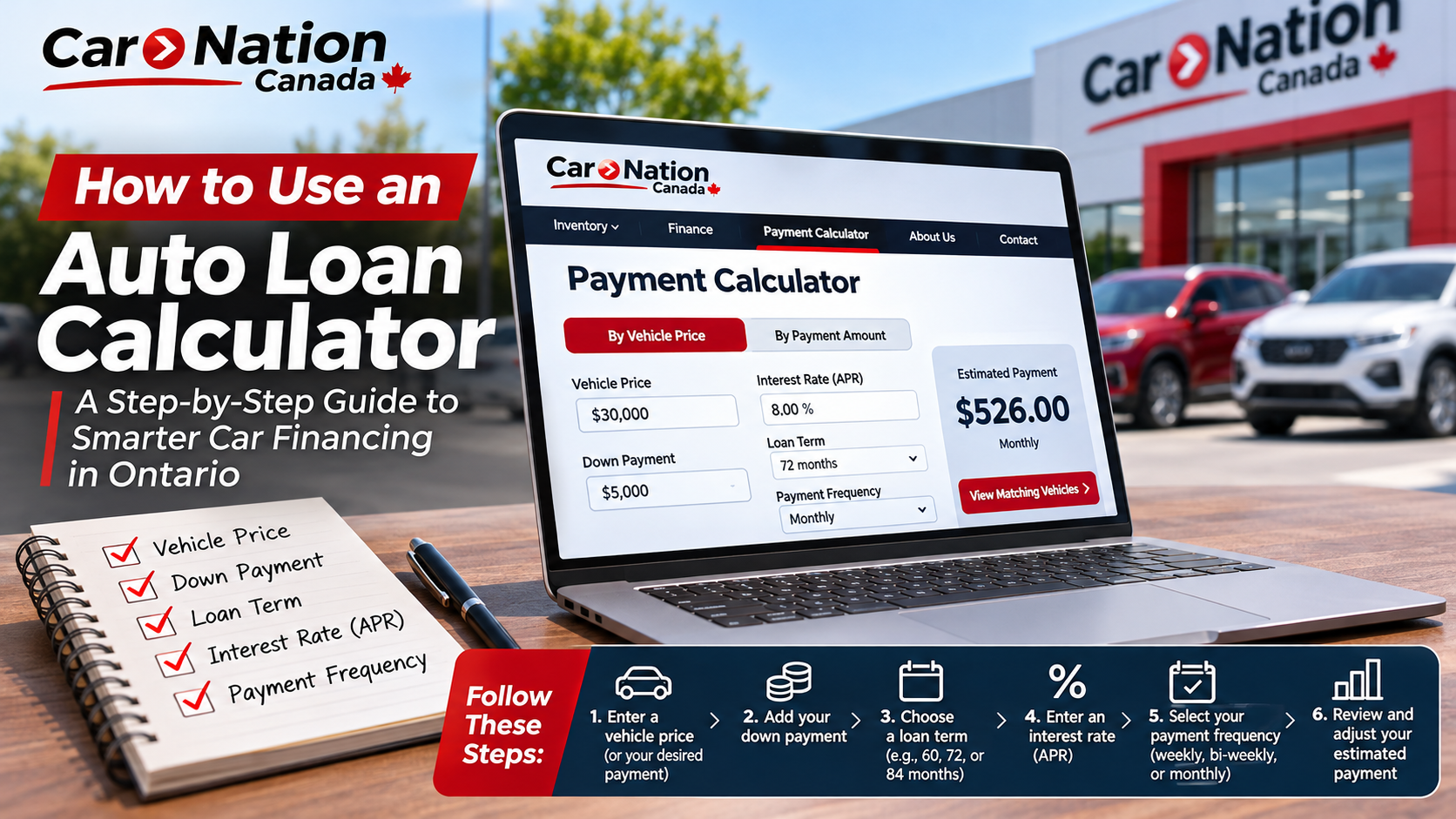
How to Use an Auto Loan Calculator in Canada: A Step-by-Step Guide to Smarter Car Financing
Learn how to use an auto loan calculator to estimate car payments, compare financing terms, understand interest rates, and find an affordable new or used vehicle in Ontario.
Buying a vehicle is exciting, but figuring out how much you can comfortably afford can be challenging. Between vehicle prices, interest rates, down payments, and loan terms, there are plenty of numbers to consider before signing a financing agreement.
Fortunately, learning how to use an auto loan calculator can make the process much easier.
At Car Nation Canada, we believe understanding your budget should come before choosing your next vehicle. Whether you're shopping for a fuel-efficient sedan, family SUV, pickup truck, or minivan, our free online auto loan calculator helps you explore estimated payments before visiting a dealership.
For drivers throughout Burlington, Hamilton, Oakville, Milton, Mississauga, and the Greater Toronto Area, it's a practical starting point for finding a vehicle that fits your lifestyle and finances.
Key Takeaways
- An auto loan calculator estimates your vehicle payments using the amount financed, interest rate, down payment, and loan term.
- Car Nation Canada's calculator lets you start with either a vehicle price or your preferred payment amount.
- You can explore weekly, bi-weekly, and monthly payment options.
- Longer financing terms generally lower individual payments but increase total interest costs.
- Calculator results are estimates, not financing approvals or guaranteed rates.
- Comparing several scenarios can help you choose a vehicle and financing arrangement that suits your budget.
What Is an Auto Loan Calculator?
An auto loan calculator is an online financial planning tool that estimates how much you could pay to finance a vehicle.
Instead of guessing whether a $25,000 sedan or $40,000 SUV fits your budget, you can explore different loan scenarios and see how financing decisions affect your estimated payments.
A typical car payment calculation considers:
- Vehicle price: The purchase price of the car, truck, SUV, or minivan.
- Down payment: Money you contribute upfront.
- Amount financed: The balance you're borrowing, including applicable taxes and financed charges.
- Annual Percentage Rate (APR): The annual cost of borrowing, expressed as a percentage.
- Loan term: How many months you'll take to repay the loan.
- Payment frequency: Whether you make weekly, bi-weekly, or monthly payments.
The best part? You can explore different payment scenarios before committing to a vehicle.
However, a calculator is a budgeting tool. Your final financing terms depend on lender approval, vehicle eligibility, and the details of your purchase.
How to Use the Car Nation Canada Auto Loan Calculator
Our calculator is designed to help shoppers explore affordable vehicles and understand how financing works.
Here's how to use it.
Step 1: Open the Car Payment Calculator
Start by visiting the Car Nation Canada Payment Calculator.
You'll see options for determining your vehicle budget.
You can approach the calculation in two ways:
Option A: Start with a vehicle price.
If you've already found a vehicle you like, enter its approximate price to explore potential payments.
Option B: Start with your preferred payment.
If you know how much you'd like to spend each week, every two weeks, or monthly, use that amount as your starting point.
This approach is particularly helpful for families balancing car payments with housing, groceries, childcare, and other expenses.
Step 2: Enter Your Down Payment
Next, indicate whether you plan to contribute a down payment.
A down payment reduces the amount of money you need to borrow.
For example, imagine you're considering a vehicle priced at $30,000 before applicable taxes.
If you contribute $5,000 toward the purchase, that reduces the purchase balance you need to finance before accounting for taxes and other applicable costs.
Larger down payments can help reduce your payments and total interest charges.
However, you don't necessarily need to empty your savings account to buy a vehicle.
Maintaining some financial flexibility for unexpected repairs, insurance deductibles, and household emergencies is equally important.
Step 3: Choose Your Auto Loan Term
Your loan term is the number of months you agree to make payments.
Common financing examples include:
- 48 months — four years
- 60 months — five years
- 72 months — six years
- 84 months — seven years
- 96 months — eight years
Available terms depend on the lender, vehicle, and credit approval.
Generally, choosing a longer term lowers your regular payment.
But there's an important trade-off: the longer you borrow, the more interest you generally pay.
For example, financing a used SUV over 84 months may appear more affordable than financing it over 60 months.
However, the longer arrangement could cost thousands of additional dollars in interest.
The Financial Consumer Agency of Canada recommends considering the total cost of financing rather than looking only at the payment amount.
Step 4: Select Your Payment Frequency
Our payment calculator allows you to explore three payment schedules:
Weekly payments
You make a payment every week. This may suit someone who gets paid weekly and prefers smaller, more frequent payments.
Bi-weekly payments
You make a payment every two weeks, usually resulting in 26 payments annually. This can work well for employees paid on a bi-weekly schedule.
Monthly payments
You make one payment each month. This option can be convenient for people who organize their household finances around monthly income and expenses.
Remember that bi-weekly does not mean twice per month. There are normally 26 bi-weekly payments in a year, compared with 24 semi-monthly payments.
Compare the annual and total costs when evaluating different payment frequencies.
Step 5: Enter an Estimated Interest Rate (APR)
The Annual Percentage Rate helps determine the cost of borrowing.
For example, a calculator scenario using an 8% APR will generally produce a different payment than one using 12%, assuming the same amount financed and loan term.
Your actual APR may depend on:
- Your credit history and credit score
- Your income and existing financial obligations
- The vehicle's age and other eligibility criteria
- The length and structure of the financing agreement
- The lender's assessment and approval requirements
If you're unsure what rate to enter, try several hypothetical rates rather than assuming you'll qualify for the lowest advertised option.
Our auto financing team can help you explore financing options available for many credit situations.
Financing is subject to lender approval. On Approved Credit (O.A.C.). Conditions may apply.
Step 6: Review Your Estimated Payment and Vehicle Budget
After entering your information, review the calculator's estimated payment and vehicle budget.
The tool also provides a way to view available vehicles related to your calculated budget.
This connects your financing research with actual vehicle shopping.
For example, if your preferred payment makes a particular SUV too expensive, you can explore a lower-priced vehicle, increase your down payment, or compare another financing scenario.
You can also browse our new and used vehicle inventory to find vehicles that suit your needs.
Step 7: Adjust the Numbers Until They Work for You
One of the biggest advantages of using an auto loan calculator is that you can experiment with different financing combinations.
Try changing one factor at a time.
Compare a $2,000 down payment with a $5,000 down payment.
Then compare a 60-month loan with a 72-month loan.
Finally, explore how different illustrative interest rates affect the result.
This process gives you a clearer picture of which factors have the greatest impact on affordability.
Auto Loan Calculator Example: Financing $30,000 in Ontario
Let's look at a realistic budgeting example.
Imagine you're financing a vehicle with the following assumptions:
- Total amount borrowed: $30,000 CAD
- Annual interest rate: 8.00%
- Fixed interest rate with standard monthly amortization
- No additional financing charges
- Payments made monthly
For this illustration, the $30,000 represents the total amount financed after any applicable taxes, down payment, and purchase-related charges.
Here's how changing the term affects your payments.
| Loan term | Est. monthly payment | Approx. total interest |
|---|---|---|
| 60 months | $608.29 | $6,498 |
| 72 months | $526.00 | $7,872 |
| 84 months | $467.59 | $9,277 |
Illustrative calculations only. Actual rates, payment schedules, lender methods, and borrowing costs may differ. O.A.C.
Notice the difference between 60-month and 84-month financing.
The longer term reduces your estimated monthly payment by approximately $141.
However, it also increases your total interest charges by approximately $2,780.
That's why understanding the full cost of a loan matters as much as finding a manageable payment.
Don't Forget Taxes, Insurance, and Other Vehicle Expenses
An affordable car payment does not necessarily mean the entire vehicle is affordable.
When setting your budget, consider expenses beyond the loan itself.
Ontario Sales Tax and Licensing
Ontario vehicle purchases commonly involve 13% HST when purchased from a registered dealership, along with applicable licensing costs.
Ontario's vehicle advertising requirements generally require mandatory dealer fees to be included in advertised prices, while HST and licensing may be excluded when clearly disclosed.
You can learn more about these requirements through the Ontario Motor Vehicle Industry Council's all-in pricing information.
Before comparing financing scenarios, confirm the total amount that will actually be financed.
Vehicle Insurance
Insurance premiums can vary significantly depending on the driver, vehicle, location, and coverage.
Get an insurance quote before purchasing, especially if you're moving from an older sedan into a newer SUV or pickup truck.
Fuel and Maintenance
Consider how far you drive each year.
Someone commuting daily from Milton to Mississauga may prioritize fuel economy differently from a driver who mainly makes short trips around town.
Winter tires, oil changes, brakes, and regular maintenance should also be included in your overall transportation budget.
How Does a Trade-In Affect Your Auto Loan Calculator Results?
Trading in your existing vehicle may reduce the amount you need to finance.
But the situation becomes more complicated when you still owe money on your current auto loan.
For example:
- Current vehicle trade-in value: $18,000
- Outstanding loan balance: $13,000
- Positive equity: $5,000
In this scenario, you potentially have $5,000 in positive trade equity to apply toward another vehicle.
Now consider the opposite situation.
If your vehicle is worth $18,000 but you owe $23,000, you have $5,000 in negative equity.
That remaining debt doesn't disappear when you trade the vehicle.
Depending on lender approval and the transaction structure, it may need to be paid separately or could be added to a new loan.
Our calculator does not present a dedicated trade-in payoff field in its main workflow, so ask our finance team to help incorporate outstanding debt and any applicable trade-in tax treatment into an accurate estimate.
Can You Use an Auto Loan Calculator With Bad Credit?
Absolutely.
An auto loan calculator is useful for budgeting regardless of your credit history.
Whether you're rebuilding your credit, buying your first vehicle, or establishing credit after moving to Canada, exploring different payment scenarios can help you understand what may be manageable.
However, the calculator does not determine whether you'll be approved.
Lenders assess applications individually, considering income, credit history, existing debt, and other factors.
If you're a payment-focused buyer rebuilding your finances, start with a comfortable monthly budget rather than choosing the most expensive vehicle that produces a seemingly affordable payment.
Our Car Nation Canada car loan pre-approval page is available when you're ready to explore financing options.
Three Common Auto Loan Calculator Mistakes to Avoid
1. Choosing the Longest Loan Simply for the Lowest Payment
Extended terms may help with monthly cash flow, but they can also increase total interest costs and the risk of owing more than the vehicle is worth.
2. Using an Unrealistic Interest Rate
Running calculations at a low promotional rate can produce misleading expectations if you don't qualify.
Compare multiple rates and request actual financing details before making your final decision.
3. Ignoring the Full Cost of Ownership
Your vehicle payment is just one part of your transportation budget.
Insurance, fuel, repairs, maintenance, and future replacement costs all matter.
A slightly less expensive vehicle with manageable operating costs may be a better financial fit.
Find a Vehicle That Fits Your Budget in Southern Ontario
Whether you're a first-time buyer in Burlington, a growing family in Oakville, or a daily commuter travelling through Hamilton, understanding your financing options can make vehicle shopping more comfortable.
At Car Nation Canada, we help Ontario drivers explore vehicles and financing solutions with their budgets in mind.
Our inventory includes a range of new and pre-owned sedans, SUVs, pickup trucks, and family vehicles.
Start by comparing your estimated payments, then explore our available inventory to find vehicles worth considering.
When researching a used vehicle, you can also try our free VIN check tool to explore available vehicle specifications and relevant lookup resources before making your decision.
A VIN lookup is a useful research step, but it doesn't replace a full vehicle history report or mechanical inspection.
Conclusion: Calculate First, Shop With Confidence
Knowing how to use an auto loan calculator puts you in a stronger position when shopping for your next vehicle.
You can estimate payments, compare terms, explore different financing scenarios, and set a budget before making a commitment.
More importantly, you can make decisions based on the total financial picture rather than a single payment amount.
Ready to discover what your next car could cost?
Try the Car Nation Canada Auto Loan Calculator today and take the first step toward finding a vehicle that fits your budget.
Frequently Asked Questions About Auto Loan Calculators
Is the Car Nation Canada auto loan calculator free?
Yes. Our online payment calculator is available to help shoppers estimate vehicle financing payments and explore different budget scenarios.
How accurate is an auto loan calculator?
A calculator can provide useful estimates when you enter accurate information. Final payments depend on your approved financing terms, applicable taxes, fees, down payment, and actual loan structure.
Can I calculate bi-weekly car payments?
Yes. The Car Nation Canada calculator offers weekly, bi-weekly, and monthly payment frequency options.
Is a 72-month car loan better than an 84-month loan?
Not necessarily. A 72-month loan generally has higher regular payments but lower total interest costs when compared with an 84-month loan at the same interest rate and amount financed. The best term depends on your budget, vehicle, and financial priorities.
Does using the calculator guarantee car loan approval?
No. Calculator results are estimates only. Auto financing depends on lender approval, creditworthiness, income, and applicable financing conditions. O.A.C.