
How to Get an Auto Loan With Minimum Wage in Ontario
How to Get an Auto Loan With Minimum Wage in Ontario
Posted on November 3, 2026
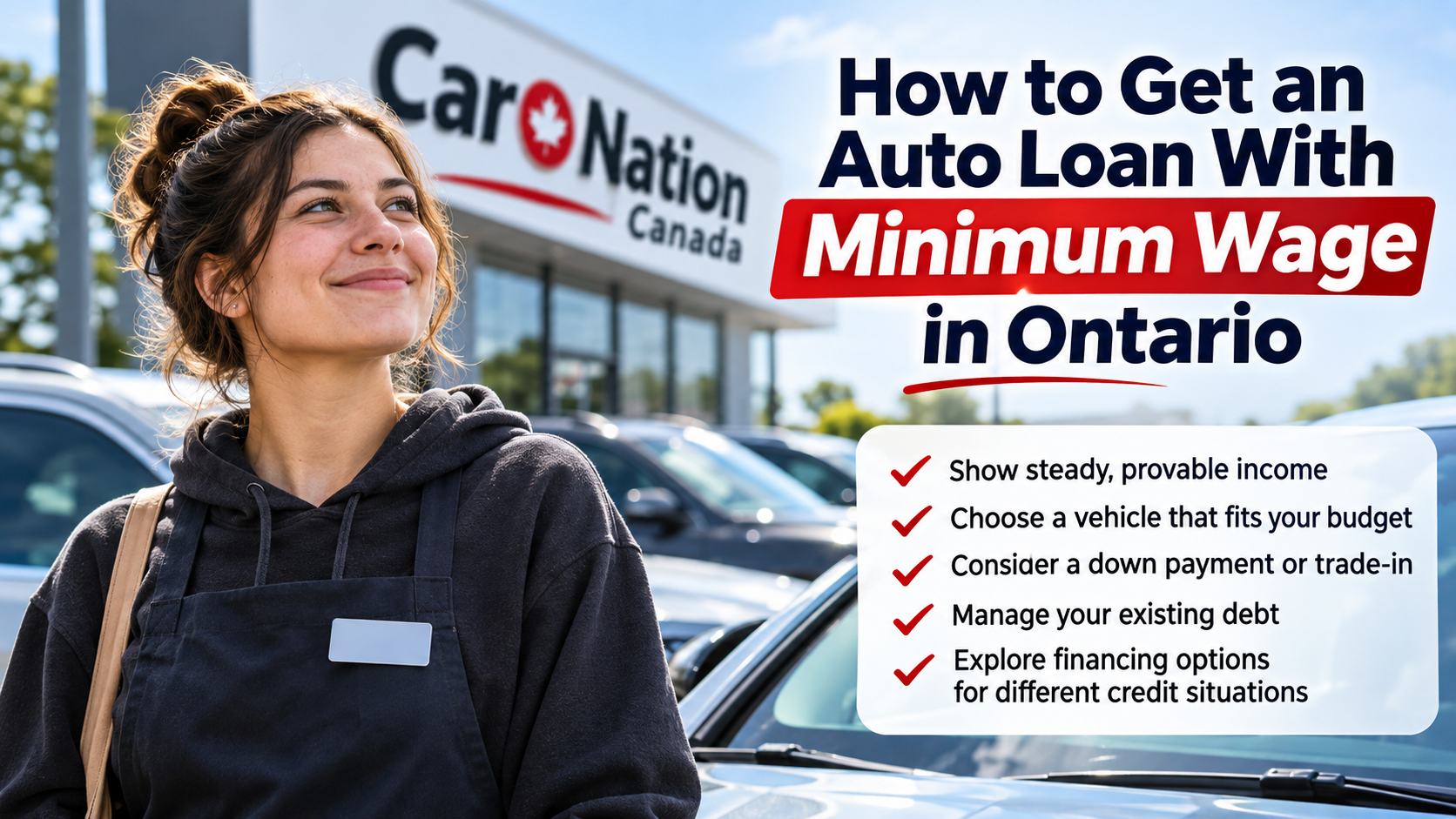
How to Get an Auto Loan With Minimum Wage in Ontario
Yes, it is possible to get an auto loan while earning minimum wage. The key is showing stable income, choosing a realistic vehicle, managing existing debt and structuring the application around what you can comfortably afford.
If you're earning minimum wage and wondering whether a lender will even consider you for a car loan, you're definitely not alone.
For many people across Burlington, Hamilton, Oakville, Milton and the Greater Toronto and Hamilton Area, having a reliable vehicle isn't a luxury. It's how you get to work, pick up your kids, attend appointments and handle everyday life.
The good news is that earning minimum wage does not automatically disqualify you from auto financing.
Ontario's general minimum wage increased to $17.95 per hour effective October 1, 2026.
Someone working 40 hours per week at that rate earns approximately $3,110 per month before deductions.
Whether that income is enough for a particular car loan depends on several other factors.
Key Takeaways
- Minimum wage employment does not automatically prevent you from qualifying for vehicle financing.
- Lenders generally want to see regular, verifiable income and an ability to make the proposed payment.
- Your credit history, current debts, housing expenses and vehicle choice can affect your application.
- A less expensive vehicle can make financing considerably easier to manage.
- A down payment or trade-in may strengthen the structure of an application.
- Poor or limited credit doesn't necessarily mean you should give up before applying.
- The goal should be an affordable car loan, not simply getting approved for the largest amount possible.
- Financing is subject to approval. O.A.C. Conditions may apply.
Can You Finance a Car While Making Minimum Wage?
Yes.
There isn't a rule saying that someone earning minimum wage cannot finance a vehicle.
Instead, lenders evaluate the overall application.
The Financial Consumer Agency of Canada explains that lenders commonly consider information such as your income, debts and credit history when deciding whether to lend money.
That means two people earning exactly the same hourly wage could receive very different financing decisions.
One person might have:
- Full-time employment
- Low monthly rent
- Very little existing debt
- Several years of good credit history
- A $2,000 down payment
Another person earning exactly the same amount could have:
- Irregular working hours
- Several maxed-out credit cards
- Large monthly debt payments
- Recent missed payments
- No money available for a down payment
Their income might be identical, but their financial situations aren't.
That's why you shouldn't automatically assume that your hourly wage determines whether you can get a car loan.
How Much Does Minimum Wage Pay in Ontario?
As of October 1, 2026, Ontario's general minimum wage is $17.95 per hour.
At 40 hours per week, that's approximately:
$718 per week before deductions
$1,436 every two weeks before deductions
$3,110 per month on average before deductions
$37,336 per year before deductions
These are approximate figures based on consistent 40-hour work weeks.
Your actual income can be different if your hours fluctuate, you work overtime, receive commissions or tips, have multiple jobs or regularly work fewer than 40 hours.
That's why your actual documented income matters.
What Do Lenders Look At Besides Your Hourly Wage?
Your pay rate is only one part of the picture.
1. Stable Employment
Consistency can help.
A lender may want to determine whether your income is likely to continue throughout the loan.
Being able to document regular employment can therefore be important, even when the hourly wage itself isn't high.
Depending on the lender and application, supporting documents may include recent pay stubs and employment information.
2. Your Monthly Income
Your lender needs to understand how much money you actually earn.
If you're working minimum wage but consistently receiving full-time hours, your application may look very different from someone working only one or two shifts per week.
If you have legitimate income from more than one job, make sure the finance professional reviewing your application knows about it.
Documentation requirements can vary by lender.
3. Your Existing Debt
This is a big one.
Imagine earning roughly $3,100 gross per month while having relatively little existing debt.
Now compare that with earning the same amount while already making large payments toward credit cards, personal loans and other obligations.
The second situation leaves less room in the household budget for a vehicle payment.
Before applying, consider paying down smaller outstanding balances where practical.
4. Your Credit History
Your credit score can influence both your ability to borrow and the interest rate you're offered.
Canada's Financial Consumer Agency explains that payment history, credit utilization, length of credit history, types of credit and credit inquiries can all affect credit scores.
But having poor credit doesn't mean you should assume financing is impossible.
There are lenders serving a variety of credit situations, and our team can help you understand which options may be available.
You can start by exploring Car Nation Canada's auto financing options.
Financing is O.A.C. Conditions may apply.
Choose the Right Vehicle for Your Income
This can make one of the biggest differences.
If you're earning minimum wage, trying to finance a $45,000 SUV may create a completely different application than financing a reliable $15,000 or $20,000 used vehicle.
Instead of asking:
What's the most expensive vehicle I can get approved for?
Ask:
What vehicle gives me reliable transportation without putting too much pressure on my monthly budget?
You can browse Car Nation Canada's current vehicle inventory to compare vehicles across different price ranges, body styles and brands.
Used vehicles can be especially useful for payment-focused shoppers because there may be considerably more price points available.
Don't Forget About the Cost of Owning the Vehicle
Your loan payment isn't your only transportation expense.
Your budget should also account for:
- Insurance
- Fuel
- Maintenance
- Tires
- Registration
- Parking where applicable
- Unexpected repairs
This is particularly important on a minimum-wage income.
A $400 car payment doesn't really cost you only $400 each month when insurance, fuel and maintenance are added.
The Government of Canada's consumer guidance recommends reviewing your budget and considering whether you can comfortably afford repayment before borrowing.
Can a Down Payment Help?
It can.
Suppose you're buying a $20,000 vehicle.
Putting money down reduces the amount that needs to be financed.
A down payment could potentially help structure an application more favourably while also reducing the principal you're borrowing.
But don't empty your emergency savings simply to make a bigger down payment.
You still need money available for groceries, housing, insurance and unexpected expenses.
What If You Have a Trade-In?
A trade-in can sometimes serve a similar purpose.
If your existing vehicle has positive equity, that value may be applied toward your next vehicle.
For example, imagine your trade is worth $6,000 and you owe $3,000.
That leaves approximately $3,000 in positive equity before other applicable transaction considerations.
That equity may be applied toward your next purchase.
If you owe more than the vehicle is worth, however, you have negative equity.
That requires more careful consideration because rolling old debt into another loan increases the amount you're financing.
What If You Have Bad Credit and Minimum-Wage Income?
This is where people often assume they'll automatically be declined.
Don't make that decision for the lender.
Credit challenges can come from many situations:
- Late payments
- Collections
- High credit-card balances
- Bankruptcy
- Consumer proposal
- Limited credit history
- Previous unemployment
- Divorce or separation
- Unexpected expenses
A credit score is important, but it isn't necessarily the only piece of information considered.
Our financing team works with customers in many different financial circumstances.
The goal is to review the full application and determine what options may realistically be available rather than promise an approval that hasn't happened.
That's an important distinction.
No responsible dealership or lender should promise guaranteed approval before reviewing your situation.
What If You Have No Credit History?
Limited credit history is different from bad credit.
This frequently affects:
- Young first-time buyers
- Students entering the workforce
- Newcomers to Canada
- People who have traditionally paid cash
- People who haven't used credit products before
If you have steady employment but very little Canadian credit history, there may still be financing options available depending on your circumstances.
Documentation becomes especially important because lenders need enough information to evaluate the application.
Would a Co-Signer Help?
Sometimes.
A qualified co-signer with stronger income or credit may improve an application in certain circumstances.
However, co-signing isn't simply providing a reference.
A co-signer becomes financially responsible for the debt according to the loan agreement.
Both people should understand that responsibility before proceeding.
Should You Take a Longer Loan Just to Lower the Payment?
Be careful here.
Longer financing terms can reduce the individual payment, but that doesn't necessarily make the vehicle cheaper.
The Financial Consumer Agency of Canada specifically warns that extending a car loan can lower payments while increasing the total interest paid over the life of the loan.
Look at:
- Vehicle price
- Interest rate
- Loan term
- Payment frequency
- Amount financed
- Total borrowing cost
Don't judge an auto loan entirely by the bi-weekly payment.
Improve Your Credit Before Applying When You Have Time
If you don't need a vehicle immediately, even a few months of preparation can help build a stronger financial picture.
One of the most important things you can do is consistently pay your bills on time.
The Financial Consumer Agency of Canada identifies payment history as the most important factor in a credit score and recommends keeping credit utilization below roughly 30% where possible.
That could mean:
- Bringing overdue accounts current
- Paying down credit-card balances
- Avoiding unnecessary new credit applications
- Keeping payments on time
- Checking your credit report for errors
Small improvements can add up.
Getting a Minimum-Wage Car Loan Around Burlington and the GTHA
Reliable transportation matters throughout Southern Ontario.
Someone living in Burlington may commute to Hamilton every day.
Someone in Oakville or Milton might need a vehicle to reach a workplace that isn't easily accessible by transit.
The same applies to workers commuting from communities such as Grimsby and Brantford.
That's why financing should be built around the real household budget, not just the price of the vehicle.
What Should You Bring When Applying for an Auto Loan?
Requirements vary by lender, but being prepared can make the process much easier.
You may be asked for documentation that confirms things such as:
- Identity
- Address
- Employment
- Income
- Banking information
If your income changes from paycheque to paycheque, bring enough documentation to show what you normally earn.
The more accurately the lender can understand your situation, the better.
The Bottom Line: Minimum Wage Doesn't Automatically Mean No
Earning minimum wage doesn't automatically prevent you from financing a vehicle.
A lender is looking at the entire application.
Your employment stability, documented income, credit history, current debts, down payment, trade-in and the price of the vehicle can all play a role.
Most importantly, don't stretch your finances simply because a particular payment can be structured.
A reliable vehicle that comfortably fits your budget is usually a much better decision than buying the maximum amount you might qualify to borrow.
If you earn minimum wage and need a vehicle for work or everyday life, start by exploring Car Nation Canada's used and new vehicle inventory.
If you're unsure where your credit or income puts you, you can also speak with our team about financing options for different credit situations.
O.A.C. On Approved Credit. Conditions may apply.
Frequently Asked Questions
Can I get a car loan working minimum wage in Ontario?
Potentially, yes. Earning minimum wage does not automatically disqualify you. Lenders may consider your total income, employment stability, credit history, existing debts and the vehicle being financed.
How much do I need to make to finance a car?
There isn't one universal income requirement that applies to every lender and every applicant. Requirements vary depending on the lender, vehicle, credit profile, existing obligations and other factors.
Can I finance a car with minimum wage and bad credit?
There may be financing options available for people with lower credit scores, but approval is not guaranteed. Your employment, income, debt obligations, down payment and vehicle selection may all affect the application.
Do I need a down payment?
Not every financing structure requires the same down payment. However, putting money down reduces the amount being financed and may help in some situations.
What's the best car to buy on minimum wage?
Generally, focus on a dependable vehicle with a purchase price, insurance cost, fuel consumption and expected maintenance costs that comfortably fit your budget. Don't choose a vehicle based solely on whether a lender will approve the payment.