
How to Find Out the History of a Vehicle Before Purchasing in Ontario
How to Find Out the History of a Vehicle Before Purchasing in Ontario
Posted on October 9, 2026
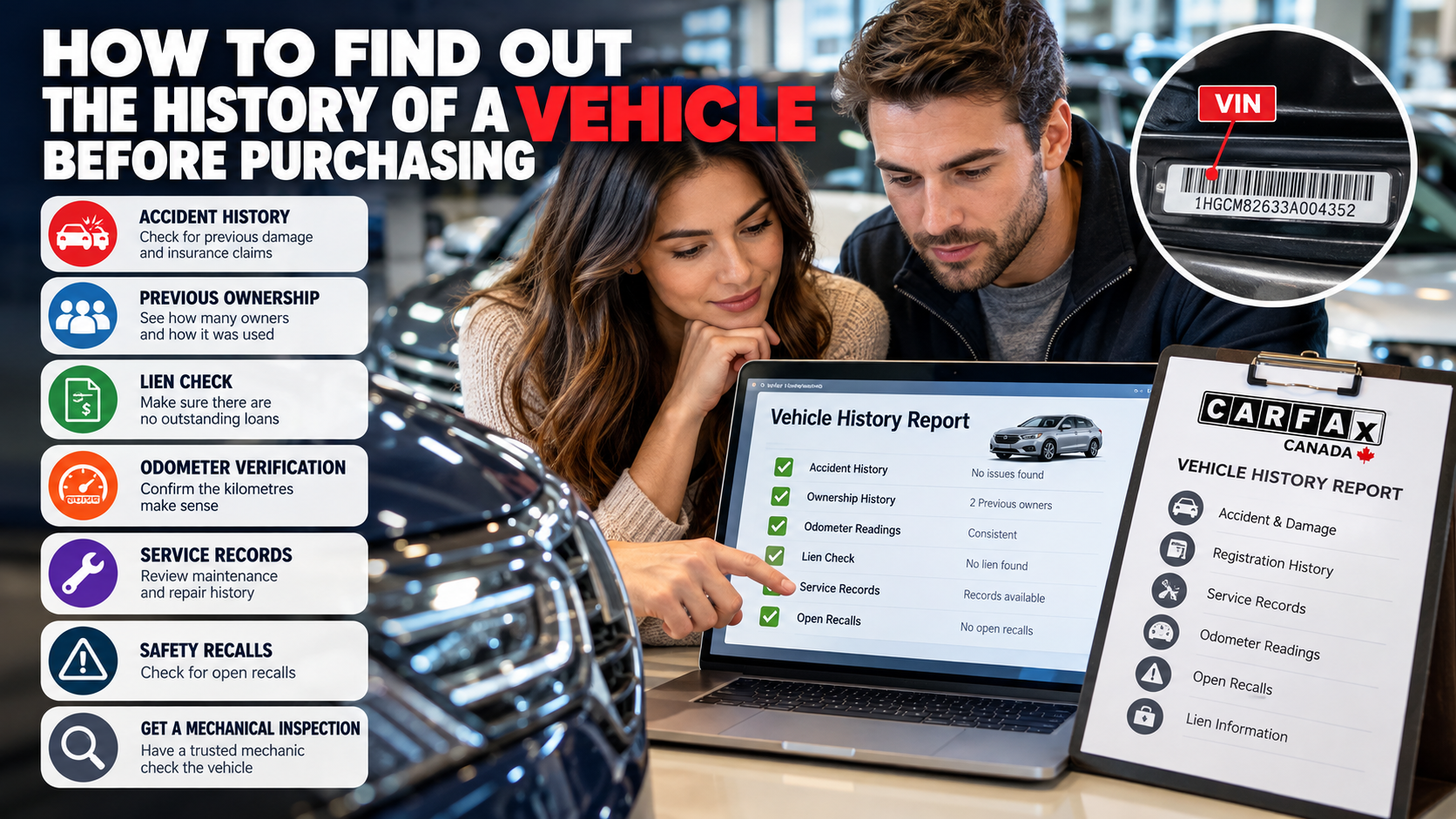
How to Find Out the History of a Vehicle Before Purchasing in Ontario
Planning to buy a used vehicle? Learn how to check accident history, previous ownership, liens, kilometres, service records, and hidden problems before making your purchase in Ontario.
Buying a used car, truck, SUV, or minivan can be a smart financial decision, especially when you're trying to balance reliable transportation with a comfortable monthly budget. But before signing a purchase agreement, there's one important question every buyer should ask: Do I really know this vehicle's history?
Whether you're shopping for a used vehicle in Burlington, Hamilton, Oakville, or Brantford, understanding a vehicle's past can help you avoid costly surprises and make a more confident decision.
At Car Nation Canada, we believe a great vehicle purchase starts with good information. That's why we're sharing the essential steps every Ontario driver should take to investigate a used vehicle before buying.
Key Takeaways
-
Always request a vehicle history report to review available accident records, previous ownership, and other important details.
-
Verify the Vehicle Identification Number (VIN) to ensure the report matches the actual vehicle.
-
Check for outstanding liens that could indicate money is still owed on the vehicle.
-
Review the vehicle's service history to identify maintenance gaps and potential mechanical issues.
-
Compare recorded kilometres to look for unexplained discrepancies.
-
Arrange an independent mechanical inspection because a vehicle history report cannot reveal every problem.
-
Understand the full purchase cost, including financing terms, insurance, repairs, and maintenance.
1. Start With a Vehicle History Report Before Buying a Used Car
One of the easiest ways to investigate a used vehicle's past is by obtaining a comprehensive vehicle history report.
In Canada, CARFAX Canada provides vehicle history reports using information collected from participating sources, including registration agencies, insurance providers, and service facilities.
Depending on the information available, a vehicle history report may identify:
-
Previous accidents and reported damage
-
Insurance claims and repair estimates
-
Registration and ownership history
-
Vehicle branding, including salvage or rebuilt status
-
Recorded odometer readings
-
Available service and maintenance records
-
Open safety recalls
-
Theft-related records
-
Canadian or American registration history
A report can provide valuable insight into how a vehicle was previously used and maintained.
However, there's an important distinction: A clean vehicle history report does not necessarily mean a vehicle has never been damaged.
Some accidents, repairs, or maintenance activities may never have been reported to the organizations supplying the information.
That's why we recommend treating a vehicle history report as an important starting point rather than your only source of information.
2. Check the Vehicle Identification Number (VIN)
Every vehicle has a unique Vehicle Identification Number, commonly called a VIN.
For most modern passenger vehicles, this 17-character identifier acts like the vehicle's fingerprint.
You can typically find the VIN:
-
On the driver's side dashboard, visible through the windshield
-
On a label inside the driver's side door frame
-
On the vehicle registration documents
-
On insurance paperwork
-
In dealership vehicle listings
Before purchasing a used vehicle, compare the physical VIN against the number shown on the ownership documents and vehicle history report.
All records should match.
Why checking the VIN matters
A VIN allows you to connect historical records to the specific vehicle you're considering.
For example, imagine you're purchasing a used SUV with 85,000 km showing on its dashboard.
If the vehicle history report shows 145,000 km recorded two years earlier, that's a serious discrepancy requiring investigation.
It could result from a recording error, an instrument cluster replacement, or odometer tampering.
Whatever the explanation, get it resolved before completing the purchase.
3. Investigate Previous Accidents and Damage History
One of the biggest concerns when buying a used vehicle is whether it has previously been involved in a collision.
Not all accident history is equally concerning.
For example, a professionally repaired minor bumper scrape is very different from extensive structural damage.
When reviewing a vehicle history report, pay attention to:
-
The number of reported accidents
-
The date of each incident
-
The location and extent of reported damage
-
Available repair estimates
-
Structural or frame damage indicators
-
Whether the vehicle received a salvage or rebuilt designation
Should you buy a used car with accident history?
Possibly.
A vehicle with a documented minor accident and quality repairs may still provide years of dependable transportation.
However, significant collision damage can affect a vehicle's safety, resale value, and long-term reliability.
Ask the seller for repair invoices and supporting documentation whenever possible.
For vehicles with substantial damage history, consider an inspection by a qualified collision repair professional in addition to a regular mechanical inspection.
The important question isn't simply whether a vehicle has been in an accident. It's whether the damage was properly repaired and appropriately reflected in the vehicle's price.
4. Check for Outstanding Liens Before Purchasing
A lien is a legal claim registered against a vehicle, commonly because money was borrowed to purchase it.
This is particularly important when buying from a private seller.
For example, someone might advertise a used pickup truck for $24,000 while still owing money to a financial institution.
If the lien isn't properly addressed, purchasing that truck could expose you to serious financial and ownership complications.
How to check for vehicle liens in Ontario
You can obtain lien information through the Ontario government's Used Vehicle Information Package, commonly called a UVIP.
You can also purchase a vehicle history report that specifically includes a Canadian lien search.
Not every standard vehicle history report includes this service, so verify what's included.
If you discover an active lien, ask for documentation showing how it will be paid and discharged before taking ownership. Where necessary, confirm the details directly with the lender.
A seller's verbal assurance that a loan has been paid off isn't sufficient protection.
5. Obtain an Ontario Used Vehicle Information Package (UVIP)
If you're purchasing a vehicle privately in Ontario, the UVIP is an important document to understand.
According to the Government of Ontario, sellers are generally required to provide a UVIP for applicable private used-vehicle sales, subject to exemptions.
The package provides information such as:
-
Vehicle description and specifications
-
Ontario registration history
-
Previous Ontario owners
-
Available odometer readings
-
Lien information
-
Other details relevant to transferring ownership
The UVIP is especially useful because it provides provincial information that can complement a commercial vehicle history report.
However, it is not a comprehensive accident-history report or a replacement for a mechanical inspection.
For anyone purchasing from a private seller in Milton, Grimsby, or Cambridge, reviewing the applicable Ontario ownership documentation is an important part of the buying process.
6. Review Service and Maintenance Records
A vehicle's maintenance history can tell you a great deal about how its previous owners looked after it.
This is particularly important when shopping for vehicles with higher kilometres.
Consider two used sedans, each showing 120,000 km.
One has documentation showing regular oil changes, brake servicing, transmission maintenance, and manufacturer-recommended inspections.
The other has almost no available service records.
Although both vehicles may look similar, the first provides stronger evidence of how it has been maintained.
Important maintenance records to review
Look for documentation covering:
-
Engine oil and filter changes
-
Transmission servicing
-
Brake repairs and replacements
-
Cooling system maintenance
-
Timing belt replacement, where applicable
-
Suspension and steering repairs
-
Tire replacement and rotation
-
Manufacturer-recommended maintenance intervals
Keep in mind that missing service records don't automatically mean a vehicle was neglected. Independent mechanics and home maintenance activities may not appear in commercial reports.
Ask for receipts and compare the documented maintenance against the manufacturer's recommendations.
7. Verify the Vehicle's Kilometres and Ownership History
Kilometres are an important factor in evaluating a used car, but they don't tell the whole story.
A well-maintained vehicle with 150,000 km may be a better purchase than a poorly maintained vehicle with 70,000 km.
Review the odometer readings recorded over time and look for a reasonable progression.
For example:
| Year | Recorded kilometres |
|---|---|
| 2021 | 32,000 km |
| 2022 | 51,500 km |
| 2023 | 74,000 km |
| 2024 | 93,500 km |
| 2025 | 111,000 km |
This pattern suggests relatively consistent use.
An unexpected decrease in recorded kilometres should be investigated.
Also review the number of previous owners and available information about how the vehicle was used.
A former rental, commercial, or fleet vehicle isn't automatically a poor choice, but its usage history deserves consideration.
8. Check for Outstanding Safety Recalls
Safety recalls are another important part of vehicle history research.
Manufacturers issue recalls when certain defects or safety-related problems need correction.
Before purchasing, check whether the vehicle has outstanding recalls using the manufacturer's official recall lookup or information available through Transport Canada.
Some recalls involve relatively minor issues, while others require important safety repairs.
Ask whether applicable recall work has been completed and request supporting documentation where available.
An open recall doesn't automatically mean you should reject a vehicle, but you should understand the issue and how it will be resolved.
9. Arrange an Independent Pre-Purchase Vehicle Inspection
Even a detailed vehicle history report has limitations.
It cannot tell you everything about a vehicle's current mechanical condition.
That's why an independent pre-purchase inspection is one of the most valuable steps you can take.
A qualified mechanic can examine important components, including:
-
Engine condition and fluid leaks
-
Transmission operation
-
Braking system
-
Steering and suspension
-
Tires and wheel alignment
-
Exhaust system
-
Rust and corrosion
-
Signs of previous collision repairs
-
Warning lights and diagnostic trouble codes
This becomes especially valuable when purchasing an older vehicle or one with substantial kilometres.
Is an Ontario safety certificate the same as a mechanical inspection?
No.
An Ontario safety standards certificate confirms that the vehicle met prescribed minimum safety standards at the time of inspection. It is not a warranty and does not establish the vehicle's long-term reliability.
A comprehensive independent inspection can provide additional information about developing problems, maintenance needs, and potential repair costs.
For a family purchasing a used minivan or an employee relying on a car for a daily commute, understanding these expenses ahead of time can make a substantial difference.
10. Know Your Consumer Rights When Buying From an Ontario Dealership
If you're purchasing a used vehicle from a registered Ontario dealership, certain disclosure requirements apply.
The Ontario Motor Vehicle Industry Council (OMVIC) oversees Ontario's registered motor vehicle dealers and salespersons.
Dealers have legal obligations to disclose specified information about vehicles, including relevant historical facts and conditions.
Buyers should carefully review written disclosures, ask questions about anything unclear, and ensure important representations are documented in the purchase agreement.
Also remember that Ontario generally does not provide an automatic cooling-off period for vehicle purchases from dealerships.
This makes reviewing the vehicle, its history, and the agreement before signing particularly important.
Whether you're purchasing a used SUV in Mississauga or a pickup truck in St. Catharines, taking the time to understand your rights is worthwhile.
11. Consider How Vehicle History Affects Your Financing and Budget
A vehicle's history matters for more than safety and reliability. It can also influence the financial side of your purchase.
Vehicles with unusually high kilometres, certain branding histories, or significant prior damage may present financing or insurance challenges, depending on the lender and insurer.
If you're working within a specific monthly budget, consider the entire cost of vehicle ownership.
That includes:
-
Purchase price and applicable taxes
-
Financing rate and repayment term
-
Total borrowing cost
-
Insurance premiums
-
Fuel consumption, measured in L/100 km
-
Maintenance and upcoming repairs
-
Expected resale or trade-in value
For example, a less expensive vehicle requiring $3,000 in immediate repairs may not be a better financial choice than a slightly more expensive vehicle with documented maintenance and fewer anticipated repairs.
What if you're rebuilding your credit?
If you've experienced credit challenges, a consumer proposal, a bankruptcy, or you're new to Canada without an established credit history, finding dependable transportation at a manageable cost can feel complicated.
Our team believes you deserve clear information and respectful guidance regardless of your credit situation.
Car Nation Canada offers vehicle financing options for many credit situations, subject to lender requirements and credit approval.
Financing is O.A.C. (On Approved Credit). Conditions may apply.
An affordable payment is important, but understanding your financing term, total interest costs, and anticipated maintenance expenses is just as valuable.
12. Watch for These Used Vehicle History Red Flags
Before committing to a purchase, investigate any of the following warning signs.
VIN numbers that don't match
The vehicle's identifying information differs from its ownership paperwork or history report.
Unexplained odometer discrepancies
Historical mileage records are inconsistent or suggest a lower reading than previously reported.
Outstanding liens without a clear discharge plan
The seller cannot provide reliable documentation confirming how an existing lien will be resolved.
Evidence of undisclosed structural repairs
Inspection findings or previous damage records contradict the seller's description of the vehicle.
Refusal to allow an independent inspection
The seller pressures you to purchase without giving you a reasonable opportunity to check the vehicle.
These warning signs don't always mean a vehicle is unsuitable, but they do justify further investigation.
Conclusion: A Little Research Can Protect Your Next Vehicle Purchase
Buying a used vehicle doesn't have to mean taking unnecessary risks.
By checking the VIN, reviewing accident and ownership records, confirming lien status, verifying kilometres, and arranging a professional inspection, you can make a much more informed decision.
The goal isn't necessarily to find a vehicle with a perfect history. It's to find one whose condition, documentation, and price make sense for your needs.
At Car Nation Canada, we understand that every shopper's situation is different. Whether you're replacing a commuter car, upgrading to a family SUV, or looking for more affordable transportation, knowing what you're buying helps protect your investment.
Ready to explore your options? Start by browsing our available new and used vehicle inventory. If you'd like to understand your purchasing power before choosing a vehicle, you can also explore financing and pre-approval options, O.A.C.
Frequently Asked Questions About Checking Vehicle History
1. Can I check a vehicle's history for free in Ontario?
Some basic information, including certain recall details, may be available free through official manufacturer resources. However, detailed accident, ownership, and lien history often requires a paid report or government document.
2. Does CARFAX Canada show every accident?
No. CARFAX Canada relies on information supplied by participating sources. Unreported accidents and repairs may not appear, so an independent inspection remains important.
3. What is the difference between a CARFAX report and a UVIP?
A CARFAX Canada report provides available historical records such as reported damage, maintenance, and registration information. An Ontario UVIP provides provincial vehicle registration history and lien information. They serve different purposes and can complement one another.
4. Can I buy a used vehicle that has previously been in an accident?
Yes, depending on the extent of the damage, the quality of repairs, the vehicle's current condition, and the selling price. Significant structural damage deserves particular scrutiny.
5. Should I check vehicle history before applying for financing?
Ideally, yes, before committing to a specific vehicle. You can explore financing eligibility earlier, but reviewing the vehicle's history and condition before finalizing a purchase helps ensure you're borrowing money for a vehicle that meets your needs and budget.
With over four decades in the automotive industry, Dealer Principal Rick Paletta is a trusted name across the Hamilton–Burlington region. Born and raised locally, Rick is respected for his integrity, work ethic, and people-first leadership—and he still loves this business because it’s about helping neighbours, building relationships, and matching people with vehicles they’re excited to drive. His commitment to the community shows up in consistent giving, including long-running support of McMaster Children’s Hospital through Car Nation Cares.