
How to Buy Your First Car in Ontario: A Step-by-Step Guide for First-Time Buyers
How to Buy Your First Car in Ontario: A Step-by-Step Guide for First-Time Buyers
Posted on September 18, 2026
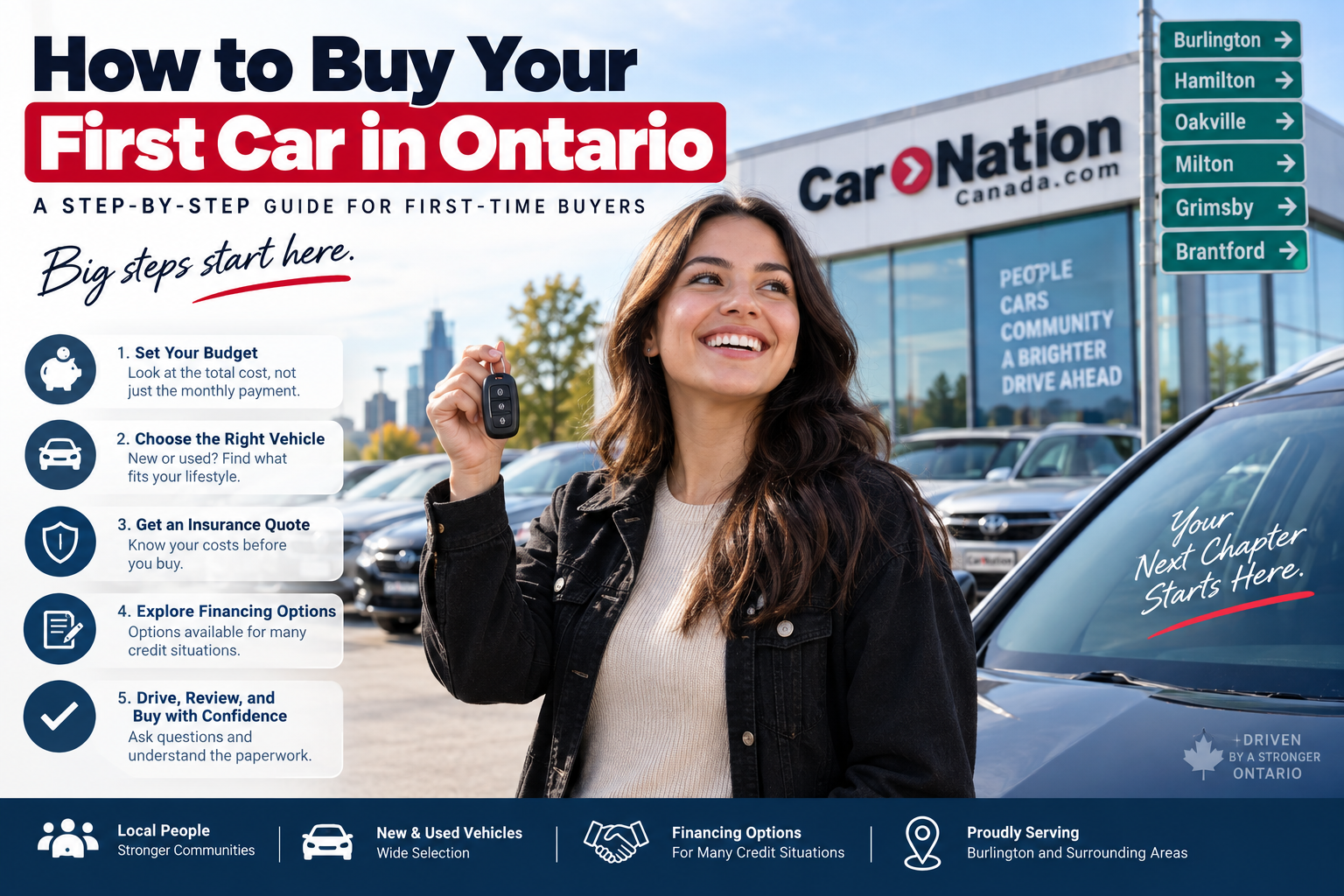
How to Buy Your First Car in Ontario: A Step-by-Step Guide for First-Time Buyers
Buying your first car in Ontario? This step-by-step guide explains budgeting, financing, insurance, new vs. used vehicles, dealership pricing, paperwork, and what to check before you sign.
Buying your first car is exciting, but it can also bring a long list of questions. How much should you spend? Is a used car better than a new one? How does financing work? What insurance do you need? And what exactly happens when you sign the paperwork?
Whether you are buying your first vehicle for commuting to work in Burlington, getting to school in Hamilton, starting a new job in Oakville, or simply gaining more independence, planning ahead can make your first purchase much easier.
At Car Nation Canada, we believe the best first-car decision starts with understanding both the vehicle and the numbers behind it.
Key Takeaways
- Start with a total transportation budget, not just a target monthly car payment.
- Compare insurance quotes before committing to a particular vehicle.
- Decide whether a new or used vehicle makes the most sense for your needs and budget.
- If financing, compare the interest rate, loan term, amount financed, payment frequency, and total cost of borrowing.
- Ontario dealer advertisements generally must include mandatory dealer fees in the advertised price, although HST and licensing may be additional when clearly disclosed.
- Ontario does not provide a general cooling-off period for vehicle purchase contracts, so understand the agreement before signing.
- Used vehicles deserve extra attention to condition, history, kilometres, and future maintenance costs.
- Financing options are available for many credit situations, including first-time buyers and newcomers to Canada. Approval and terms are O.A.C. — On Approved Credit. Conditions may apply.
1. Set Your Budget Before Shopping for Your First Car in Ontario
One of the most common first-time car-buying mistakes is starting with a vehicle instead of starting with a budget.
Your car payment is only one part of what owning a vehicle costs.
Your monthly transportation budget may include:
- Loan or lease payment
- Auto insurance
- Fuel
- Maintenance and repairs
- Winter tires
- Parking
- Licence and registration costs
- Unexpected expenses
For someone commuting between Milton and Burlington five days a week, fuel consumption and kilometres driven may matter much more than they would for someone who only drives on weekends.
That is why a compact sedan or efficient small SUV may sometimes make more financial sense than choosing a larger vehicle simply because its monthly payment appears affordable.
The Financial Consumer Agency of Canada recommends looking beyond the payment and considering the total cost of the vehicle and financing. A longer loan can reduce the regular payment but increase the amount of interest paid over the life of the loan.
2. Decide What Type of First Vehicle You Actually Need
Before comparing makes, models, colours, or features, think about how you are going to use the vehicle.
Sedan or compact car
A sedan or compact hatchback can be a practical first vehicle for commuting, school, city driving, and keeping fuel costs manageable.
SUV
An SUV may provide additional passenger room, cargo space, ground clearance, and versatility for Ontario winters.
Truck
A pickup truck can make sense if your work, recreation, towing, or hauling requirements justify the additional size and operating costs.
Minivan or larger family vehicle
For a young family, a minivan or three-row SUV may offer the passenger and cargo capacity needed for car seats, sports equipment, groceries, and family trips.
Rather than asking, “What is the nicest car I can get for this payment?” ask:
“What vehicle solves my transportation needs without putting unnecessary pressure on my monthly budget?”
You can browse our current new and used vehicle inventory to compare body styles, kilometres, model years, features, and price ranges before visiting a dealership.
3. New vs. Used: Which Is Better for a First-Time Car Buyer?
There is no universal answer.
A new vehicle may offer current technology, manufacturer warranty coverage, and the reassurance that you know the vehicle's history from day one.
A used vehicle may allow your budget to reach a higher trim level, larger vehicle, or lower purchase price than an equivalent new model.
For first-time buyers, the important thing is to compare more than the sticker price.
For a used vehicle, consider:
- Current kilometres
- Maintenance history
- Accident and damage history
- Tire and brake condition
- Vehicle age
- Remaining warranty, if any
- Expected repairs and maintenance
- Fuel economy
Ontario recommends checking vehicle history information, confirming the VIN, looking for liens where applicable, examining the vehicle for damage, and considering an inspection when buying used.
A vehicle that costs slightly more but is in stronger condition may ultimately fit your budget better than a cheaper vehicle requiring immediate repairs.
4. Get an Insurance Quote Before Buying the Car
This step can prevent a major surprise.
In Ontario, you need insurance before registering and legally driving your vehicle. Ontario requires automobile owners to carry third-party liability coverage of at least $200,000.
However, the amount you actually pay for insurance can vary substantially.
Factors may include:
- Your age
- Driving history
- Where you live
- Vehicle make and model
- Coverage selected
- Annual kilometres
- How you use the vehicle
That means two similarly priced cars can have very different overall monthly costs.
Before signing a purchase agreement, contact an insurance provider with the exact year, make, model, and preferably the VIN of the vehicle you are considering.
For a young driver commuting from Grimsby or Brantford, knowing the insurance cost before purchasing can help determine whether the vehicle truly fits the household budget.
5. Understand First-Car Financing in Ontario
Many first-time buyers finance their vehicle rather than paying the full purchase price in cash.
When you finance a vehicle, your approval and financing terms can depend on several factors, which may include your income, credit profile, existing financial obligations, down payment, requested loan amount, and the vehicle itself.
If you have limited or no established Canadian credit history, that does not automatically mean there are no options.
Our team works with buyers in many different financial situations, including:
- First-time borrowers
- Newcomers to Canada
- Buyers rebuilding credit
- People who have experienced a consumer proposal or bankruptcy
- Buyers returning to stronger credit after previous challenges
- Prime-credit buyers looking for competitive options
You can start by reviewing our vehicle financing options and finance application process before selecting a vehicle.
Financing options are available for many credit situations. O.A.C. — On Approved Credit. Conditions may apply.
6. Look Beyond the Monthly Payment
A comfortable monthly or biweekly payment matters, but it should not be your only consideration.
When comparing financing options, review:
- Vehicle selling price
- Down payment
- Amount financed
- Interest rate
- Payment amount
- Payment frequency
- Loan term
- Total interest
- Total cost of borrowing
The Financial Consumer Agency of Canada notes that extending a car loan can lower regular payments while increasing the total amount of interest paid. It also identifies negative equity as a risk with longer-term borrowing.
Negative equity means you owe more on the vehicle loan than the vehicle is currently worth.
That becomes especially important if you want to trade the vehicle before the loan has been substantially paid down.
A first-time buyer should therefore look for a balance between a manageable payment today and a loan structure that continues to make sense several years from now.
7. Understand Ontario's Advertised Vehicle Pricing Rules
Knowing Ontario's pricing rules can make vehicle shopping less confusing.
For vehicles advertised by Ontario-registered dealers, OMVIC's all-in pricing requirements generally mean that the advertised price must include the mandatory fees and charges the dealer intends to collect.
The main permitted additions are HST and licensing, provided the advertisement clearly indicates that they are extra.
Ontario's HST rate is currently 13%.
As a shopper, compare the advertised price with the bill of sale and ask questions about anything you do not understand.
Optional products may also be presented during the purchase process. Take time to understand what each product covers, what it costs, and whether you want it before agreeing to add it.
8. Test Drive the Vehicle Properly
Your first test drive should be more than a five-minute trip around the block.
Try to drive in conditions similar to your normal routine.
Pay attention to:
- Seating position and visibility
- Acceleration and braking
- Steering feel
- Highway noise
- Parking and turning radius
- Blind spots
- Heating and air conditioning
- Infotainment controls
- Cargo space
- Passenger comfort
If your normal week includes the QEW through Burlington and Hamilton, for example, make sure you are comfortable with highway merging, visibility, and lane changes.
If you mostly drive short urban trips, low-speed manoeuvrability and parking may matter more.
9. Review a Used Car Carefully
A used vehicle deserves a little more homework.
Check the kilometres against the vehicle's age and ask about its history and condition.
You should also make sure the VIN on the vehicle corresponds with its documentation.
Ontario's Used Vehicle Information Package, or UVIP, is particularly relevant to private sales. A private seller is generally required to provide the buyer with a UVIP, which can contain Ontario registration history, lien information, vehicle details, wholesale value information, and other records. Registered dealership transactions are treated differently and do not require the dealer to provide a UVIP.
If buying privately, Ontario says the new owner must register the vehicle transfer within six days of purchase and bring the required documentation to ServiceOntario.
Private vehicle purchases are also generally subject to 13% Retail Sales Tax, commonly calculated on the greater of the purchase price or applicable wholesale value for qualifying cars, vans, and light trucks.
10. Read Everything Before You Sign
This may be the most important step in the entire first-car buying process.
Ontario does not have a general cooling-off period for motor vehicle purchase agreements.
Once you sign, the contract will normally be binding except in specific circumstances provided by law.
Before signing, confirm:
- Vehicle year, make, model, and VIN
- Purchase price
- Trade-in value, if applicable
- Down payment
- Financing rate
- Loan term
- Payment amount and frequency
- Total cost of borrowing
- Any optional products you selected
- Any agreed repairs or conditions
- Delivery arrangements
Do not be embarrassed to ask someone to explain a line item.
A good car-buying decision is one you understand.
11. Don't Let a Thin Credit File Stop You From Getting Started
Many first-time vehicle buyers have limited credit history simply because they have not borrowed much before.
This is common among younger buyers and newcomers establishing themselves in communities such as Mississauga, Burlington, Hamilton, and throughout Southern Ontario.
Your first step does not have to be choosing the car.
It may make more sense to first determine what financing range and payment structure may be available to you.
Our finance team can help explain possible paths based on your circumstances without judgement. You can begin with our online finance information and application page and then shop within a realistic vehicle range.
Financing options are available for many credit situations. O.A.C. — On Approved Credit. Conditions may apply.
Conclusion: Buying Your First Car in Ontario Starts With a Plan
Learning how to buy your first car in Ontario is really about making a series of smaller, informed decisions.
Set a realistic overall budget. Check your insurance. Choose the right body style. Compare new and used options. Understand financing beyond the monthly payment. Review the vehicle carefully. And read your contract before signing.
Most importantly, choose a vehicle that works for your life today without making tomorrow unnecessarily difficult.
If you're ready to start looking, you can browse Car Nation Canada's current vehicle inventory and compare cars, SUVs, trucks, and other options that fit your needs.
If financing is your bigger question, start with our finance centre. Our team can help you understand available financing paths based on your budget and credit situation, including options for many first-time buyers and newcomers to Canada.
O.A.C. — On Approved Credit. Conditions may apply.
FAQ: Buying Your First Car in Ontario
What do I need to buy my first car in Ontario?
Your exact requirements depend on how and where you purchase the vehicle. To drive and register a vehicle in Ontario, you will generally need appropriate identification, vehicle documentation, and proof of insurance. Used private-sale transactions have additional documentation requirements through ServiceOntario.
Is it better to buy a new or used car as my first vehicle?
Either can work. Used vehicles can provide strong value for a limited budget, while new vehicles may offer current features and manufacturer warranty coverage. Compare total ownership cost, insurance, financing, condition, and expected maintenance rather than deciding on purchase price alone.
Can I finance my first car with little or no credit history?
Financing options are available for many credit situations, including some buyers with limited Canadian credit history. Approval, rate, term, down payment requirements, and loan amount depend on the lender and applicant. O.A.C. — On Approved Credit. Conditions may apply.
Is there a cooling-off period after buying a car in Ontario?
Generally, no. Ontario does not provide a standard cooling-off period for motor vehicle purchase contracts. Once you sign, the agreement will normally be binding, subject to specific legal exceptions.
How much should I spend on my first car?
There is no single correct amount. Start with what your household can comfortably manage after accounting for the vehicle payment, insurance, fuel, maintenance, parking, and other regular expenses. If you are financing, also compare the total cost of borrowing instead of choosing a vehicle solely based on the advertised monthly or biweekly payment.