
How Does Auto Loan Interest Work in Canada? A Simple Guide for Ontario Drivers
How Does Auto Loan Interest Work in Canada? A Simple Guide for Ontario Drivers
Posted on November 17, 2026
How Does Auto Loan Interest Work in Canada? A Simple Guide for Ontario Drivers
Wondering how auto loan interest works? Learn how Canadian car loan interest is calculated, how APR affects payments, and how to save money when financing a vehicle in Ontario.
Buying a vehicle is exciting, but understanding how your financing works is just as important as choosing the right car. Whether you're shopping for a used SUV, a family minivan, a pickup truck, or your very first vehicle, auto loan interest can significantly affect how much you actually pay.
Many Canadians focus on one question: "How much will my car payment be?" That's important, but the interest rate, loan length, and total cost of borrowing deserve just as much attention.
At Car Nation Canada, we believe understanding your financing options helps you make better decisions. Let's break down exactly how car loan interest works in Canada, using simple examples and real numbers.
Key Takeaways: How Auto Loan Interest Works
- Interest is the cost of borrowing money. You repay the amount financed plus interest charged by your lender.
- Your interest rate matters. A higher rate generally means higher borrowing costs.
- Longer loans usually cost more. An 84-month loan may have smaller payments than a 60-month loan, but typically results in more total interest.
- Interest usually decreases as your balance falls. On a standard reducing-balance loan, more of each payment goes toward principal over time.
- Your credit profile affects your rate. Income, existing debts, payment history, and lender requirements can influence financing offers.
- You can potentially save thousands. Choosing an affordable vehicle, shortening your loan term, and making additional principal payments when permitted can reduce interest costs.
What Is Auto Loan Interest?
Auto loan interest is the amount a lender charges you for borrowing money to purchase a vehicle.
When you finance a car, you're generally borrowing from a bank, credit union, manufacturer financing company, or automotive finance provider.
Your financing agreement determines how much you borrow, the applicable interest rate, and how long you have to repay the balance.
Three important terms explain the process.
1. Principal: The Amount You Borrow
Principal is your outstanding loan balance before interest.
For example, imagine purchasing a vehicle with a total financed purchase cost of $35,000 CAD.
You make a $5,000 down payment.
Your original principal would be $30,000 CAD.
That is the balance used to calculate interest under a typical reducing-balance auto loan.
2. Interest Rate: The Cost of Borrowing
Your interest rate is expressed as an annual percentage.
If your loan carries an 8% annual interest rate, that does not mean you automatically pay $2,400 in interest every year on a $30,000 loan.
Instead, on a typical reducing-balance loan, interest is calculated using your outstanding principal.
As you gradually repay the amount borrowed, the balance subject to interest decreases.
3. Loan Term: How Long You Have to Repay
Your loan term determines the repayment schedule.
Common auto loan terms include 36, 48, 60, 72, and 84 months. Some lenders offer longer terms.
A shorter loan generally has larger regular payments but lower total interest costs, assuming the same amount financed and interest rate.
A longer loan spreads repayment across more time, reducing the regular payment while increasing the overall borrowing cost.
How Is Auto Loan Interest Calculated in Canada?
Many Canadian auto loans use a reducing-balance interest calculation.
This means interest is charged on the amount you still owe, rather than repeatedly charging interest on your original loan amount.
Some lenders calculate interest daily, while others use different contractual methods. Always review your agreement for the exact calculation.
The Basic Auto Loan Interest Formula
For a daily simple-interest calculation:
Daily interest = Outstanding principal × Annual interest rate ÷ 365
Suppose you have:
- Loan balance: $30,000
- Annual interest rate: 8%
- Loan term: 60 months
The initial daily interest would be approximately:
$30,000 × 0.08 ÷ 365 = $6.58 per day
Interest accumulates according to your lender's agreement.
When you make a payment, the lender generally applies the amount toward interest due and then reduces the principal.
As principal decreases, less interest accumulates each day at the same rate.
This is why paying down your loan faster can save money.
How Much of Your Payment Goes Toward Interest?
Let's use a simplified monthly amortization example.
With a $30,000 loan at 8% annual interest over 60 months, your monthly payment would be approximately $608.29.
For the first month, using an annual rate divided into 12 equal monthly periods:
First month's interest: $200.00
First month's principal repayment: $408.29
Balance after payment: $29,591.71
In the second month, the interest portion falls to approximately $197.28 under the same model.
The process continues throughout the loan.
Actual payments and interest allocations can vary slightly depending on payment dates, daily accrual, rounding, and lender terms.
Why Do You Pay More Interest at the Beginning of a Car Loan?
You might hear someone say that auto loan interest is "front-loaded."
For a standard reducing-balance amortizing loan, that description can be misleading.
The lender generally isn't secretly charging all your interest upfront. Instead, your outstanding principal is largest at the beginning of your loan.
A larger balance produces more interest.
As the balance decreases, the interest portion becomes smaller, allowing more of each regular payment to reduce principal.
This repayment process is called amortization.
Understanding amortization is particularly important if you plan to trade your vehicle before paying off the loan.
A driver commuting daily between Burlington and Hamilton might accumulate substantial mileage over five years.
If the vehicle depreciates faster than the outstanding loan decreases, the driver could end up owing more than the vehicle is worth.
This is called negative equity.
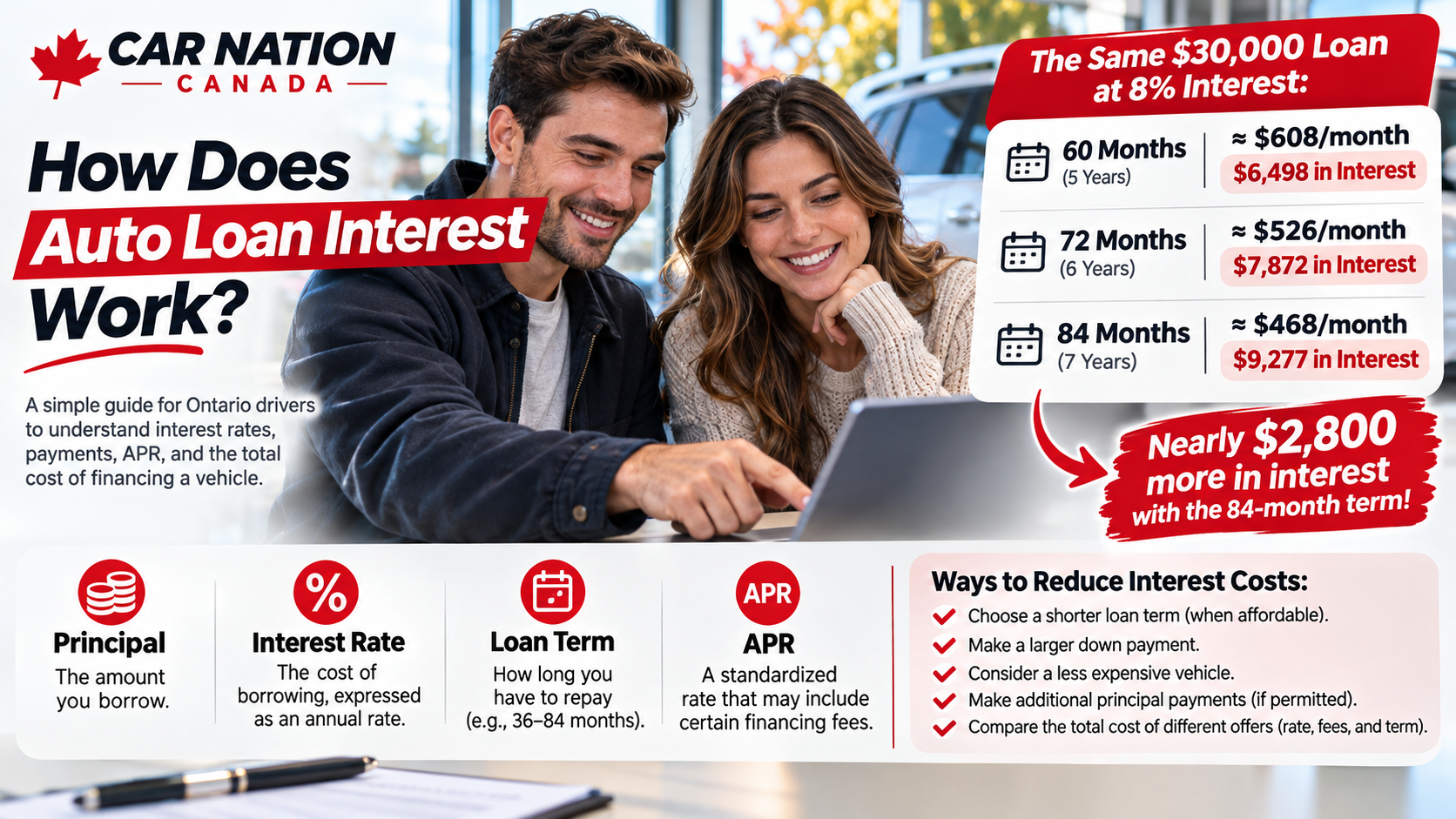
How Much Interest Will You Pay on a $30,000 Car Loan?
Let's compare three different auto loan terms.
Assume you finance $30,000 CAD at a fixed annual interest rate of 8%, with equal monthly payments.
| Loan Term | Approx. Monthly Payment | Total Interest |
|---|---|---|
| 60 months | $608.29 | $6,498 |
| 72 months | $526.00 | $7,872 |
| 84 months | $467.59 | $9,277 |
Illustrative calculations only. Assumes monthly amortization, no additional financing charges, and no early payments. These are not current financing offers.
The difference is significant.
Choosing the 84-month term instead of the 60-month term reduces your monthly payment by approximately $141.
However, you would pay roughly $2,780 more in total interest.
That's additional money spent financing the same vehicle.
For families shopping around Oakville, Milton, or Mississauga, the lower monthly payment may seem attractive.
But a manageable payment and a good overall financing decision are not necessarily the same thing.
The Financial Consumer Agency of Canada recommends comparing the loan term, interest rate, fees, amount financed, and total cost before choosing automotive financing.
What Is the Difference Between APR and an Auto Loan Interest Rate?
APR stands for Annual Percentage Rate.
Your annual interest rate describes the interest charged on your loan.
APR is a standardized measure of borrowing costs that may also incorporate certain non-interest financing charges.
For example, a financing agreement could disclose an annual interest rate of 7.99% while showing a higher APR because of applicable borrowing-related fees.
However, APR does not necessarily include every cost associated with purchasing or owning a vehicle.
Taxes, vehicle maintenance, insurance, and certain optional products may be separate expenses.
When comparing loan offers, ask your lender to explain:
- The annual interest rate
- The APR
- The total amount being financed
- All applicable financing charges
- The total amount you will repay
Two financing offers with similar monthly payments can have very different total costs.
What Determines Your Auto Loan Interest Rate in Ontario?
There isn't one universal auto loan rate available to every Canadian driver.
Lenders evaluate several factors when considering financing applications.
Your Credit History
Your credit history gives lenders information about how you've managed borrowing in the past.
Consistent payments, manageable credit balances, and a history of meeting your obligations may help support a stronger application.
Past missed payments, collections, or limited borrowing history can affect the rates available.
Your Income and Existing Debt
Lenders may look at your employment stability, income, housing costs, and other monthly debt payments.
Having steady income is helpful, but lenders also evaluate how much of that income is already committed to existing obligations.
Your Down Payment
A larger down payment reduces the amount you need to finance.
Borrowing less generally reduces total interest costs when other loan terms stay the same.
The Vehicle You Choose
Vehicle age, mileage, purchase price, and estimated value can influence financing eligibility.
A newer SUV, an older sedan, and a high-mileage pickup truck may qualify for different lending conditions.
Your Loan Term
Lenders may offer different rates or approval requirements depending on the requested repayment period.
This is another reason to compare more than just the monthly payment.
Can You Get an Auto Loan With Bad Credit?
Yes, financing options may be available for many credit situations, including applicants rebuilding their credit.
A lower credit score doesn't automatically mean you cannot finance a vehicle.
However, financing offers can vary significantly.
If you have previously experienced missed payments, a consumer proposal, or limited credit history, lenders may assess the entire application rather than relying on a credit score alone.
At Car Nation Canada, our team helps Ontario drivers explore available financing options while considering their budgets and individual circumstances.
For someone rebuilding credit, a reliable, reasonably priced used vehicle can sometimes make more financial sense than stretching into a more expensive purchase.
Explore our Ontario auto loan financing and pre-approval options to learn how the process works.
All financing is O.A.C. — On Approved Credit. Conditions may apply.
Does Paying Bi-Weekly Reduce Car Loan Interest?
It can, but the details matter.
Many Canadian drivers receive their paycheques every two weeks and prefer vehicle payments on the same schedule.
There is an important difference between regular bi-weekly payments and accelerated bi-weekly payments.
With a standard bi-weekly payment schedule, the lender may calculate 26 payments that equal approximately the same annual amount as 12 monthly payments.
Accelerated bi-weekly payments typically use half of the monthly payment, made 26 times annually.
That equals the equivalent of 13 monthly payments instead of 12.
This additional annual payment can reduce your principal faster and potentially lower interest costs.
However, the actual savings depend on your interest calculation method and whether your lender permits additional payments without penalties.
Five Ways to Reduce Auto Loan Interest Costs
1. Choose a Shorter Loan When Affordable
The shortest term isn't always the best option if it strains your monthly budget.
But choosing a shorter term that you can comfortably manage generally reduces your total interest expense.
2. Make a Larger Down Payment
A down payment lowers the amount borrowed.
Even a modest reduction in your original loan balance can lower interest costs over several years.
3. Consider a Less Expensive Vehicle
Sometimes the most effective way to reduce financing costs is simply to borrow less.
Instead of focusing only on the largest SUV or newest truck available, compare vehicles that match your actual needs and budget.
Explore our available cars, trucks, SUVs, and minivans to find options across different price ranges.
4. Make Additional Principal Payments When Permitted
Some auto loans allow borrowers to make additional payments or repay the balance early without penalties.
Others may have restrictions or charges.
Confirm your lender's prepayment conditions and how extra payments are applied before making them.
5. Compare the Total Cost of Different Offers
An attractive interest rate doesn't automatically make one vehicle purchase the better financial deal.
For example, a manufacturer may offer a promotional interest rate with different cash incentives than another purchase option.
Compare the final financed amount, total payments, applicable fees, and repayment terms.
The Government of Canada's car financing guidance explains how longer repayment periods can increase borrowing costs and negative equity risk.
Should You Choose a Fixed or Variable Auto Loan Interest Rate?
A fixed-rate auto loan maintains the same contractual annual interest rate throughout the agreed fixed-rate period.
That provides predictability when planning monthly expenses.
A variable-rate loan can change if its underlying reference rate changes.
Depending on the agreement, an increase in the rate could affect your payments, repayment period, or total borrowing costs.
Many shoppers prefer the predictability of fixed-rate financing, but the appropriate choice depends on the terms available and your personal finances.
Always understand how rate changes affect your obligations before signing a variable-rate agreement.
Auto Loan Interest in Burlington and Southern Ontario
Whether you're purchasing your first vehicle in Burlington, upgrading the family minivan in Oakville, financing a work truck in Hamilton, or searching for a commuter car in Mississauga, understanding interest helps you shop confidently.
The same applies to drivers in Grimsby, Brantford, and communities throughout the Greater Toronto and Hamilton Area.
For commuters travelling thousands of kilometres annually, choosing the right combination of vehicle reliability, payment affordability, and loan term can make a meaningful difference.
Before signing any financing agreement, review the written disclosures and ask questions about anything you don't understand.
A vehicle purchase should fit your transportation needs without creating unnecessary financial pressure.
Final Thoughts: Understanding Interest Helps You Make Smarter Decisions
Auto loan interest doesn't have to be complicated.
The most important thing to remember is that the interest rate, the amount financed, and the loan term work together to determine your borrowing costs.
Lower monthly payments are helpful, but you should always compare the total amount you'll repay.
At Car Nation Canada, we want Ontario drivers to feel informed about their financing choices.
Whether you have excellent credit, are building a Canadian credit history, or are recovering from previous financial difficulties, our team can help you explore options suited to your circumstances.
Ready to explore your next vehicle?
Start with our Car Nation Canada finance application and browse our new and used vehicle inventory.
Before purchasing a pre-owned vehicle, you can also use our free VIN check tool to decode factory specifications and access useful Canadian vehicle safety resources. Remember that a VIN decoder does not replace a comprehensive vehicle history and lien check.
Financing O.A.C. — On Approved Credit. Conditions may apply.
Frequently Asked Questions About Auto Loan Interest
Is car loan interest calculated daily or monthly in Canada?
Many Canadian auto lenders calculate interest daily on the outstanding principal, while other agreements use different calculation methods. Check your financing contract to understand exactly how interest accumulates.
Is 8% interest on a car loan considered good?
That depends on market conditions, your credit profile, the vehicle, and available financing offers. Compare the total cost of several offers rather than judging a rate in isolation.
Does paying off a car loan early save interest?
On many reducing-balance loans, paying off the principal early can reduce future interest charges. However, savings depend on the agreement and any applicable prepayment charges or restrictions.
Can I refinance my car loan to get a lower interest rate?
Potentially. Refinancing may be an option if your financial situation, credit profile, or available lending terms improve. Approval is not guaranteed, and fees or a longer new term can offset the benefit of a lower rate.
Does a higher down payment reduce auto loan interest?
Generally, yes. A larger down payment reduces the principal you borrow. With the same interest rate and repayment term, financing a smaller amount usually results in lower total interest costs.