
Getting Approved for a Car Loan With a Score Under 600 in Ontario
Getting Approved for a Car Loan With a Score Under 600 in Ontario
Posted on November 2, 2026
Getting Approved for a Car Loan With a Score Under 600 in Ontario
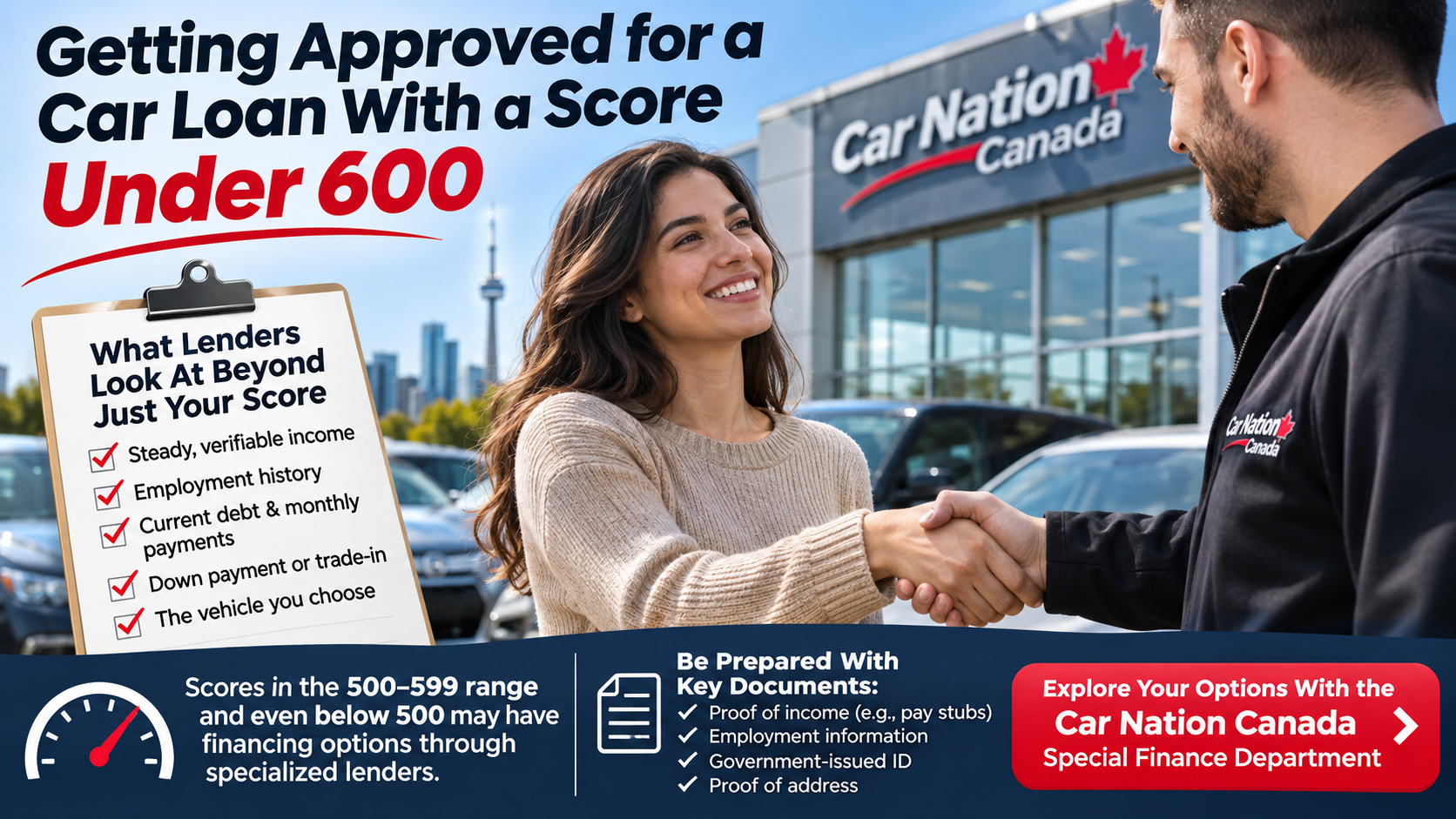
A credit score under 600 does not automatically mean you cannot finance a vehicle. Ontario lenders may look at your income, employment stability, existing debt, down payment, vehicle choice and overall ability to make the payments—not simply one number on your credit report.
If your credit score is somewhere in the 500s—or even below 500—you may assume getting approved for a car loan is impossible.
That is not necessarily the case.
Specialized automotive lenders work with borrowers across a wide range of credit situations. While stronger credit normally gives you access to better rates and more options, a lower score by itself does not always end the conversation.
For drivers in Burlington, Hamilton, Oakville, Milton and throughout the GTHA, understanding what lenders actually examine can make the financing process much less intimidating.
Key Takeaways
- A credit score below 600 does not automatically disqualify you from auto financing.
- Some specialized lenders consider applications from borrowers in the 500–599 range and, depending on the circumstances, below 500.
- There is no universal minimum credit score or income requirement used by every lender.
- Stable, verifiable income can be extremely important.
- Recent pay stubs, employment information, identification and proof of residence can strengthen an application.
- Your current debts and monthly obligations matter because lenders need to determine whether another payment is affordable.
- A down payment or trade-in may improve the structure of an application.
- Choosing the right vehicle can sometimes matter almost as much as the credit score.
- Approval, interest rate and loan terms are always subject to lender criteria and O.A.C.
Can You Get a Car Loan With a Credit Score Under 600?
Yes, financing options may be available.
A score below 600 is generally going to make financing more challenging than it would be for a borrower with excellent credit, but vehicle financing is not necessarily a simple pass-or-fail system based on your score.
Lenders evaluate risk.
Your credit report is part of that evaluation, but lenders may also consider whether you have steady employment, how much you earn, how much debt you already carry and whether the proposed vehicle payment makes sense within your budget.
The federal government's financial consumer guidance notes that lenders commonly look for regular income and consider your debts and credit history when evaluating a borrowing application.
That distinction matters.
Someone with a 580 credit score, two years at the same job and manageable monthly expenses may present a very different application than another person with exactly the same score but unstable income and significantly higher debt.
What About Credit Scores Between 500 and 599?
The 500–599 range is commonly associated with borrowers who have experienced credit challenges.
Those challenges could include:
- missed or late payments
- collections
- high credit-card balances
- a previous repossession
- a consumer proposal
- bankruptcy
- limited Canadian credit history
- too many recent credit applications
Some specialized automotive lenders consider borrowers in this range.
It is important, however, not to treat 500, 550, 575 or 600 as universal approval lines.
Every lender has its own underwriting guidelines.
A dealership's finance department may have access to multiple lenders, allowing the application to be matched with a lender whose criteria better fit the customer's circumstances.
You can start by learning about the different Car Nation Canada financing options available for customers with a variety of credit histories.
Can You Finance a Vehicle With a Credit Score Below 500?
Potentially.
There are lenders that specialize in more difficult credit files, sometimes described as deep-subprime financing.
An approval becomes more dependent on the complete financial picture.
For example, a lender may want to understand:
- Why did the previous credit problems happen?
- Has the situation changed?
- Are you currently employed?
- How long have you been at your job?
- Is your income consistent?
- How much are your existing monthly debt payments?
- Can you realistically afford the proposed vehicle payment?
- Do you have a down payment or trade-in?
- Is the vehicle appropriate for the loan being requested?
A very low score will normally reduce your financing options and may lead to a higher borrowing cost.
But it does not mean you should automatically assume there are no options.
Income Can Matter More Than Many Shoppers Expect
One of the biggest misconceptions around bad-credit car loans is that your credit score is the only number lenders care about.
Income can be just as important.
The lender ultimately wants evidence that you have enough dependable income to make the vehicle payment along with your other obligations.
Some specialized lenders may have internal minimum-income guidelines, and figures around $2,000 per month are sometimes encountered in subprime automotive financing.
However, there is no single Ontario-wide $2,000 monthly income rule that applies to every auto lender.
Requirements depend on the lender, employment situation, existing debts, requested loan amount and other factors.
A borrower earning $2,500 per month with very little existing debt might have a completely different affordability picture from someone earning $4,000 per month while carrying several large monthly obligations.
That is why documentation matters.
Documents You May Need for a Bad-Credit Car Loan
Being prepared can make the application process much smoother.
Proof of Income
You may be asked for recent pay stubs.
Depending on your employment situation, additional documents could include:
- employment letter
- bank statements
- T4
- Notice of Assessment
- proof of pension income
- proof of other acceptable recurring income
Self-employed applicants may need different documentation because their income is not always represented by a traditional pay stub.
Employment Information
Be prepared to provide:
- employer name
- employer address
- employer telephone number
- job title
- length of employment
Stable employment can help show consistency.
Identification
Typically, you will need valid government-issued identification.
Your driver's licence is commonly part of the process.
Proof of Address
A lender may need to verify where you live.
Documents could include a utility bill, bank statement or another accepted document showing your current address.
Banking Information
Some lenders may request banking information or supporting bank statements, particularly when additional income verification is required.
The exact documentation varies by lender.
What If You Recently Completed a Consumer Proposal?
A consumer proposal does not necessarily mean you can never borrow again.
The Office of the Superintendent of Bankruptcy explains that your ability to obtain credit following a proposal depends on convincing a lender that you are financially able and prepared to repay the new debt. There is no guarantee that a lender must provide credit.
That is an important way to think about rebuilding.
The question gradually shifts from:
What happened to your credit in the past?
to:
What does your financial situation look like today?
If you recently completed a proposal, you may want to bring documentation confirming its completion along with proof of your current income.
You can also review information directly from the Office of the Superintendent of Bankruptcy.
What If You Have Been Bankrupt?
Bankruptcy is serious, but it does not permanently prevent you from obtaining credit.
According to the Office of the Superintendent of Bankruptcy, lenders considering credit after a discharge will look at whether they are satisfied with the applicant's ability to repay. Again, approval is never guaranteed.
For someone rebuilding after bankruptcy, lenders may pay particularly close attention to what has happened since the financial difficulty.
That may include:
- stable employment
- responsible use of new credit
- no new missed payments
- reduced debt
- money saved for a down payment
- realistic vehicle selection
The objective is to demonstrate that your present circumstances are different from the circumstances that caused the earlier credit problems.
Your Vehicle Choice Can Affect the Application
This is one area shoppers often overlook.
You are not simply applying for money.
You are financing a specific vehicle that becomes security for the loan.
The lender therefore evaluates the vehicle as well as the borrower.
Price, age, kilometres, loan amount and overall deal structure can influence what financing options are available.
Suppose you qualify for a certain payment range.
Trying to finance a $55,000 vehicle may be difficult, while a reliable $25,000 used SUV could produce a much more reasonable application.
That does not mean buying the cheapest vehicle available.
It means matching the vehicle to your finances.
You can compare different price ranges through our Car Nation Canada vehicle inventory before deciding which vehicle fits your budget.
Can a Down Payment Help?
It can.
A down payment reduces the amount that needs to be financed.
For example, if you purchase a $24,000 vehicle and put $3,000 down, the requested loan amount is lower than it would be with zero down.
That may improve the overall structure of the application.
A down payment does not guarantee approval, and you should not drain your emergency savings simply to make a larger down payment.
The goal is sustainable financing—not getting approved for a payment that leaves you with no financial breathing room.
Can a Trade-In Help?
A trade-in can sometimes work similarly to a cash down payment if there is positive equity in the vehicle.
If your vehicle is worth $12,000 and you owe $8,000, for example, you have approximately $4,000 in positive equity before other transaction considerations.
That equity may reduce the amount you need to finance.
Negative equity works differently.
If you owe more than the vehicle is worth, the difference may need to be paid separately or, where lender guidelines allow, incorporated into the replacement financing.
Rolling negative equity into another loan increases the amount being financed, so the numbers should be reviewed carefully.
Avoid Applying Everywhere at Once
When people get declined, the natural reaction is often:
I'll just apply somewhere else.
Then somewhere else.
Then somewhere else.
That can turn into multiple applications without actually solving the problem that caused the first decline.
A better strategy is to understand your application first.
What is your income?
What are your debts?
What vehicle price makes sense?
Is there negative equity?
What appears on the credit report?
A finance team that works with multiple credit situations can use that information to determine which financing path may be appropriate instead of treating every applicant exactly the same.
Focus on the Payment You Can Sustain
Approval is only useful if the loan works within your real budget.
Consider the complete cost of owning the vehicle:
- loan payment
- insurance
- fuel or electricity
- maintenance
- parking
- registration
- winter tires
- unexpected repairs
A slightly less expensive vehicle that leaves room in your budget is often a better financial decision than stretching to the absolute maximum a lender will approve.
That is particularly important when rebuilding credit.
Consistent, on-time payments are far more valuable than getting into a vehicle that becomes difficult to afford six months later.
Getting Approved With Bad Credit in Burlington and the GTHA
Credit problems happen for all kinds of reasons.
A job loss.
Divorce.
Illness.
Unexpected expenses.
A consumer proposal.
Bankruptcy.
Being new to Canada and having almost no Canadian credit history at all.
Whatever created the situation, the useful question is what your finances look like now.
At Car Nation Canada, the starting point is understanding the entire application rather than judging someone based solely on a credit-score number.
Whether you are commuting from Burlington to Hamilton, living in Oakville or Milton, or travelling throughout the Greater Toronto and Hamilton Area, the goal should be the same: find a vehicle and financing structure that you can realistically manage.
Conclusion: Under 600 Does Not Automatically Mean No
A credit score below 600 can make an auto loan more challenging.
It does not automatically make one impossible.
Specialized lenders may consider applications in the 500s and, in some circumstances, below 500. The strength of the application will depend on much more than the score itself.
Stable income, manageable debt, employment history, available down payment, trade equity and vehicle selection can all matter.
If your credit has taken a hit, gather your documentation first and understand what you can comfortably afford.
Then explore Car Nation Canada's finance options or browse our available new and used vehicles to find a price range that fits your budget.
Financing is O.A.C. — On Approved Credit. Approval, rates, terms, down-payment requirements and vehicle eligibility vary by applicant and lender. Conditions may apply.
Frequently Asked Questions
What credit score do I need for a car loan in Ontario?
There is no single minimum credit score used by every lender. Higher scores generally provide more financing choices, while specialized lenders may consider applicants with scores below 600 depending on the overall application.
Can I get a car loan with a 550 credit score?
Potentially. A score around 550 may be considered by some specialized lenders. Income, existing debts, employment history, down payment and vehicle selection can all affect the decision.
Can I get approved with a score below 500?
Possibly, although options can be more limited. Some lenders specialize in more challenging credit files. Approval remains subject to the lender's underwriting requirements.
Do I need to earn $2,000 per month to finance a car?
Not universally. Some lenders may use minimum-income guidelines around this level or higher, but there is no single $2,000 rule used by all Ontario auto lenders. Your income must ultimately support the proposed payment along with your existing financial obligations.
What should I bring when applying for a bad-credit car loan?
Be prepared with government-issued identification, proof of address, employment information and recent proof of income. Depending on your situation, a lender may request additional documentation such as bank statements, an employment letter or documents relating to a completed consumer proposal.