
Gas Prices Are High: Is Now the Right Time to Buy an EV or Fuel-Efficient Car in Ontario?
Gas Prices Are High: Is Now the Right Time to Buy an EV or Fuel-Efficient Car in Ontario?
Posted on October 5, 2026
Gas Prices Are High: Is Now the Right Time to Buy an EV or Fuel-Efficient Car in Ontario?
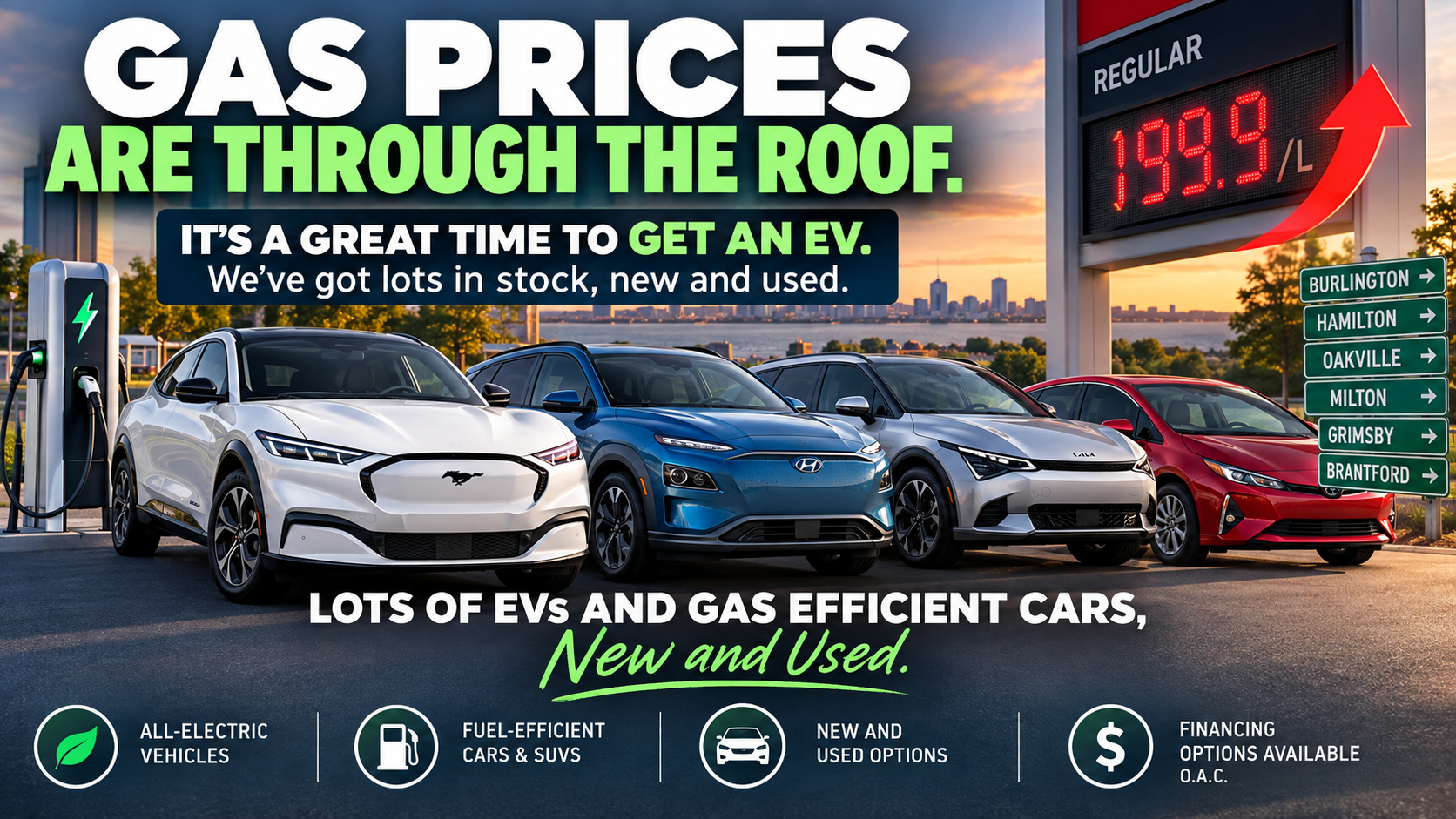
Looking for EVs for sale in Ontario? With fuel costs taking a bigger bite out of many household budgets, now is a good time to compare new and used EVs with today’s fuel-efficient gas vehicles.
For Ontario commuters and families, stopping at the gas station can feel a lot more painful when fuel prices climb.
If you drive to work every day, take the kids to school and activities, or regularly travel between communities such as Burlington, Hamilton, Oakville and Milton, fuel can represent a significant part of your monthly vehicle budget.
That is one reason more drivers are taking a closer look at EVs for sale in Ontario.
But going electric is not the only option.
At Car Nation Canada, we have a wide selection of new and used vehicles, including EVs and fuel-efficient cars, SUVs and other vehicles that can help drivers rethink how much they spend getting from A to B.
You can start by browsing our current new and used vehicle inventory and compare options based on your driving habits, budget and preferred vehicle type.
Key Takeaways
- Higher fuel costs can make the operating expenses of your current vehicle much more noticeable.
- A battery-electric vehicle eliminates gasoline purchases, but charging access, driving range and purchase price still need to fit your lifestyle.
- A fuel-efficient gas car or SUV can also significantly reduce fuel use compared with a larger or less-efficient vehicle.
- A used EV may offer another way to move into electric driving while shopping within a different price range.
- Compare the entire vehicle budget—not simply the price at the pump or the advertised monthly payment.
- Financing options are available for many credit situations, O.A.C., so shoppers can compare vehicles and financing together rather than treating them as separate decisions.
Why High Fuel Costs Have More Drivers Looking at EVs for Sale in Ontario
Gasoline prices do not stay in one place for long.
According to Natural Resources Canada’s information on Canadian transportation fuel prices, pump prices can be affected by factors including crude-oil prices, supply and demand, inventories and local market conditions.
For the person filling a tank several times a month, though, the important question is often much simpler:
How can I spend less on transportation?
An EV can be one answer because electricity replaces gasoline as the vehicle’s energy source.
That can be particularly attractive for drivers with predictable daily commutes, especially if they have convenient access to charging at home or work.
Someone commuting from Burlington to Hamilton every weekday, for example, may evaluate an EV very differently from someone who regularly makes long-distance trips without predictable charging access.
That is why the right decision is based on your actual driving—not simply on the fact that gasoline is expensive today.
New and Used EVs Give Ontario Shoppers More Choices
One of the biggest changes in the EV market is choice.
Electric vehicles are no longer limited to one particular type of buyer or one body style. Depending on available inventory, shoppers may find electric sedans, crossovers, SUVs and other configurations alongside traditional gasoline vehicles.
Buying new can appeal to shoppers who want the latest technology, current manufacturer warranty coverage and the newest generation of battery and charging systems.
Buying used can be attractive for shoppers who want to explore EV ownership at a different purchase price.
When considering a used EV, look beyond the odometer.
Ask about factors such as battery warranty coverage, charging equipment, estimated range, vehicle history and how the vehicle fits the distance you normally drive.
Natural Resources Canada’s EnerGuide information for battery-electric vehicles provides useful comparison information including electricity consumption in kWh/100 km, estimated driving range and recharge time.
Those numbers give you a much better basis for comparison than simply asking, “Is it electric?”
EV or Fuel-Efficient Gas Vehicle: Which Makes More Sense?
An EV is not automatically the right vehicle for every driver.
And a gasoline-powered vehicle is not automatically expensive to operate.
The better question is:
Which vehicle fits your driving pattern and total monthly budget?
Natural Resources Canada recommends comparing vehicle fuel-consumption ratings when choosing a vehicle. For gasoline vehicles, a lower L/100 km rating means lower fuel consumption.
That means someone moving from a larger, less-efficient vehicle into a compact sedan, crossover or efficient SUV may still see a meaningful reduction in fuel use without switching completely to electric power.
For some households, this can be the practical choice.
For others, especially people with a predictable commute and convenient home charging, an EV may make more sense.
There is also a middle ground. Plug-in hybrids can combine electric driving capability with a gasoline engine, depending on the model and how it is used. Natural Resources Canada provides separate consumption information for electric and gasoline operation on plug-in hybrid vehicles.
Don't Compare Vehicles on Fuel Costs Alone
Saving on gasoline is appealing, but fuel is only one part of vehicle ownership.
Before changing vehicles, consider:
- Purchase price
- Monthly payment
- Financing term
- Interest rate
- Insurance
- Electricity or gasoline costs
- Maintenance
- Expected annual kilometres
- Trade-in value
- Any remaining balance on your current vehicle
- Your expected length of ownership
This becomes particularly important if you still owe money on the vehicle you plan to trade.
If the amount owing is higher than the vehicle’s trade-in value, that difference is commonly called negative equity.
That does not automatically mean you cannot change vehicles, but it does mean the numbers should be reviewed carefully.
Our team can help you examine your trade-in, vehicle choices and financing together so you can understand the complete picture before deciding.
Could an EV Work for Your Daily Commute?
Consider what a normal week actually looks like.
How many kilometres do you drive each day?
Can you charge at home?
Is workplace charging available?
How often do you take longer highway trips?
Do you need a sedan, SUV or another body style?
How much passenger and cargo space do you actually use?
Those questions matter more than choosing a vehicle because it happens to be labelled “electric.”
For a commuter travelling around Oakville, Milton and Burlington, a vehicle that comfortably handles the normal daily drive and can charge overnight may be highly practical.
Someone frequently travelling through Grimsby, Niagara and communities farther from home may put more emphasis on highway range and public charging availability.
The goal is not to convince every driver to buy an EV.
It is to find the vehicle that works for the way you actually drive.
Fuel-Efficient Cars Are Still a Smart Alternative
Maybe you like the idea of spending less on fuel but are not ready to go fully electric.
That is completely reasonable.
A fuel-efficient gasoline vehicle can still be a major upgrade if your current car, truck or SUV uses considerably more fuel.
Natural Resources Canada’s vehicle comparison guidance points out that selecting the most fuel-efficient vehicle that still meets your everyday needs can reduce fuel expenses over the period you own it.
The key phrase is meets your everyday needs.
Buying the smallest vehicle available does not help if it cannot handle your family, cargo or commute.
Instead, compare similar vehicles.
If you need an SUV, compare efficient SUVs.
If you mostly commute alone, a smaller sedan or crossover may deserve a look.
If you need more passenger space, compare the efficiency ratings of vehicles that can realistically accommodate your household.
Our new and used inventory gives you the ability to shop across different vehicle types rather than forcing yourself into a single powertrain.
Used EVs Can Be Worth Considering
For budget-conscious shoppers, the used market deserves attention.
A pre-owned EV can provide many of the benefits of electric driving while opening another range of purchase prices.
As with any used vehicle, condition and history matter.
With an EV, you should also understand:
- Current estimated driving range
- Remaining battery-related warranty coverage
- Charging compatibility
- Charging cable or equipment included with the vehicle
- Your ability to charge at home or nearby
- How cold-weather driving could affect your normal range requirements
The right used EV is not simply the one with the lowest price.
It is the one whose purchase cost, condition, range and financing all make sense together.
Financing an EV or Fuel-Efficient Vehicle
A vehicle can save gasoline and still be the wrong choice if the overall payment stretches your budget too far.
That is why we encourage shoppers to look at affordability as a complete picture.
At Car Nation Canada, financing options are available for many credit situations, whether you have established credit, are rebuilding your credit, are a newcomer to Canada with a limited credit file, or have experienced financial challenges in the past.
You can learn more about our vehicle financing options and start the finance process online.
A finance application does not mean you have to select the most expensive vehicle available.
For many shoppers, the smarter conversation is:
What combination of vehicle price, payment, term length and operating cost makes sense for my household?
That is especially important for families whose budgets have already been squeezed by food, housing, fuel and other everyday expenses.
Financing is subject to lender approval. O.A.C. — On Approved Credit. Conditions may apply.
Shopping for EVs Across Southern Ontario
Car Nation Canada serves drivers from communities across Southern Ontario, giving shoppers access to new and used options without limiting the search to one type of vehicle.
That includes customers travelling from Burlington and Hamilton as well as Brantford, Grimsby, Oakville, Milton and the surrounding Halton and Niagara areas.
Whether you are specifically searching for EVs for sale in Ontario, comparing a used EV with a newer gas vehicle, or simply trying to find a car that uses less fuel than the one in your driveway today, starting with a broader inventory gives you more ways to compare.
Conclusion: High Gas Prices Are a Good Reason to Compare—Not Rush
When gasoline becomes more expensive, it is natural to wonder whether this is the moment to switch vehicles.
For some Ontario drivers, an EV can make excellent sense.
For others, a fuel-efficient gas vehicle or plug-in hybrid may provide the balance they are looking for.
The important part is to compare the whole picture: your commute, annual kilometres, charging access, vehicle price, trade-in, financing, term length and ongoing energy costs.
If you are spending more than you would like at the pump, start by browsing our available new and used vehicles. Compare EVs with fuel-efficient cars and SUVs that fit your actual needs.
When you are ready to look at the budget side, you can also explore financing and pre-approval options with Car Nation Canada.
Our goal is to help you find a vehicle—and a payment structure—that makes sense for where you are today.
Financing options are available for many credit situations. O.A.C. — On Approved Credit. Conditions may apply.
FAQ
Is an EV cheaper to drive than a gas vehicle in Ontario?
It can be, particularly for drivers who cover significant kilometres and have convenient charging access. However, the best comparison includes electricity costs, gasoline consumption, purchase price, insurance, financing and how many kilometres you drive each year.
Should I buy a new or used EV?
Both can make sense. A new EV may provide the newest battery and charging technology, while a used EV may offer a lower purchase-price range. With a pre-owned EV, pay particular attention to vehicle history, estimated range, battery-related warranty coverage and charging compatibility.
What if I want better fuel economy but I'm not ready for an EV?
Consider a fuel-efficient gasoline car, SUV or crossover. Compare L/100 km ratings between vehicles that meet the same practical needs. A lower L/100 km figure indicates lower fuel consumption.
Can I finance a used EV with less-than-perfect credit?
Financing options are available for many credit situations, including shoppers rebuilding credit or establishing a Canadian credit history. Approval, rate, term and other conditions depend on the applicant and lender. O.A.C. — On Approved Credit. Conditions may apply.
Can I trade my gas vehicle for an EV?
Yes, a trade-in can be considered as part of the transaction. If you still owe money on your current vehicle, the remaining loan balance and trade-in value should be reviewed together, particularly if there is negative equity. Our team can help you understand the numbers before you make a decision.