
Free VIN Check Tool Canada: Check a Vehicle Before You Buy
Free VIN Check Tool Canada: Check a Vehicle Before You Buy
Posted on November 11, 2026
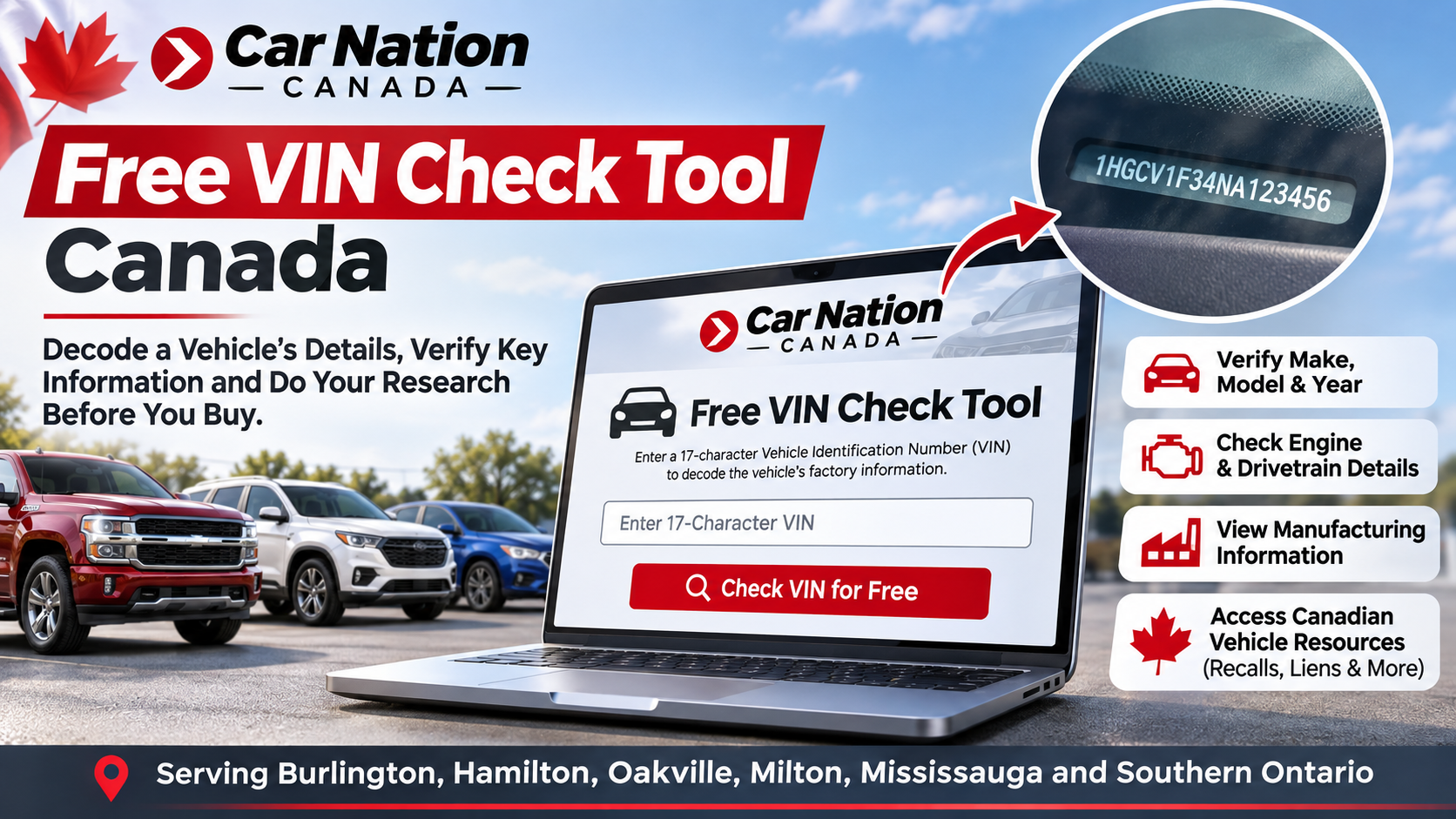
Free VIN Check Tool Canada: Check a Vehicle Before You Buy
Use the Car Nation Canada free VIN check tool to decode a vehicle’s factory specifications and start verifying important information before buying, selling, trading, or financing a vehicle in Ontario.
Buying a used vehicle should never begin with the question, “How much is the monthly payment?”
It should begin with a simpler one: What exactly is this vehicle?
Every car, truck, SUV and minivan carries a Vehicle Identification Number — better known as a VIN. For most modern vehicles, that 17-character code acts like a unique fingerprint that can help identify important factory information about the vehicle.
With the Car Nation Canada free VIN check tool, Ontario drivers can enter a VIN and quickly decode useful vehicle information before taking the next step.
Whether you are shopping in Burlington, Hamilton, Oakville, Milton, Mississauga or elsewhere in Southern Ontario, checking the VIN is one of the easiest pieces of research you can do before getting serious about a vehicle.
Key Takeaways
- A VIN is the unique identifying number assigned to a vehicle.
- Most modern North American vehicles use a standardized 17-character VIN.
- A VIN decoder can help identify factory information such as make, model, model year, body style, engine and drivetrain details.
- A free VIN decoder is not the same thing as a complete vehicle history report.
- Used-car shoppers should also investigate accident history, liens, registration information, safety recalls and the physical condition of the vehicle.
- Ontario private-sale buyers should understand the Used Vehicle Information Package, or UVIP, requirements.
- You can start your research using the Car Nation Canada free VIN check tool.
What Is a VIN?
VIN stands for Vehicle Identification Number.
Transport Canada’s Motor Vehicle Safety Regulations require vehicles to carry a vehicle identification number and establish requirements governing how that number is assigned and displayed.
Think of the VIN as the vehicle’s serial number.
Instead of identifying a smartphone or appliance, the VIN identifies a particular automobile.
On a modern vehicle, information encoded into the VIN can help determine details such as:
- Manufacturer
- Make
- Model
- Model year
- Vehicle type
- Body style
- Engine configuration
- Drivetrain
- Manufacturing plant
- Country of manufacture
The Car Nation Canada tool is designed to decode that factory information and provide convenient pathways to additional Canadian vehicle resources.
Where Do I Find My Vehicle's VIN?
You do not usually need any special equipment to find a VIN.
Start by looking at the lower corner of the dashboard on the driver's side of the vehicle. It is normally visible through the windshield.
You may also find the VIN:
- On the driver's-side door or door pillar
- On your vehicle permit or ownership paperwork
- On insurance documents
- On service and maintenance records
- On certain manufacturer labels attached to the vehicle
The Car Nation Canada tool accepts the standard 17-character VIN used on modern North American vehicles.
One easy detail to remember: standardized VINs do not use the letters I, O or Q, helping avoid confusion with the numbers 1 and 0.
What Does the Car Nation Canada Free VIN Check Tool Do?
Our free Canadian VIN check and vehicle decoder is designed to give shoppers a useful starting point.
Enter the vehicle's 17-character VIN and the tool can decode available factory build information.
Depending on the vehicle, that can include information such as:
Vehicle Identity
You may be able to verify the manufacturer, model, model year, trim-related information and body configuration.
That is helpful when an online advertisement simply says something vague like “fully loaded SUV” or “premium truck.”
The VIN gives you another data point to compare with what is physically sitting in front of you.
Engine and Powertrain Information
The VIN decoder may identify factory powertrain details such as:
- Engine displacement
- Cylinder configuration
- Fuel type
- Transmission information
- Front-wheel drive
- Rear-wheel drive
- All-wheel drive
- Four-wheel drive
That can be particularly useful when researching used trucks and SUVs where different engine or drivetrain combinations can significantly affect capability, fuel consumption and market value.
Manufacturing Information
VIN data can also help identify where a vehicle was manufactured and information associated with its assembly.
That does not tell you how the previous owner treated the vehicle, but it does help establish what the vehicle was originally built to be.
A VIN Decoder Is Not a Full Vehicle History Report
This distinction is extremely important.
A VIN decoder primarily helps identify the vehicle and its factory specifications.
A comprehensive vehicle history investigation goes further.
It may involve checking:
- Reported collisions
- Previous registrations
- Odometer readings
- Existing liens
- Salvage or rebuilt branding
- Insurance claims
- Stolen-vehicle records
- Outstanding recalls
The Car Nation Canada VIN tool helps you begin the process and provides access to additional Canadian resources, but it should not be treated as proof that a vehicle has never been damaged, has no lien or has a perfectly clean history.
OMVIC recommends that used-vehicle buyers review a vehicle history report and carefully research a vehicle before committing to a purchase.
Why Check a VIN Before Buying a Used Car?
Used vehicles can look remarkably similar in photographs.
Two SUVs sitting side by side could have the same paint colour, wheels and exterior appearance but completely different engines, trims, drivetrains and original equipment.
Checking the VIN lets you compare the decoded information with the seller's description.
For example, imagine you are considering a used AWD SUV for commuting between Burlington and Mississauga during the winter.
The listing says AWD.
The badge on the tailgate says AWD.
But you still want to verify as much information as possible before putting money down.
A VIN check gives you another layer of information.
If something does not match, that does not automatically mean the vehicle is problematic. Modifications, repairs and database limitations can all create discrepancies.
It does mean you should ask more questions.
Check the VIN When Buying Privately in Ontario
A VIN check becomes especially valuable when buying from a private seller.
OMVIC advises private-sale buyers to carefully research the seller and vehicle, review a vehicle history report, inspect the Used Vehicle Information Package and check for liens.
The VIN connects much of that research together.
Ontario's Used Vehicle Information Package can provide information including previous Ontario registrations, lien information and historical odometer information where available.
OMVIC specifically notes that a VIN is required to obtain a UVIP or vehicle history report.
That means the VIN should be one of the first pieces of information you request when investigating a private-sale vehicle.
Check for Safety Recalls
A vehicle can appear to run perfectly while still being subject to an outstanding manufacturer safety recall.
After decoding the VIN, shoppers can continue their research through official resources such as Transport Canada to investigate recalls and safety information.
Our VIN tool also provides convenient pathways to Canadian safety and recall resources.
Remember that a recall lookup and a factory VIN decode answer different questions.
The decoder helps answer:
“What vehicle is this?”
A recall search helps answer:
“Does this vehicle have safety campaigns I should investigate?”
Both matter.
Check for Stolen-Vehicle Information
Vehicle theft remains another reason to verify a VIN carefully.
When considering a private vehicle, compare the VIN displayed on the dashboard with the VIN shown on the ownership paperwork.
If the numbers do not match, stop.
Do not send money.
Do not assume it is simply a typo.
OMVIC recommends verifying the identity of a private seller and making sure it matches the vehicle's ownership documents. It also recommends researching vehicle history before completing the transaction.
The Car Nation Canada VIN page provides access to the RCMP Canadian Police Information Centre stolen-vehicle search so buyers can continue researching the vehicle through official channels.
Check the VIN Before Financing a Vehicle
VIN research is not only useful for cash buyers.
It matters when financing too.
Before committing to a major purchase, you want to understand both the vehicle and the financing.
Start by researching the VIN.
Then consider:
- Purchase price
- Down payment
- Trade-in value
- Existing negative equity
- Loan term
- Interest rate
- Total borrowing cost
- Expected ownership expenses
- Insurance
- Fuel
- Maintenance
If financing is part of your purchase, you can explore Car Nation Canada's automotive financing options and speak with our team about programs that may be available for different financial situations.
Financing is O.A.C. — On Approved Credit. Conditions may apply.
The goal should never be to simply get approved.
The goal is to find a vehicle and financing structure that realistically fits your budget.
Using a VIN Check When Trading In Your Vehicle
VIN decoding can also be useful when you are selling or trading your current vehicle.
Your exact configuration matters.
For example, the difference between two versions of the same truck could include:
- Engine
- Drivetrain
- Cab configuration
- Box length
- Factory package
- Trim level
Those details can influence desirability and valuation.
If you are considering replacing your current vehicle, decode your VIN first and make sure you know exactly what you own.
Then you can compare replacement options in our Car Nation Canada vehicle inventory.
VIN Checks Are Particularly Helpful When Shopping Online
A huge portion of vehicle research now happens before a shopper ever reaches a dealership.
That is convenient, but photographs only tell you so much.
OMVIC warns consumers to be particularly careful with online vehicle listings and recommends physically inspecting vehicles, confirming the legitimacy of the seller and researching vehicle history before paying.
If you are browsing an SUV in Hamilton, a commuter car in Oakville or a truck advertised somewhere across the Greater Toronto and Hamilton Area, ask for the VIN.
Then research it before getting emotionally attached to the deal.
A legitimate used-vehicle purchase should stand up to reasonable questions and research.
Free VIN Check for Burlington and Southern Ontario Drivers
Car Nation Canada serves drivers throughout Southern Ontario, and vehicle research does not stop at municipal boundaries.
Someone living in Burlington might find the right truck in Hamilton.
A shopper from Milton might find their next SUV while searching toward Oakville.
Someone from Mississauga may discover the right used vehicle farther west.
Drivers from Grimsby, Brantford and communities throughout the Niagara and GTHA corridors increasingly search across a wide geographic area to find the right vehicle.
The farther you expand your search, the more important it becomes to research a vehicle before travelling to see it.
Asking the seller for the VIN gives you something concrete to investigate first.
A Simple Used-Car Research Checklist
Before purchasing a pre-owned vehicle, work through a checklist instead of relying on appearance alone.
1. Get the VIN.
Decode it and verify the basic factory information.
2. Compare the VIN physically.
Make sure the VIN visible on the vehicle matches the paperwork.
3. Review the vehicle's history.
Investigate accident, registration and odometer information through appropriate vehicle-history resources.
4. Investigate liens.
Do not assume a privately sold vehicle is lien-free.
5. Check recalls.
Use official manufacturer or Transport Canada recall resources.
6. Inspect and test drive the vehicle.
A database cannot tell you whether a suspension component is worn out, the brakes pulsate or the transmission behaves abnormally.
7. Understand your financing.
Know the payment, term, rate and total borrowing cost before signing.
8. Get promises in writing.
OMVIC recommends that buyers ensure promises and representations made during a transaction appear in the contract.
Start With the Car Nation Canada Free VIN Check Tool
A VIN will not tell you everything about a vehicle.
But it can tell you where to start looking.
Before buying, selling, trading or financing a used car, truck, SUV or minivan, take a few minutes to identify the vehicle properly.
Use our free VIN check tool to decode the vehicle's available factory information and access additional Canadian resources for your research.
Once you know what you are looking at, you can browse our current vehicle inventory or learn more about auto financing through Car Nation Canada.
A smarter vehicle purchase starts with better information.
Frequently Asked Questions About Free VIN Checks
Is the Car Nation Canada VIN check really free?
Yes. You can use the Car Nation Canada VIN decoder to enter a valid 17-character VIN and decode available factory vehicle information without paying for the decoder.
Can a free VIN check tell me if a car has been in an accident?
Not necessarily. A VIN decoder identifies factory vehicle information. Accident and insurance history generally requires additional vehicle-history research. The Car Nation Canada VIN page provides links to resources that can help you continue investigating a vehicle.
Can I check a Canadian VIN for free?
Yes. You can enter a standard 17-character VIN into the Car Nation Canada free VIN check tool to decode available vehicle information and then continue your research using Canadian recall, ownership, lien and stolen-vehicle resources where applicable.
Can a VIN tell me if a vehicle has a lien?
The VIN is used when conducting lien searches, but the VIN decoder itself should not be treated as confirmation that a vehicle is lien-free. Ontario buyers should conduct the appropriate lien and UVIP research before completing a private purchase.
Should I check the VIN before applying for vehicle financing?
It is a good idea to understand exactly which vehicle you are considering before making a major financial commitment. After researching the vehicle, you can review Car Nation Canada financing options. Financing is O.A.C. and conditions may apply.
Where can I check a VIN in Ontario?
You can start online with the Car Nation Canada free VIN check tool and then use the resulting information alongside official provincial, federal and vehicle-history resources before making your purchase decision.