
EV Financing Options in Ontario for Burlington Drivers
EV Financing Options in Ontario for Burlington Drivers
Posted on October 20, 2026
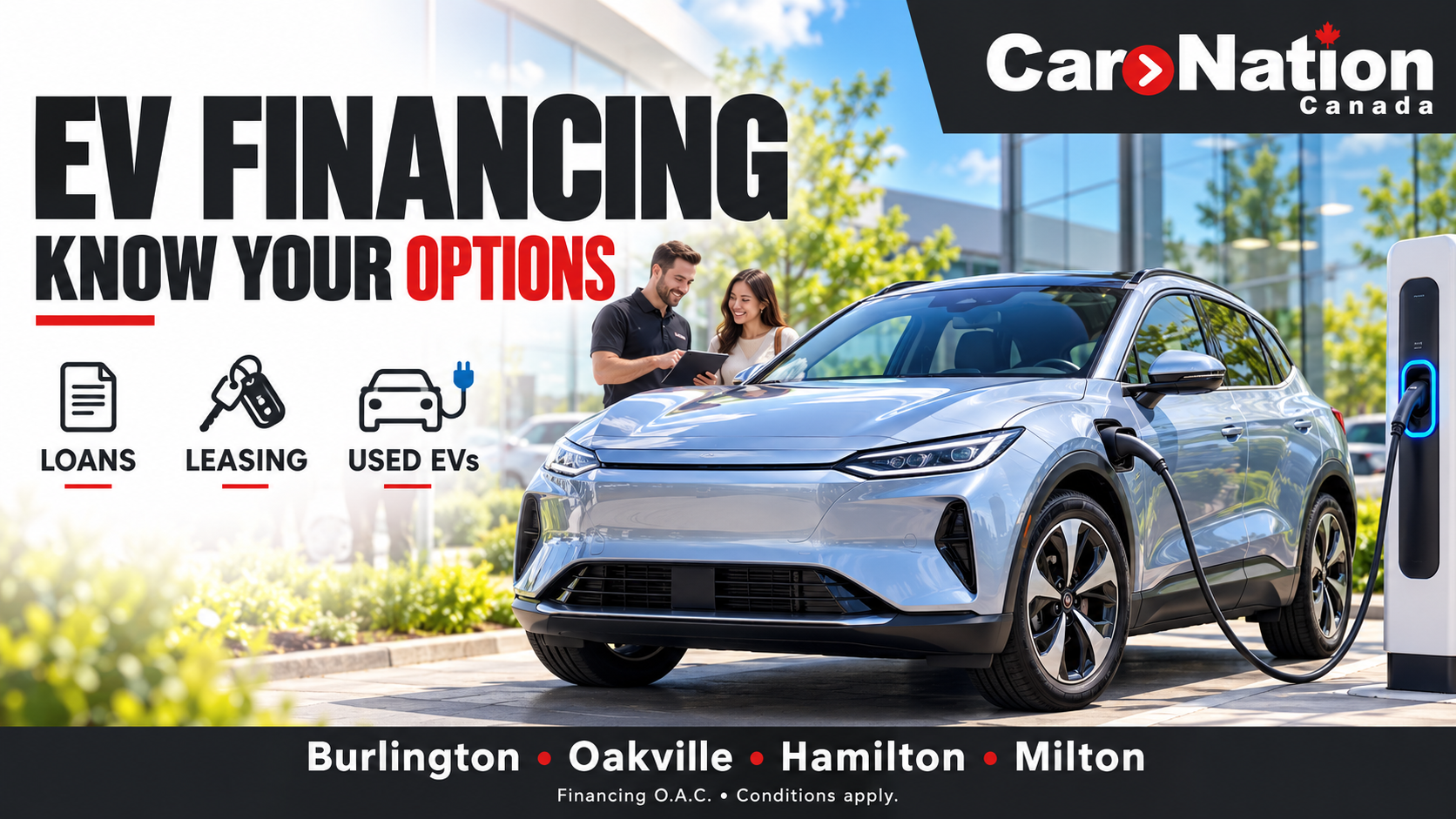
EV Financing Options in Ontario for Burlington Drivers
Compare EV loans, leasing, used EV financing, credit options and Canadian incentives to find a payment plan that fits your budget.
Your main EV financing options are a dealership-arranged loan, a bank or credit union loan, and a lease. Depending on your circumstances, you can also explore green vehicle lending programs, personal credit, business financing or a combination of savings and borrowing. Canada.ca
For drivers in Burlington, Oakville, Hamilton and Milton, the right choice starts with how much you can comfortably spend and how long you expect to keep the vehicle.
Whether you are considering an electric SUV, sedan, pickup truck or plug-in hybrid minivan, compare the complete deal: purchase price, borrowing costs, charging expenses and any amount still owing when you want to change vehicles.
Key Takeaways
- Compare the APR, term and total amount payable alongside the monthly payment.
- Loans support ownership; leases provide use of the vehicle under a contract with specific return or purchase terms.
- Used EVs can be financed, but financing eligibility and federal rebate eligibility are different.
- A trade-in helps your budget only after you account for its outstanding loan.
- Include charging, insurance and remaining battery warranty in your decision.
The Main EV Financing Options
Financing through a dealership
With dealer-arranged financing, you apply at the dealership and a lender provides the loan. That lender may be a bank, credit union, manufacturer finance company or independent finance provider, as explained in the Financial Consumer Agency of Canada’s guide to car financing. Canada.ca
The annual percentage rate, or APR, includes interest and certain borrowing charges, helping you compare financing costs. OMVIC
The convenience is handling the vehicle purchase, trade-in and financing together. Ask which offers are available for your application, then compare their APRs, terms and total costs. Do not assume one offer represents every option in the market.
For a new EV, ask whether manufacturer-supported financing is available. Compare a promotional rate against any alternative purchase discount. A lower rate does not automatically produce the lowest overall cost if the vehicle price or available discounts change.
Borrowing directly from a bank or credit union
You can also approach your own financial institution for a vehicle loan. A written quote gives you a useful comparison when reviewing dealership financing.
Check the approval’s expiry date, vehicle restrictions and required down payment. A preliminary pre-approval may still depend on income verification and the specific EV you choose.
The FCAC’s comparison guidance recommends reviewing the amount financed, payment schedule, fees and loan length together. Canada.ca
Asking about green vehicle loans
Some lenders have dedicated electric or hybrid vehicle financing programs. Ask whether the specific new or used vehicle qualifies, what rate applies and whether the offer requires a participating dealership.
Green-loan eligibility is separate from government rebate eligibility. An EV that qualifies for one may not qualify for the other. CIBC
Leasing an EV
A lease pays for the use of an EV over an agreed period. It may suit you if you prefer changing vehicles every few years and can estimate your annual kilometres reliably.
With a closed-end lease, you can generally return the vehicle at the end or exercise a purchase option, subject to the contract. Excess kilometres, damage and other applicable charges can still be payable. An open-end lease can leave you responsible for a shortfall between the agreed residual value and the vehicle’s eventual sale value.
The distinction matters when comparing EV resale risk. Review OMVIC’s explanation of leasing and ask for the kilometre allowance, return conditions, buyout price and early termination costs in writing. OMVIC
If ownership is your goal, compare the full lease-and-buyout cost with financing the purchase from the start.
Financing a Used EV or a Lease Buyout
A used EV can be financed through an eligible lender, but its age, kilometres and value may affect the available term and approval. TD Canada Trust
Before choosing the loan, request battery condition information, confirm the remaining battery warranty and its transfer rules, review vehicle history, and arrange an appropriate inspection. Consider how much of your repayment period could fall outside warranty coverage.
If you already lease an EV, a lease buyout loan may let you finance the contractual purchase amount, applicable taxes and eligible fees. Compare that complete buyout cost with the vehicle’s condition and current market value.
Buyout financing requires a fresh lending decision. The rate and approval are not automatically carried over from the lease. Exclusive Offers
Other Ways to Fund an EV Purchase
Personal loans and lines of credit
A personal instalment loan or existing line of credit may be another option, subject to the lender’s terms. Compare its cost with a vehicle loan before using it.
A line of credit commonly has a variable rate. Minimum payments may cover only interest, leaving the principal unchanged. Set a repayment schedule that actually clears the vehicle debt, using the FCAC’s guidance on lines of credit. Canada.ca
Home equity borrowing
A home equity line of credit, or HELOC, uses your home as security. It may offer a different rate, but it brings the vehicle purchase into your housing debt.
Consider fees, rate changes and the risk to your home if you cannot repay. A seemingly inexpensive rate can become costly if you repay the car over many more years. Review the FCAC’s HELOC guidance before choosing this route. Canada.ca
Balloon financing and specialty contracts
If you are offered balloon financing, part of the balance remains for a larger final payment. Ask exactly how much will be due and whether you must pay it, refinance it or sell the vehicle to settle the debt. Do not assume the contract gives you a right to return the EV. bmw.ca
Rent-to-own arrangements also require close attention to the total paid, ownership conditions and any final purchase amount. Availability depends on the provider and vehicle. Canada.ca
Savings and a smaller loan
You can pay cash or combine savings with financing. Compare the interest saved with your need to keep money available for emergencies, charging installation and other household expenses.
A larger down payment can reduce borrowing, but using every available dollar may leave the overall budget too tight.
EV Financing Options When Credit Is a Concern
If you are rebuilding credit or new to Canada, ask about lenders that consider your circumstances. Some offer newcomer or credit rebuilding programs, with their own requirements. TD Canada Trust
Prepare identification, income documentation, details of your existing debts and the amount you can realistically contribute. There is no single credit score that guarantees approval or a particular EV financing rate.
A co-signer or co-borrower may strengthen an application, but is equally responsible for repaying the unpaid loan balance. Review the FCAC’s joint borrower guidance together before committing. Canada.ca
Refinancing later may be possible if you qualify. Compare the new fees, remaining repayment period and total interest. Avoid committing to an unaffordable loan on the assumption that a lower rate will become available.
Our Car Nation Canada finance application provides a starting point for discussing your budget and available options. Financing is O.A.C., or On Approved Credit. Conditions may apply.
Down Payments and Trade-In Equity
Your trade-in’s value and its loan balance are separate numbers.
For example, if the vehicle is worth $18,000 and you owe $22,000, you have $4,000 in negative equity. If a lender allows that shortfall to be added to your EV loan, the debt remains and you may pay interest on it.
Request an itemized breakdown showing the EV price, trade-in allowance, loan payout, taxes, incentives and final amount financed. The FCAC’s guide to negative equity explains why carrying old debt into a replacement vehicle can increase financial pressure. Canada.ca
For zero-down or deferred-payment offers, ask about eligibility, total borrowing costs and whether interest accumulates before payments begin.
How Federal EV Incentives Affect Financing
As of October 20, 2026, the federal program is the Electric Vehicle Affordability Program, or EVAP.
At the 2026 incentive level, an eligible purchase or lease of at least 48 months can receive up to:
- $5,000 for a battery electric or hydrogen fuel-cell vehicle.
- $2,500 for a plug-in hybrid electric vehicle.
Eligible leases from 12 to 47 months receive a prorated amount. Ordinary used EVs do not qualify; qualifying dealer demonstrators under 10,000 km are an exception. Conventional hybrids that do not plug in are outside the program’s eligible vehicle categories. tc.canada.ca
Vehicles generally need to be manufactured in Canada or a country with a Canadian free-trade agreement. The program-defined final transaction value must generally be $50,000 or less, with no price cap for Canadian-made eligible EVs. tc.canada.ca
That eligibility calculation is different from the amount financed. A down payment or trade-in does not reduce the program’s transaction value to make an otherwise over-limit vehicle qualify.
A participating dealership applies an approved incentive after taxes and fees. Cash purchases can qualify too. Review the EVAP questions and answers for the transaction rules. tc.canada.ca
The incentive level is scheduled to decrease in 2027. The applicable year depends on when the dealership submits the eligibility assessment, with program timing requirements, rather than simply the delivery date. Have the amount confirmed for your transaction. tc.canada.ca
Do not automatically add an Ontario provincial purchase rebate to your budget. The current federal provincial incentive directory does not list one for Ontario. Canada.ca
Business and Commercial EV Financing
Business owners can ask about commercial vehicle loans, leases and business credit facilities. Confirm that the financing and insurance permit the intended use, including deliveries or rideshare work where relevant.
The CRA’s motor vehicle expense guidance explains how eligible interest, leasing expenses and capital cost allowance may be deductible, subject to business use and applicable limits.
Loan principal is not itself a deductible operating expense. Have your accountant compare the tax treatment, available incentives and ownership structure before signing. A tax deduction does not provide the same cash benefit as a purchase rebate. Canada.ca
Compare the Payment With the Total Cost
Consider this hypothetical example, with $40,000 financed at a fixed 7.00% annual interest rate, monthly payments and no additional financing fees, making the APR 7.00%.
The $40,000 is the final loan balance after any taxes, fees, incentives, trade-in and down payment. This is an illustration, not an available financing offer.
| Loan term | Approximate monthly payment | Total interest | Total repaid |
|---|---|---|---|
| 60 months | $792.05 | $7,522.88 | $47,522.88 |
| 84 months | $603.71 | $10,711.40 | $50,711.40 |
The longer term lowers the monthly payment by about $188, but adds about $3,189 in interest. Calculations assume monthly compounding and no extra payments; actual payment rounding may differ.
Ask whether your rate is fixed or variable, how extra payments are applied, and whether early repayment carries a charge. Use the Government of Canada’s lease or loan calculator to compare written quotes.
Add Charging and Ownership Costs to the Budget
Include insurance, winter tires, maintenance, repairs and charging in your monthly plan. If you want home charging, obtain an installation quote before deciding how much vehicle payment you can afford.
A commuter with reliable home charging may face a different energy bill from someone relying on public fast charging. Use your actual driving distance and likely charging mix, with Natural Resources Canada’s charging-cost guidance as a starting point. Natural Resources Canada
Under OMVIC’s all-in pricing rules, dealer advertisements generally must include the mandatory charges the dealer intends to collect, apart from HST and licensing when disclosed. OMVIC
Review optional warranties and protection products individually. Ask what they cover, what they exclude and how financing them changes your total cost.
Choose an EV Financing Plan You Can Sustain
Start with your household budget, expected ownership period and charging access. Then compare written financing options for vehicles that meet those needs.
You can explore Car Nation Canada’s current inventory to shortlist vehicles and ask our team about EV and plug-in hybrid availability. When you are ready, start a finance application so we can discuss the options available for your circumstances.
Financing options are available for many credit situations, O.A.C. Rates, terms, vehicle eligibility and incentives are subject to applicable conditions.
Frequently Asked Questions
Can I finance a used electric vehicle?
Yes, subject to lender approval and vehicle eligibility. Compare the loan terms alongside battery condition, warranty coverage and the vehicle’s history. Used EV financing does not make the vehicle eligible for EVAP.
Is leasing an EV better than financing?
It depends on your ownership plans, kilometres and the complete cost. A closed-end lease provides a contractual return option. Financing may suit someone who plans to keep the vehicle after the loan is repaid.
Do I need a special EV loan?
No. A standard vehicle loan may finance an eligible EV. A green vehicle program is an additional option to compare where available.
Can I get EV financing with bad credit or no Canadian credit history?
It may be possible. Lenders assess your application and the vehicle, and available rates or down-payment requirements may differ. Approval is not guaranteed.
Do I have to finance to receive the federal EV incentive?
No. Eligible cash purchases, financed purchases and qualifying leases can receive EVAP support. The buyer, vehicle and transaction must meet the program’s requirements.