
Escaping the 96-Month Auto Loan Trap: How Long Terms Keep You Underwater
Escaping the 96-Month Auto Loan Trap: How Long Terms Keep You Underwater
Posted on November 13, 2026
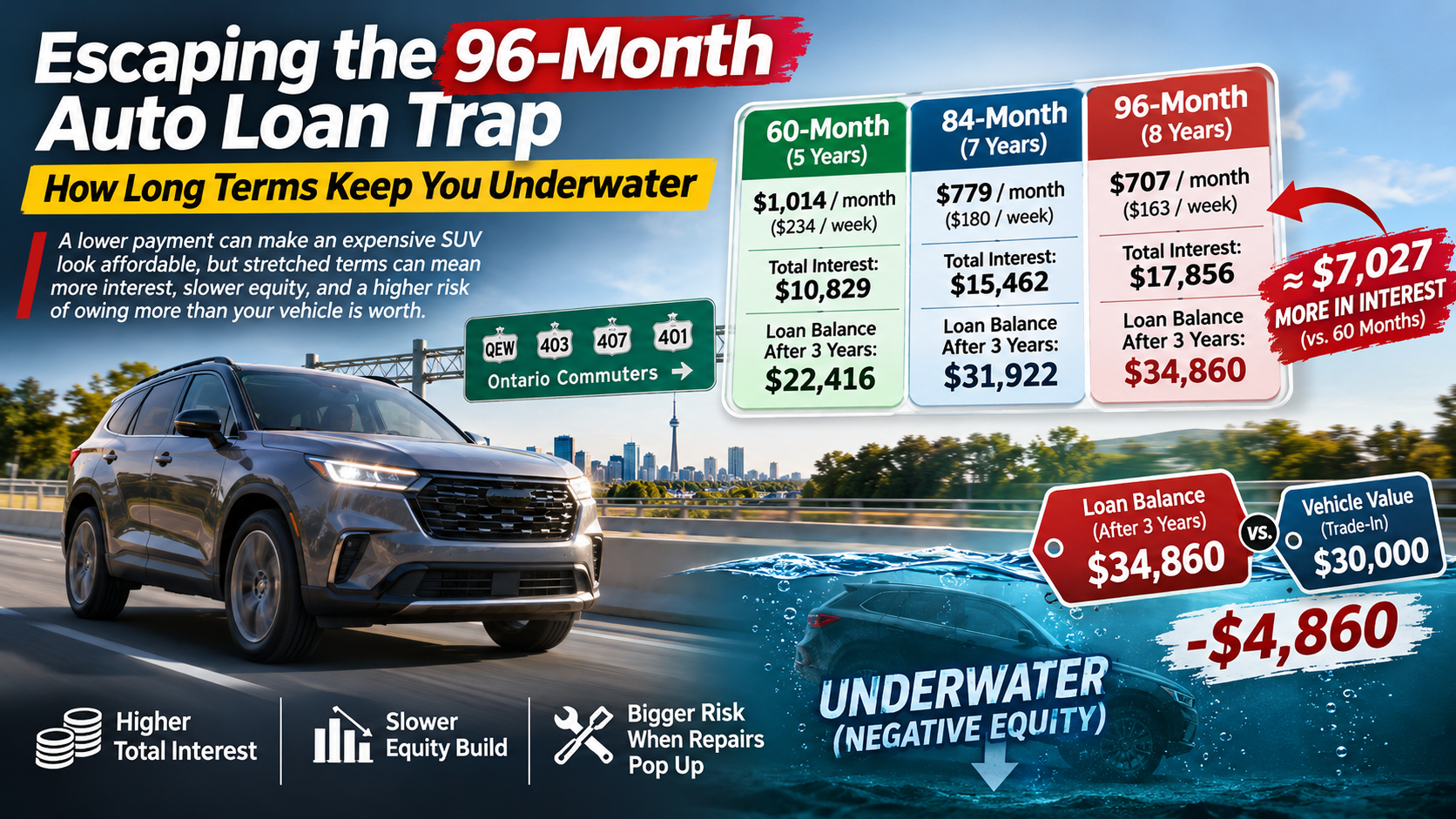
Escaping the 96-Month Auto Loan Trap: How Long Terms Keep You Underwater
An eight-year car loan can make an expensive SUV look affordable, but the lower payments may cost you thousands in additional interest and leave you owing more than your vehicle is worth. Here's what Ontario drivers need to know before signing a 96-month financing agreement.
The $160-a-Week SUV That Could Cost You Thousands More
You found the perfect SUV. It has heated seats, all-wheel drive, enough room for the family, and everything you need for Ontario winters.
The price? A little higher than you planned.
But then you hear the magic number: "You could drive it home for around $160 a week!"
Suddenly, that expensive SUV seems manageable.
There is just one problem. That affordable payment could be attached to a 96-month auto loan, meaning you will still be making payments eight years from now.
For commuters travelling between Burlington, Hamilton, Oakville, and the Greater Toronto Area, those eight years could mean hundreds of thousands of kilometres on the odometer before the vehicle is paid off.
At Car Nation Canada, we believe your financing should fit your budget without creating unnecessary financial pressure down the road.
Let's look at what actually happens when you stretch a car loan from five years to eight.
Key Takeaways
- A 96-month loan lowers your payment but increases your total interest costs.
- Longer loan terms reduce your principal balance more slowly, increasing the risk of negative equity.
- A vehicle's market value can fall faster than your outstanding loan balance, especially with high annual mileage.
- Repairs and maintenance don't stop just because you still owe money on the vehicle.
- Comparing 60-, 84-, and 96-month financing options before buying can help you avoid expensive surprises.
60 vs. 84 vs. 96-Month Auto Loans: The Real Numbers
Let's compare three financing options on the same SUV.
For this example, assume:
- Total amount financed: $50,000 CAD
- Annual interest rate: 8.00%
- Down payment: $0
- Fixed interest rate with monthly amortization
- No additional financing fees or early repayments
These are hypothetical calculations, not advertised financing offers. The $50,000 represents the complete financed amount, including any applicable vehicle taxes and fees.
| Loan comparison | 60 months | 84 months | 96 months |
|---|---|---|---|
| Loan duration | 5 years | 7 years | 8 years |
| Monthly payment | $1,014 | $779 | $707 |
| Weekly equivalent | $234 | $180 | $163 |
| Total interest | $10,829 | $15,462 | $17,856 |
| Total repayment | $60,829 | $65,462 | $67,856 |
| Loan balance after 3 years | $22,416 | $31,922 | $34,860 |
Figures are rounded. Weekly equivalents are calculated from monthly payments and are not actual weekly payment quotes. Actual financing calculations depend on the lender's interest calculation method, contract terms, fees, and payment schedule. Financing O.A.C.
What Does This Comparison Tell Us?
The 96-month loan reduces the monthly payment by approximately $307 compared with the 60-month option.
That can make a meaningful difference for a family balancing mortgage payments, groceries, insurance, and other household expenses.
However, the eight-year loan also produces approximately $7,027 more interest over its full repayment period.
You are financing the exact same vehicle.
You are paying the exact same assumed interest rate.
The difference is how long you remain in debt.
Even the difference between 84 and 96 months is significant. Extending the loan by just one additional year lowers the monthly payment by approximately $72 but adds around $2,394 in interest.
The Financial Consumer Agency of Canada's guidance on auto-financing risks explains why longer financing terms can increase borrowing costs and expose consumers to negative equity.
How Car Loan Amortization Works During the First Three Years
A common misconception is that lenders collect all the interest first and leave the principal untouched.
That is not how a standard amortizing car loan works.
With the fixed-rate monthly example above, interest is calculated on the remaining balance. Because the balance is highest at the beginning, a larger share of your early payments goes toward interest.
As the balance declines, more of each payment goes toward principal.
Consider the first payment on our $50,000 loan at 8%.
The first month's interest is approximately $333.
On the 96-month plan, the $707 monthly payment leaves only about $374 to reduce principal.
On the 60-month plan, the $1,014 payment puts approximately $680 toward principal during the first month.
Both loans begin with the same debt and interest rate, but the shorter loan pays down the balance much faster.
After 36 Months, the Difference Is Enormous
Here is how much of the original $50,000 debt you have actually eliminated after making three years of scheduled payments:
| Loan term | Principal repaid | Remaining debt |
|---|---|---|
| 60 months | $27,584 | $22,416 |
| 84 months | $18,078 | $31,922 |
| 96 months | $15,140 | $34,860 |
After three years, the 60-month borrower has paid off more than half the original loan.
The 96-month borrower has paid off only about 30%.
In other words, nearly 70% of the original debt is still outstanding after three full years of payments.
That becomes particularly important when it is time to trade, sell, or replace the vehicle.
What Happens When Your SUV Is Worth Less Than Your Loan?
Welcome to negative equity.
Also called being underwater on a car loan, negative equity occurs when you owe more than your vehicle could reasonably sell or trade for.
Your loan balance doesn't determine what your vehicle is worth.
Its value depends on factors such as age, mileage, condition, accident history, equipment, and current market demand.
Let's revisit our financing comparison.
Imagine that after three years, your SUV has a hypothetical trade-in value of $30,000.
| Loan term | Balance owed | Trade value | Equity |
|---|---|---|---|
| 60 months | $22,416 | $30,000 | +$7,584 |
| 84 months | $31,922 | $30,000 | -$1,922 |
| 96 months | $34,860 | $30,000 | -$4,860 |
The $30,000 trade-in value is an illustrative assumption, not a predicted depreciation rate or appraisal.
On the 60-month loan, you have approximately $7,584 in positive equity.
On the 96-month loan, you are underwater by approximately $4,860.
That means if you want to trade the SUV, the amount owing exceeds its trade value by nearly $5,000.
You would generally need to address that shortfall before completing the trade.
One potential option is adding eligible negative equity to a replacement vehicle loan, subject to lender approval. However, doing so increases the debt on your next vehicle and may start another cycle of expensive borrowing.
Ontario's automotive regulator, OMVIC, provides consumer education on understanding negative equity and the dangers of carrying unpaid vehicle debt into another purchase.
Why Ontario Highway Commuters Face Extra Risk
An eight-year loan can be particularly challenging for drivers who accumulate significant annual mileage.
Think about a commuter travelling from Milton to Mississauga every weekday or someone driving between Burlington and downtown Hamilton.
Add weekend trips, family activities, appointments, and holiday travel.
An annual driving distance of 28,000 km is entirely possible.
Over a 96-month loan, that could mean:
| Time driving | Cumulative mileage |
|---|---|
| 1 year | 28,000 km |
| 3 years | 84,000 km |
| 5 years | 140,000 km |
| 8 years | 224,000 km |
Those figures assume consistent driving and are not a prediction of how far every Ontario driver travels.
A well-maintained vehicle can certainly remain reliable at high mileage.
However, additional kilometres typically introduce more wear, influence resale value, and increase the possibility of major maintenance during ownership.
This creates a difficult combination:
Your vehicle gets older, your mileage increases, your trade value may decline, and you still owe a substantial amount on the loan.
That is why drivers covering significant distances along the QEW, Highway 403, Highway 407, and Highway 401 should consider annual kilometres alongside loan affordability.
The Mechanical Repair Problem: When Your Loan Outlasts Your Warranty
Now imagine you are six years into an eight-year auto loan.
You are still making payments.
Your vehicle has accumulated significant mileage.
Its original factory warranty may have expired, depending on the manufacturer's coverage, warranty terms, and kilometres driven.
Suddenly, you need a repair.
Maybe it is a suspension component, air-conditioning system, transmission repair, or another unexpected mechanical issue.
You could be facing a substantial maintenance bill while still owing money on your original purchase.
The lender does not automatically stop collecting payments because your vehicle needs repairs.
You must continue meeting your contractual loan obligations while determining how to cover the mechanical expense.
If the repairs cost more than you can reasonably afford, replacing the vehicle might seem appealing.
But if the vehicle has negative equity, trading it could create an additional financial burden.
What About Insurance?
A major accident can introduce another risk.
If your vehicle is declared a total loss, your insurer's settlement may be based on the applicable insured value and policy conditions rather than your outstanding loan balance.
If the settlement is lower than what you owe, you may be responsible for the difference.
Certain guaranteed asset protection products may address specified shortfalls, but coverage, exclusions, eligibility, and costs vary considerably.
Ask questions and review the policy before purchasing optional protection.
Are 96-Month Car Loans Always a Bad Idea?
Not necessarily.
Long-term financing may be appropriate for some buyers, especially those who plan to keep their vehicle for the entire loan term and understand the total borrowing cost.
A reliable vehicle, competitive rate, meaningful down payment, and manageable monthly expenses can reduce some of the risks.
The concern is not that an eight-year loan is automatically irresponsible.
It is that a low monthly payment can distract buyers from the total debt they are accepting.
Someone planning to drive a vehicle for ten years may view a long term differently from someone who likes trading vehicles every three or four years.
Before signing, ask yourself whether you expect to keep the vehicle long enough to repay the loan and whether your budget can comfortably handle maintenance and repairs along the way.
Seven Ways to Avoid the 96-Month Auto Loan Trap
1. Shop by Total Vehicle Cost, Not Just the Payment
A lower weekly payment does not necessarily mean you found a less expensive vehicle.
Compare the complete amount financed, annual percentage rate, term length, financing fees, and total repayment cost.
Ask for the details in writing.
2. Consider a 60-Month Loan First
Five-year financing builds equity faster than eight-year financing when the amount borrowed and interest rate are otherwise identical.
If the payment is too high, consider a more affordable vehicle rather than automatically stretching the repayment term.
3. Look at Quality Pre-Owned Vehicles
A well-chosen used SUV, sedan, minivan, or truck may offer the features you need with a smaller amount to finance.
Our Car Nation Canada used vehicle inventory is a useful starting point for comparing available prices, kilometres, features, and body styles.
Always review the individual vehicle's condition, history, and total purchase cost.
4. Make a Down Payment When Possible
A down payment reduces the amount borrowed.
That generally lowers your payment, total interest, and exposure to negative equity.
For example, reducing a $50,000 loan to $45,000 means you begin with $5,000 less debt.
However, avoid exhausting savings needed for emergencies simply to make a larger down payment.
5. Avoid Rolling Negative Equity Into Another Loan
If you owe $25,000 on a vehicle worth $20,000, you have a $5,000 shortfall.
Financing that shortfall with your next purchase may make the new loan larger and more expensive.
Before trading, request your lender's current payout figure and obtain a realistic vehicle appraisal.
6. Check Your Early Repayment Options
Ask whether the financing agreement permits additional principal payments or early repayment without penalties.
Where permitted, extra payments can reduce outstanding principal and potentially lower future interest costs.
Confirm how extra payments are applied before relying on this strategy.
7. Work With a Financing Team That Explains the Numbers
At Car Nation Canada, our goal is to help customers understand the financing options available for their circumstances.
Whether you are rebuilding your credit, purchasing your first vehicle, or looking for a more practical family SUV, comparing different loan structures is an important part of making an informed decision.
You can explore our Ontario auto financing and pre-approval options to begin reviewing your choices.
Financing is subject to lender approval, creditworthiness, vehicle eligibility, and applicable conditions.
Already Stuck in a 96-Month Car Loan? Here's What to Do
If you already have an eight-year car loan, there may be options worth exploring.
Start by requesting your current loan payout figure from your lender.
Next, compare that balance against a realistic estimate of your vehicle's current market value.
If you are underwater, consider whether maintaining the vehicle and continuing to pay down principal is more sensible than trading immediately.
If your agreement permits penalty-free additional payments and your budget allows, increasing principal repayments could help you get out of negative equity sooner.
You can also ask about refinancing, but be careful.
A lower interest rate does not automatically guarantee lower total financing costs if the new loan extends your repayment period or includes additional fees.
Before refinancing, compare your remaining cost under the existing agreement with the complete cost of the proposed replacement loan.
Most importantly, avoid replacing one unaffordable loan with another simply to achieve a smaller payment.
Smart Car Financing Starts Before You Sign
A car loan should help you purchase reliable transportation without putting unnecessary pressure on your financial future.
For Ontario families commuting through Burlington, Oakville, Hamilton, Mississauga, Grimsby, and the surrounding GTHA, financing decisions should reflect how much you drive, how long you intend to keep your vehicle, and how much total debt you can reasonably manage.
The best loan is not automatically the one with the lowest monthly payment.
It is the financing arrangement that supports your budget, ownership plans, and long-term financial stability.
At Car Nation Canada, you can explore available vehicles in our current inventory and discuss a range of potential financing terms with our team.
Before buying a used vehicle, you can also use our free VIN check tool to decode its vehicle identification number and access additional Canadian vehicle information resources. A VIN decode is a useful starting point but does not replace a comprehensive vehicle history report or mechanical inspection.
Ready to make a more informed financing decision? Explore our car loan pre-approval options and ask our team to compare the total costs of different loan terms.
Financing O.A.C. — On Approved Credit. Conditions may apply. Payment illustrations are hypothetical and do not represent a guaranteed rate, payment, vehicle price, or approval. Actual rates, fees, and repayment terms vary by lender, applicant, and vehicle.
Frequently Asked Questions About 96-Month Auto Loans
Is a 96-month car loan a bad idea?
Not always, but it carries additional risks. Longer terms generally increase total interest costs and slow down principal repayment compared with shorter loans at the same rate. They may also increase your exposure to negative equity.
How much interest do you pay on a 96-month car loan?
It depends on the loan amount, interest rate, fees, and payment schedule. In our hypothetical $50,000 loan example at 8% annual interest, the 96-month option costs approximately $17,856 in total interest, compared with approximately $10,829 over 60 months.
Can I trade in a car with negative equity?
Yes, a trade-in may still be possible. However, the shortfall between the vehicle's trade value and loan payout must be addressed. Depending on lender approval and the transaction structure, that could involve paying the difference or adding eligible debt to a replacement loan.
Should I choose a 60-month or an 84-month car loan?
A 60-month term generally reduces interest costs and builds equity faster when other loan conditions are equal. An 84-month term reduces regular payments but leaves the debt outstanding longer. The right choice depends on your budget, rate, vehicle, and intended ownership period.
Can I pay off a 96-month car loan early?
Many auto financing agreements permit early repayment, but terms vary. Contact your lender to confirm any prepayment restrictions or charges and whether extra payments are applied directly to principal. Paying down principal sooner may reduce future interest costs.