
Down Payment on a Car Lease in Ontario: Why Putting Cash Down Can Be a Huge Financial Risk
Down Payment on a Car Lease in Ontario: Why Putting Cash Down Can Be a Huge Financial Risk
Posted on August 31, 2026
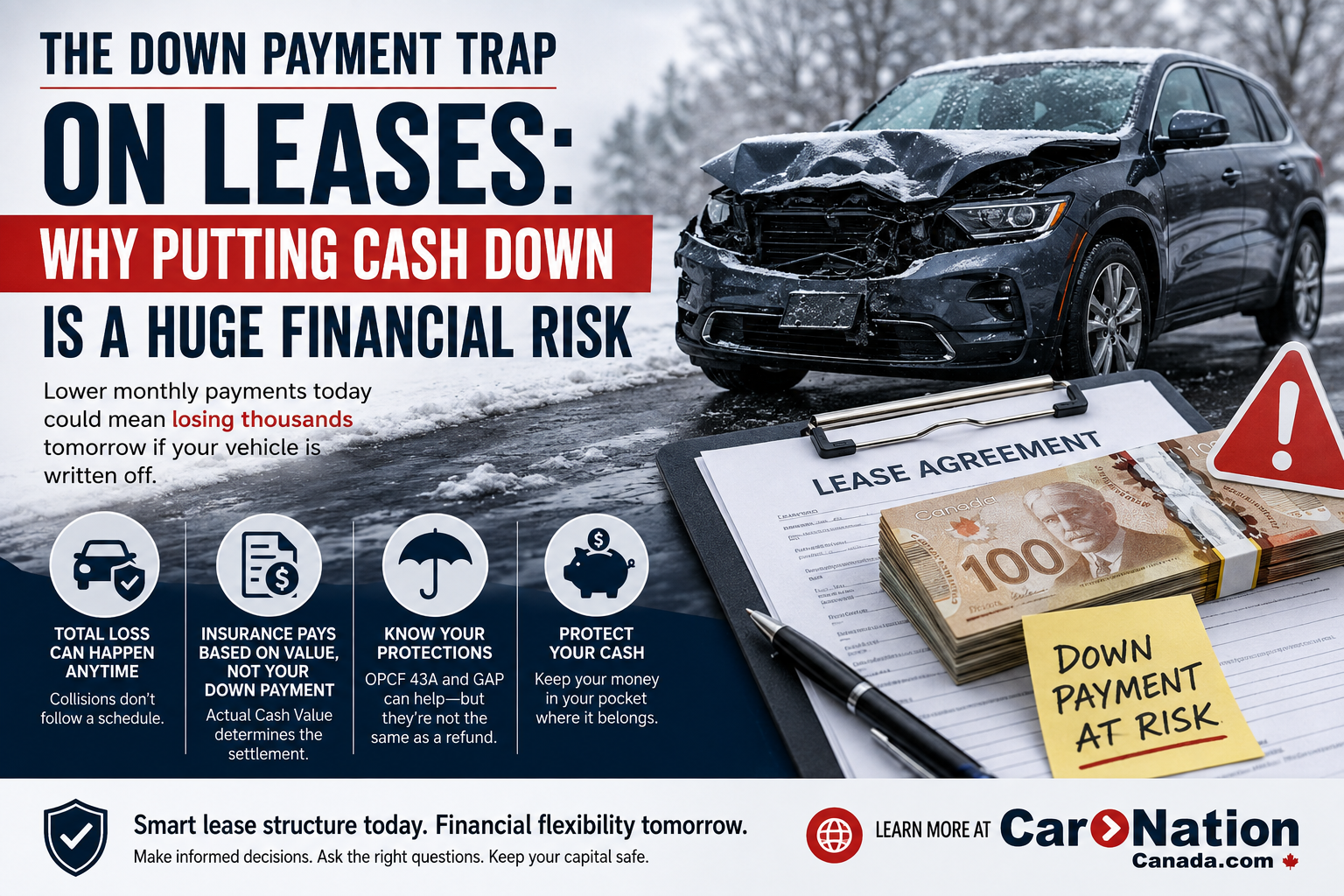
Down Payment on a Car Lease in Ontario: Why Putting Cash Down Can Be a Huge Financial Risk
Putting thousands of dollars down on a car lease can lower your monthly payment, but it may also put your cash at risk if the vehicle is written off early in the lease.
Putting a large cash down payment on a vehicle lease can feel financially responsible. You hand over $3,000, $5,000 or even more, your monthly payment drops, and the lease suddenly looks easier to fit into the household budget.
But there is an important difference between lowering your monthly payment and reducing your financial risk.
On a lease, a large upfront payment—often called a capital cost reduction—is generally money used immediately to reduce the amount being financed through the lease. It is not the same thing as putting money into an account that remains yours.
If the leased vehicle is stolen or written off shortly after you drive away, your insurance claim is handled according to the vehicle's insured value, your policy coverage and the lease agreement. Your insurer does not simply hand your original down payment back to you.
That makes a big lease down payment a risk worth understanding before you sign.
Key Takeaways
- A large lease down payment can reduce your monthly payment without necessarily improving your overall financial position.
- If a leased vehicle is written off, Ontario insurers generally determine the claim based on the vehicle's value and applicable policy coverage—not how much cash you originally put down.
- The leasing company is the vehicle's owner, which affects how insurance proceeds and the remaining lease obligation are handled.
- Optional protection such as OPCF 43A can remove depreciation deductions in qualifying total-loss situations involving specified lessees.
- GAP protection may help with a shortfall between the insurance settlement and the remaining lease obligation, but it should not be assumed to reimburse a voluntary cash down payment.
- For many shoppers, keeping a lease down payment small and retaining cash in savings can be the more flexible payment structure.
- Financing and leasing terms are always subject to lender approval. O.A.C. — On Approved Credit. Conditions may apply.
Why a Large Down Payment on a Car Lease Can Be Misleading
Imagine two drivers leasing the same vehicle for the same term.
Driver A puts $5,000 down.
Driver B puts very little down and keeps that $5,000 in savings.
Driver A will normally see a lower monthly lease payment because part of the lease cost has already been paid upfront.
That lower payment can look like a better deal.
But Driver A has not necessarily made the vehicle cheaper. They have largely changed when the money is paid.
This is why we encourage shoppers to look beyond the monthly payment and compare the complete structure of a lease:
- cash due at signing
- monthly payment
- lease term
- kilometre allowance
- applicable interest or lease rate
- taxes and fees
- residual value
- insurance requirements
- total amount paid over the term
A payment-focused shopper commuting between Burlington and Hamilton, for example, may understandably want the lowest possible monthly obligation.
But putting several thousand dollars down simply to reach a target payment can trade monthly flexibility for greater upfront exposure.
What Happens If Your Leased Vehicle Is Written Off in Ontario?
This is where the down payment trap becomes much easier to see.
Ontario's Financial Services Regulatory Authority explains in its guide to the automobile claims process that insurers generally compare the cost of repairing a damaged vehicle with its actual cash value at the time of the loss. An insurer will not normally spend more repairing a vehicle than the vehicle is worth.
If the vehicle is declared a total loss, the claim is settled under the applicable insurance coverage and policy terms.
The important point for a lease customer is this:
The insurance calculation does not start with, "How much money did the customer put down?"
It starts with the insured loss.
A $5,000 lease down payment does not automatically create an extra $5,000 insurance benefit.
That money has already been used in the lease transaction.
A Simplified Example
Suppose you lease an SUV and voluntarily put $5,000 down to reduce the payment.
Three months later, the vehicle is involved in a serious collision and is declared a total loss.
Your insurer determines the amount payable based on the vehicle's insured value and the terms of your policy. Because the vehicle is leased, the leasing company has an ownership interest in the vehicle and will be part of the settlement process.
Your $5,000 capital cost reduction is not automatically carved out of the settlement and returned to you as a separate refund.
The precise result depends on the lease contract, insurance settlement, optional endorsements, GAP protection and any remaining obligations, which is why drivers should confirm the details with both the leasing company and their licensed insurance representative.
Why This Matters Even More During an Ontario Winter
Drivers throughout Oakville, Milton, Grimsby and Brantford know how quickly Southern Ontario road conditions can change.
Freezing rain, packed snow, slush and black ice can dramatically change traction and stopping distance.
The Government of Ontario's winter-driving guidance specifically warns that many winter collisions happen when drivers travel too quickly for road conditions. Ontario also notes that winter tires can improve traction and control while shortening braking distances by as much as 25%.
The province has previously reported roughly 70,000 collisions occurring during winter months in a year—about 30% more than during summer in the period referenced by that Ontario safety campaign. Because that statistic is historical, it should be treated as context rather than a prediction of current collision frequency.
The point is not that your leased vehicle is likely to be written off.
It is that a total loss can happen unexpectedly—and tying thousands of dollars of your available cash to a depreciating leased vehicle creates an exposure you may not need to take.
What About OPCF 43A?
This is one of the most important insurance conversations for Ontario lease customers.
FSRA identifies OPCF 43A — Removing Depreciation Deduction for Specified Lessee(s) as an endorsement designed for leased vehicles. Its stated purpose is to remove the insurer's right to deduct depreciation when the covered vehicle is a total loss, subject to the endorsement's conditions.
That can materially affect a total-loss settlement on an eligible newer vehicle.
However, OPCF 43A should not be confused with a guarantee that every dollar you paid upfront on your lease will come back to you.
They are different issues.
Before taking delivery of a leased vehicle, ask your licensed insurance agent or broker:
- Is OPCF 43A available for this vehicle?
- How long does the coverage apply?
- What conditions or exclusions apply?
- How would a total-loss payment be handled on my specific lease?
- Who receives the settlement?
- Would any deductible apply?
That conversation is much more valuable than assuming "new vehicle replacement coverage" automatically protects every part of your lease transaction.
What About GAP Insurance on a Lease?
GAP insurance or a contractual GAP-type waiver is intended to address a different problem.
A vehicle can depreciate faster than the balance remaining on a finance or lease obligation.
For example, if the insurer values the total-loss vehicle at $32,000 but the remaining covered obligation is $36,000, there may be a $4,000 shortfall.
FSRA describes GAP insurance as optional protection designed to address that type of difference between a vehicle's actual cash value and the remaining loan or lease obligation.
But Ontario consumers should verify exactly what they are purchasing.
In July 2026, FSRA issued a specific warning about unlicensed businesses or individuals selling GAP insurance in Ontario, advising consumers to make sure insurance products are being provided through properly licensed channels.
GAP protection can therefore be useful, but it does not mean you should automatically feel comfortable putting $5,000 or $10,000 down on a lease.
Ask specifically whether your upfront capital cost reduction would be protected in a total-loss situation.
Do not assume.
A Smarter Lease Payment Structure: Protect Your Capital
For many drivers, the cleaner approach is straightforward:
Avoid making a large voluntary capital cost reduction purely to create a lower advertised monthly payment.
Instead, compare the lease with little or no discretionary money down.
You may still have legitimate amounts due at delivery, including items such as the first payment, registration charges, applicable fees or a lender-required amount depending on the transaction.
The important distinction is between required cash due at signing and extra cash you voluntarily contribute simply to reduce the monthly payment.
If keeping an extra $5,000 in the bank means your lease payment rises by a manageable amount each month, maintaining access to that cash may provide considerably more flexibility.
It can remain available for:
- emergency savings
- winter tires
- insurance deductibles
- home expenses
- unexpected repairs on another household vehicle
- debt repayment
- future transportation needs
- the next vehicle purchase
That is real financial flexibility.
Don't Turn Trade-In Equity Into the Same Trap
The same thinking can apply when you have substantial equity in a trade-in.
Suppose your current vehicle is worth materially more than the amount you owe.
It can be tempting to apply every dollar of that equity toward a new lease simply to push the monthly payment as low as possible.
Before doing that, ask how the equity is being applied.
If a large portion is effectively being used as a capital cost reduction, you should understand what happens to that money if the new leased vehicle suffers an early total loss.
Sometimes the smallest monthly payment is not the safest structure.
Our team can help you review the numbers before deciding how much cash or trade equity makes sense to put into a transaction. You can also browse our current new and used vehicle inventory to compare vehicles by price, body style and budget.
What If You Need a Lower Payment to Qualify?
This is where the conversation needs to stay practical.
Some shoppers are rebuilding credit. Others are newcomers to Canada establishing a credit file, families managing a tighter budget or commuters trying to keep transportation expenses predictable.
A lower payment can absolutely matter.
But there may be more than one way to reach an affordable payment.
Depending on your credit profile and lender approval, possibilities can include:
- choosing a different vehicle
- adjusting the term
- reviewing the annual kilometre allowance
- comparing leasing with financing
- using a smaller down payment
- considering available incentives
- reviewing your trade-in position
- changing the overall vehicle budget
Financing options are available for many credit situations, but approval, rates and terms depend on the applicant and lender.
If you want to understand what your budget may support before committing significant cash upfront, you can explore Car Nation Canada's finance options and pre-approval process.
O.A.C. — On Approved Credit. Conditions may apply.
The Question to Ask Before Putting Money Down on a Lease
Before you hand over a large down payment, ask yourself one question:
If this vehicle were written off next month, would I still be comfortable with the amount of cash I put into the lease today?
Then ask the leasing and insurance professionals involved in the transaction exactly how that scenario would be handled.
You should know:
- what happens to your upfront payment
- how a total-loss settlement is calculated
- whether OPCF 43A applies
- whether you have GAP protection
- what the lease contract says about an insurance loss
- whether any remaining balance could become your responsibility
If those answers are unclear, do not let the attraction of a lower monthly payment rush the decision.
Conclusion: Lower Monthly Payment Does Not Always Mean Lower Financial Risk
A big down payment on a car lease in Ontario can make the monthly number look attractive.
But it can also move thousands of dollars out of your bank account and into a lease at the very beginning of the contract.
If the vehicle is stolen or written off, the insurance settlement is determined by the insured loss, vehicle value, available endorsements and policy terms—not simply by refunding whatever you originally put down.
For many drivers, keeping the voluntary lease down payment modest and maintaining more cash in reserve can provide stronger financial flexibility.
If you're comparing an SUV, truck, sedan or minivan for commuting or family use across Southern Ontario, browse Car Nation Canada's current inventory and compare the complete cost structure—not just the monthly payment.
And if the payment needs to fit a specific household budget or credit situation, our finance team can help you explore available options.
Financing options are available for many credit situations. O.A.C. — On Approved Credit. Conditions may apply.
Frequently Asked Questions
Is it bad to put money down on a car lease?
Not automatically. Some cash may be required at signing, and every lease is different. The concern is putting a large voluntary amount down simply to reduce the monthly payment. That money may not be separately reimbursed if the vehicle is written off.
Do I get my lease down payment back if the car is totalled in Ontario?
Do not assume that you will. A total-loss claim is handled according to the vehicle's insured value, applicable coverage and the lease agreement. Your original capital cost reduction is not automatically treated as a refundable deposit. Confirm your specific arrangement with your insurer and leasing company.
Does GAP insurance protect my lease down payment?
GAP insurance is generally intended to cover certain shortfalls between a vehicle's insured value and the remaining loan or lease obligation. Coverage varies, so you should verify whether an upfront capital cost reduction is covered rather than assuming it is. FSRA also recommends ensuring any GAP insurance you purchase in Ontario comes through properly licensed channels.
What is OPCF 43A in Ontario?
OPCF 43A is an optional Ontario automobile insurance endorsement for specified lessees that can remove the insurer's right to deduct depreciation when settling an eligible total-loss claim. Conditions apply, so speak with your licensed insurance representative about eligibility and limitations.
What is the safest amount to put down on a lease?
There is no universal number. A useful approach is to avoid contributing more voluntary cash than necessary simply to manufacture a lower monthly payment. Compare the total lease cost, your emergency savings, insurance protection and monthly budget before deciding.