
Co-signing an Auto Loan in Ontario: Why It Can Stall Your Next Mortgage Approval
Co-signing an Auto Loan in Ontario: Why It Can Stall Your Next Mortgage Approval
Posted on September 9, 2026
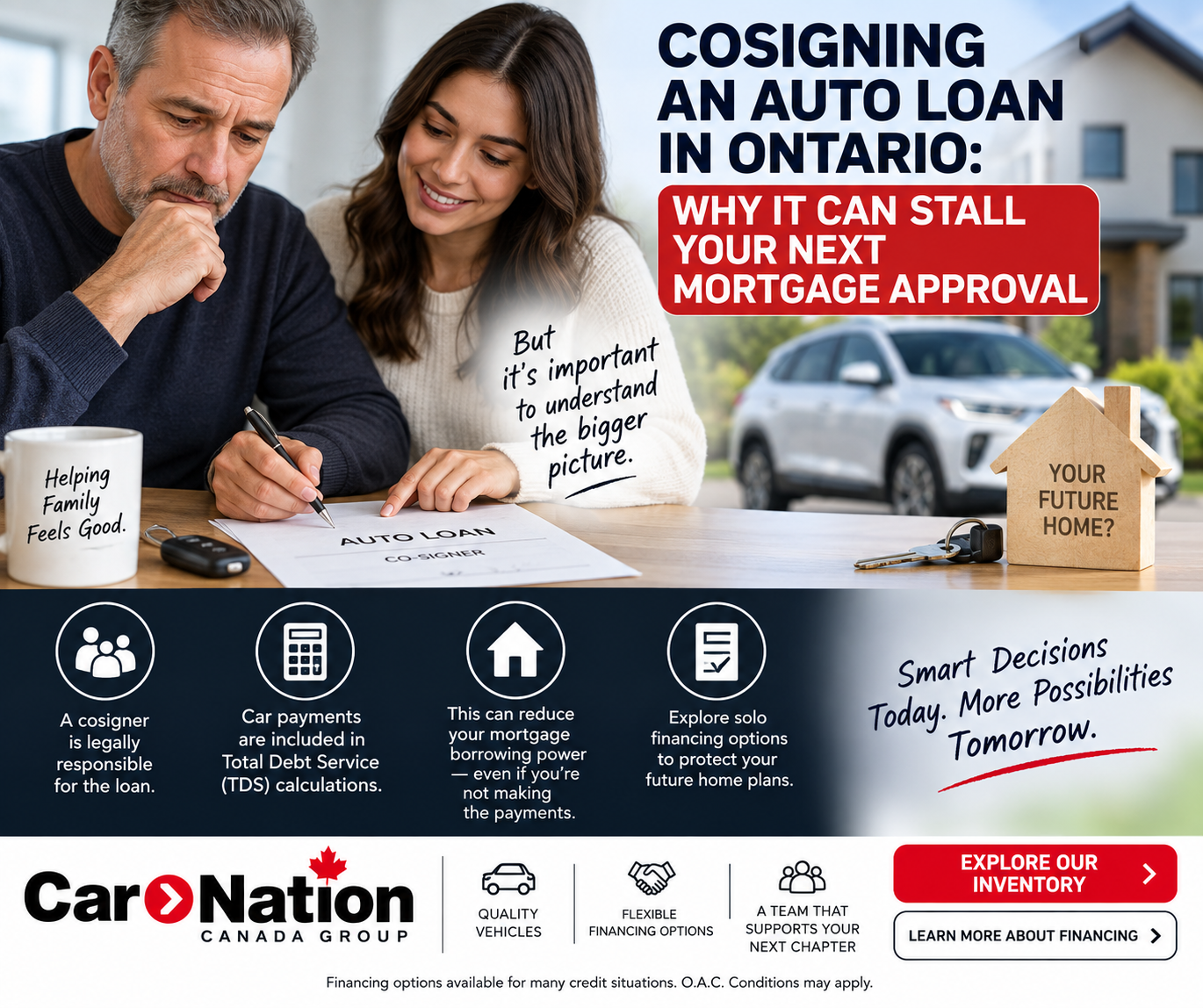
Co-signing an auto loan in Ontario can affect your mortgage borrowing power because the vehicle payment becomes part of your debt obligations—even when someone else drives the car and makes the payments.
Co-signing a car loan for a son, daughter, spouse, sibling or other family member can feel like a simple favour. You may think you are lending your good credit to the application, helping them establish themselves, and then stepping out of the picture.
From a lender's perspective, it can be much more significant.
When you become a co-signer or joint borrower, you are taking legal responsibility for the debt. The Financial Consumer Agency of Canada explains that a joint borrower who co-signs a loan becomes equally responsible for repaying the unpaid balance.
That matters if buying a home, refinancing or increasing your mortgage is somewhere in your future.
For buyers in Burlington, Hamilton, Oakville, Milton, and surrounding Southern Ontario communities, an auto payment that seemed manageable today could reduce the amount of mortgage debt a lender is prepared to approve tomorrow.
Key Takeaways
- Co-signing is not simply providing a character reference. A co-signer or joint borrower assumes responsibility for the loan.
- Car-loan payments are included when calculating Total Debt Service, or TDS, for mortgage qualification.
- Current federal guidance commonly uses approximately 39% for Gross Debt Service and 44% for Total Debt Service, although individual lender underwriting can vary.
- The mortgage stress test applies a higher qualifying interest rate to the mortgage itself; the vehicle payment separately consumes room within your TDS calculation.
- Even when another person normally makes the car payment, the debt can still affect the co-signer's mortgage application because the co-signer remains legally responsible.
- Whenever practical, qualifying for an auto loan independently can protect both the buyer's credit development and the co-signer's future borrowing capacity.
What Does Cosigning an Auto Loan in Ontario Actually Mean?
A common misunderstanding is that a co-signer simply tells the lender, "I know this person, and they're trustworthy."
That isn't what the agreement means.
According to the Financial Consumer Agency of Canada, co-signing makes you a joint borrower and leaves you equally responsible for repayment of the outstanding amount.
So imagine your daughter finances an SUV and you co-sign because she has a thin credit file.
She drives it.
She insures it.
She transfers the payment every month.
You may never contribute a dollar.
But your name remains attached to a legal debt obligation.
That difference becomes particularly important when you later ask a mortgage lender to calculate how much additional debt your income can support.
How Cosigning an Auto Loan Affects Your TDS Ratio
Canadian mortgage lenders look closely at two calculations: Gross Debt Service, or GDS, and Total Debt Service, or TDS.
GDS focuses mainly on housing costs.
TDS goes further. It includes those housing costs plus other debt obligations.
The Financial Consumer Agency of Canada specifically identifies car loans among the monthly debts included when calculating TDS. It says total debt load generally should not exceed 44% of gross income, while monthly housing costs generally should not exceed 39%. Individual lender and mortgage-insurer requirements may differ.
CMHC similarly describes TDS as housing costs plus other debt obligations and lists car loans among those obligations. Its published debt-service guidance uses maximum ratios of 39% GDS and 44% TDS for the applicable insured-mortgage framework.
This is why a cosigned vehicle can matter even when the arrangement feels entirely separate from your home purchase.
The auto loan occupies part of your available monthly debt capacity.
The Money Math: What a $650 Car Payment Can Do to Mortgage Room
Consider a simplified example.
Suppose an Ontario household earns $110,000 per year before tax.
That equals approximately $9,167 per month in gross income.
Using a 44% TDS benchmark, total monthly housing expenses and qualifying debt payments would be roughly limited to:
$9,167 × 44% = $4,033 per month
Now assume the mortgage lender calculates qualifying housing expenses of approximately $3,300 per month, including the mortgage payment used for qualification, property taxes, heating and any applicable portion of condominium fees.
Without the vehicle loan:
$3,300 ÷ $9,167 = approximately 36.0% TDS
There is approximately $733 per month of room remaining before reaching 44%.
Now add a $650 monthly cosigned vehicle payment.
$3,300 + $650 = $3,950
$3,950 ÷ $9,167 = approximately 43.1% TDS
The family has gone from having meaningful room inside the example TDS limit to sitting very close to it.
Only about $83 per month remains before reaching 44%.
Nothing about the house changed.
Nothing about household income changed.
The difference was the vehicle obligation.
This example is simplified for education. Actual mortgage qualification depends on the lender, mortgage type, qualifying interest rate, property taxes, heating costs, condominium fees, other debts, credit profile, income verification and numerous underwriting requirements.
Could a Car Payment Reduce Your Mortgage Approval by Tens of Thousands of Dollars?
Potentially, yes.
Suppose the $650 monthly payment in the previous example could otherwise have been available to service mortgage debt.
At an illustrative mortgage qualifying rate of 6.60% over a 25-year amortization, roughly $650 per month corresponds to approximately $95,000 of mortgage principal.
That does not mean every $650 auto payment automatically cuts a mortgage approval by exactly $95,000.
It demonstrates the scale of the problem.
Different qualifying rates, amortization periods, taxes, heating expenses, condominium costs, lender policies and borrower circumstances will change the calculation substantially.
But when families are trying to qualify for a home in Southern Ontario, losing hundreds of dollars of monthly debt-service capacity can make a meaningful difference.
For families looking around Grimsby, Brantford or the broader Niagara and Hamilton corridors, that distinction can affect the price range they are realistically able to consider.
Where the Canadian Mortgage Stress Test Fits In
There is another important distinction.
The mortgage stress test does not mean your car payment itself is "stress-tested" by adding two percentage points to the vehicle interest rate.
Instead, the mortgage is qualified using a higher mortgage interest rate while your other debt obligations are factored into the overall affordability calculation.
OSFI currently states that the minimum qualifying rate for uninsured mortgages is the greater of the mortgage contract rate plus 2% or 5.25%. OSFI's current page was updated January 29, 2026.
FCAC also explains that federally regulated banks require borrowers to qualify using the higher of 5.25% or their negotiated mortgage rate plus two percentage points and describes this test as applying to insured and uninsured mortgages.
So the pressure can come from both sides.
Your mortgage payment is being calculated at a qualifying rate that may be higher than the actual contract rate, while your auto loan, credit lines, student loans and other debts are simultaneously occupying TDS capacity.
That's why taking on a cosigned auto loan shortly before a home purchase deserves careful thought.
"But I'm Not Making the Car Payments"
This is one of the most understandable objections we hear.
A parent might say their son has made every payment.
A spouse might say the vehicle comes entirely out of the other partner's bank account.
Someone helping a newcomer to Canada may view their involvement as temporary assistance until the borrower establishes credit.
Those circumstances may matter to an individual lender's underwriting review, and lenders can have different documentation standards and policies.
But the starting point remains important: as a co-signer or joint borrower, you have assumed responsibility for the debt.
That is why you should never assume a future mortgage lender will simply disregard the auto loan because someone else normally pays it.
If a mortgage purchase is approaching, speak with your mortgage professional before cosigning additional debt.
Why Solo Auto Financing Can Be the Better Long-Term Goal
Sometimes a co-signer is necessary to obtain suitable financing. There is nothing inherently wrong with a properly understood joint application.
The mistake is treating a co-signer as the automatic first solution.
At Car Nation Canada Finance, our goal is to explore whether a vehicle buyer has a realistic path toward an independent approval before relying on someone else's borrowing capacity.
That can be especially relevant for someone rebuilding credit after financial difficulty, a newcomer developing a Canadian credit file, a younger first-time borrower or a household already balancing several monthly expenses.
Through our automotive finance options, our team can review financing possibilities available for many credit situations and look at how vehicle choice, loan amount, down payment, trade-in position and term length interact.
Financing is O.A.C. — On Approved Credit. Conditions may apply.
The objective isn't simply getting an application across the finish line.
It is finding a structure that makes sense for the buyer's larger financial picture.
Vehicle Choice Can Be Part of the Financing Strategy
Sometimes the difference between requiring a co-signer and pursuing a solo approval isn't simply the applicant's credit score.
The vehicle matters too.
A lower vehicle price can reduce the amount being financed.
A useful trade-in can reduce the required loan amount, although existing negative equity needs to be considered carefully.
A different term length can change the monthly payment, but stretching the loan solely to make the payment appear smaller can increase the total borrowing cost.
The right answer therefore isn't automatically "find the lowest monthly payment."
It is to understand payment, term, interest cost, loan balance and future financial plans together.
Someone hoping to purchase a home in two years may reasonably make a different auto-financing decision from someone with no near-term mortgage plans.
That is why we encourage shoppers to compare vehicles through our new and used vehicle inventory while also considering the financing structure behind the purchase.
Whether you need an SUV for a growing family, a truck for work, an efficient sedan for commuting or a minivan for everyday family life, the vehicle should fit both your transportation needs and your budget.
What If You've Already Cosigned?
If you've already cosigned a vehicle loan, don't assume your future mortgage plans are finished.
Start by understanding exactly what appears on your credit file and the remaining balance, payment amount and loan term.
Then speak with your mortgage lender or broker before making assumptions about what will or will not be included in qualification.
Depending on the circumstances, future options could include paying the vehicle loan down or off, waiting until the obligation ends, or having the primary borrower investigate whether they can qualify to refinance the remaining balance independently.
A refinance is never automatic. The primary borrower would need to qualify with the applicable lender, and new financing may have different rates, terms and total borrowing costs.
The earlier you understand the issue, however, the more choices you may have.
Protect the House Plan Before Signing the Car Loan
Helping family is important.
So is understanding what your signature means.
If you expect to apply for a mortgage, refinance a home or move to another property in the next few years, consider speaking with your mortgage professional before cosigning a major loan.
And if the person buying the vehicle is worried that they cannot qualify independently, explore the available financing possibilities before assuming a co-signer is required.
Our Car Nation Canada Finance team works with drivers across Burlington, Hamilton, Oakville, Milton, Grimsby, Brantford and surrounding Southern Ontario communities to explore financing options for many credit situations.
You can start by reviewing our finance application and education options and comparing vehicles through our current inventory.
The goal is a vehicle you can manage today without unnecessarily compromising another important financial goal tomorrow.
Financing O.A.C. — On Approved Credit. Conditions may apply.
FAQ
Does cosigning a car loan affect getting a mortgage in Ontario?
It can. A co-signer is responsible for the vehicle debt, and car-loan payments are among the debts considered in Total Debt Service calculations. That can reduce the amount of additional debt your income can support when applying for a mortgage.
Is the entire cosigned car payment counted against my mortgage?
CMHC-style TDS calculations include vehicle loan or lease payments as monthly debt obligations. However, individual lenders may have different underwriting policies or documentation requirements, so you should confirm how a specific lender will treat the debt rather than assuming it will automatically be excluded.
What is a good TDS ratio for a mortgage in Canada?
Federal consumer guidance generally describes total debt load as staying at or below approximately 44% of gross income, while CMHC publishes a 44% TDS maximum within its applicable mortgage-insurance framework. Mortgage qualification still depends on the lender and the full application.
Can the person I cosigned for refinance the car loan into their own name later?
Potentially. They would need to qualify independently for new financing, and approval, interest rate, loan term and other conditions would depend on the lender and their financial profile at that time. Approval is not guaranteed.
Can Car Nation Canada help someone try to finance a vehicle without a co-signer?
Our team can explore financing options available for many credit situations, including credit rebuilding and newer Canadian credit files. A solo approval cannot be promised, but evaluating vehicle price, down payment, trade-in, term and available lending options before adding a co-signer may help identify a more independent path. Financing O.A.C. Conditions may apply.