
Buying an As-Is Car in Ontario: The Real Cost of Skipping a Dealership Inspection
Buying an As-Is Car in Ontario: The Real Cost of Skipping a Dealership Inspection
Posted on September 15, 2026
Buying an As-Is Car in Ontario: The Real Cost of Skipping a Dealership Inspection
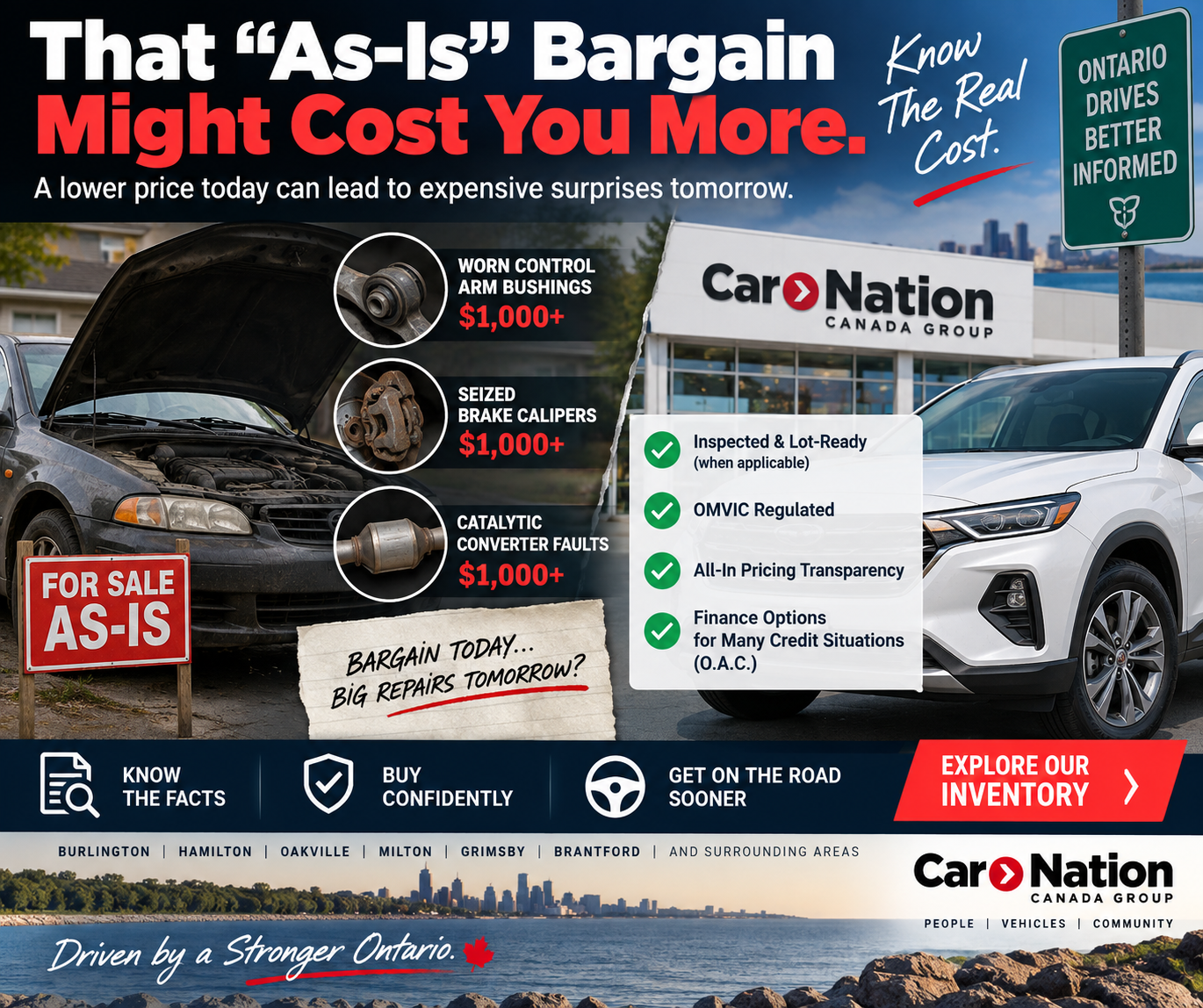
An “as-is” private-marketplace bargain can look thousands cheaper upfront, but worn suspension, brake, exhaust, and other repair needs can quickly erase the savings. Here’s how Ontario safety standards and OMVIC dealer protections change the money math.
Buying an as-is car in Ontario can be tempting, especially when a private listing is priced $2,000, $3,000, or even $5,000 below seemingly similar used vehicles.
For a payment-focused commuter, a family trying to stretch its budget, a newcomer building credit, or someone working through a fresh financial start, that lower purchase price can feel like the responsible choice.
But the number in the marketplace ad is only the beginning. If the vehicle still needs suspension work, brakes, exhaust repairs, tires, or other fixes before it can be safely put on the road, the real cost can be much higher.
Key Takeaways
- An Ontario Safety Standards Certificate confirms that a vehicle met the province's minimum safety standards on the date of inspection. It is not a mechanical warranty or guarantee of future reliability.
- A vehicle can be purchased and registered without a Safety Standards Certificate in some circumstances, but an applicable certificate is required before plates can be attached for normal road use.
- Private vehicle purchases do not receive the same OMVIC protections available when buying from an OMVIC-registered dealer.
- Ontario private sellers are generally required to provide a Used Vehicle Information Package, or UVIP, which contains information such as Ontario registration history, lien information, vehicle status, and other details.
- A low purchase price should always be compared against the total cost required to get the vehicle safely on the road, not just the seller's asking price.
- If financing is part of your purchase, compare the payment, term length, total cost of borrowing, trade-in position, and expected immediate repairs—not simply the monthly payment. Financing is O.A.C. (On Approved Credit). Conditions may apply.
Why Buying an As-Is Car in Ontario Can Be More Expensive Than It Looks
Imagine you find a private SUV for $12,000.
A comparable vehicle prepared for retail at a registered dealership might be advertised for $15,000 or $16,000.
At first glance, the private SUV appears to save you $3,000 or more.
That comparison is incomplete if the private vehicle has not been inspected.
Ontario's Safety Standards Certificate process looks at minimum safety requirements. The province states that vehicles requiring a certificate must pass an inspection performed through a licensed DriveON vehicle inspection centre.
That inspection can expose problems a short driveway test may not.
A clunk over a bump may be more than an annoyance. A vehicle pulling under braking may be more than an alignment issue. A warning light may represent a relatively inexpensive sensor—or an expensive exhaust-system problem.
Until the vehicle is properly inspected, you simply don't know.
The Repair-Bill Math Behind the “Cheap” Private Car
There is no honest way to quote a repair bill without inspecting the specific vehicle. Labour rates, parts prices, vehicle design, corrosion, and the extent of the damage all affect the final number.
But we can demonstrate how quickly the economics can change.
Consider this illustrative example only—not a repair quote:
| Cost | Private “As-Is” SUV |
|---|---|
| Purchase price | $12,000 |
| Control arm/bushing repairs | $1,100 |
| Brake calipers, rotors and pads | $1,300 |
| Exhaust/catalytic-converter-related repairs | $1,400 |
| Inspection, diagnostic and miscellaneous work | $350 |
| Illustrative cost before applicable tax/registration | $16,150 |
The $12,000 bargain has now become a $16,150 vehicle.
And that assumes the first inspection uncovers everything in the example.
Compare that with a $15,500 vehicle where the advertised condition, included preparation, history disclosures, and safety-certification status have already been clearly established before you sign.
The private vehicle is not automatically a bad purchase, and the dealer vehicle is not automatically cheaper. The point is that purchase price and total cost are two different numbers.
For shoppers in Burlington, Hamilton, Oakville, and Milton, that distinction matters even more when a vehicle is needed every day for work, school, childcare, and commuting.
Why Worn Control Arm Bushings Matter to an Ontario Safety Inspection
Suspension problems are easy to underestimate because a vehicle can still move while components are worn.
Ontario's inspection requirements address suspension and control-arm condition. The applicable standards require suspension components to meet minimum mechanical fitness requirements before a Safety Standards Certificate can be issued.
A worn bushing can contribute to looseness, poor alignment, abnormal tire wear, vague steering, clunking, or unwanted movement.
The financial problem is that repairs may extend beyond one rubber bushing.
Depending on the vehicle, the practical repair may involve replacing an entire control arm assembly. An alignment may then be required. If irregular suspension movement has already damaged the tires, another expense can follow.
That $2,500 difference between two advertised vehicles can shrink quickly.
Seized Brake Calipers: A Small Symptom Can Become a Large Bill
Brakes are another common place where an inexpensive-looking car can become expensive.
A sticking or seized caliper can create uneven braking and excessive heat. It may also damage pads and rotors.
By the time the problem is properly diagnosed, the repair may involve more than one component.
For a buyer trying to protect a tight monthly budget, this distinction matters. Spending nearly all available cash on the purchase price and then discovering an immediate four-figure repair can be much more disruptive than choosing a vehicle with a more predictable upfront cost.
That is why we encourage shoppers to think in terms of transportation budget, not simply vehicle price.
What About a Catalytic Converter Warning?
Catalytic-converter and emissions-related faults need careful explanation.
A catalytic-converter trouble code does not automatically mean the same thing as failing Ontario's safety inspection.
Ontario safety rules do, however, address the condition and integrity of the exhaust system, including issues such as missing or insecure exhaust components and exhaust leaks.
Separately, a check-engine light or catalytic-efficiency code can still signal an ownership expense you need to understand before purchasing.
Sometimes the converter itself is the problem. Sometimes another engine-management issue is causing the code. Proper diagnosis matters because replacing expensive parts before identifying the underlying cause can waste money.
For an as-is buyer, this is exactly why a pre-purchase mechanical inspection can be worth far more than its upfront cost.
Private Sale vs. OMVIC-Registered Dealer: The Protection Difference
This is where the comparison becomes bigger than worn parts.
OMVIC explains that buyers purchasing from an OMVIC-registered dealer receive protections under Ontario's Motor Vehicle Dealers Act framework. Private transactions do not receive those same OMVIC protections, and OMVIC cannot assist private-sale buyers through its dealer complaint framework or Motor Vehicle Dealers Compensation Fund.
Registered-dealer protections include requirements around vehicle disclosures and advertising.
For example, dealers have obligations to disclose prescribed information about a used vehicle's history and condition in the sales contract.
That does not mean a dealership vehicle can never have a mechanical problem.
It means the transaction takes place within a regulated framework that does not apply in the same way when you buy from an individual through a private marketplace.
How OMVIC All-In Pricing Changes the Comparison
Ontario shoppers should also understand all-in price advertising.
When an OMVIC-registered dealer advertises a vehicle with a price, the advertised price generally has to include the mandatory fees and charges the dealer intends to collect. HST and the actual cost of licensing can be excluded when that exclusion is clearly disclosed.
That helps you compare advertised dealer prices more meaningfully.
There is an important exception.
Dealers can also advertise vehicles as “as-is” or “unfit.” When they do, OMVIC requires specific disclosure language. The cost of safety certification is not necessarily included in the advertised price of such a vehicle, and if certification is offered for an additional amount, that must be disclosed appropriately.
So don't assume “dealership” automatically means “safety certified.”
Read the advertisement and bill of sale.
When comparing vehicles in Grimsby, Brantford, Burlington, or elsewhere in Southern Ontario, compare vehicles based on the condition and terms actually being offered.
Buying an As-Is Car in Ontario? Check the UVIP Before Paying
Ontario generally requires a private seller to provide the buyer with a Used Vehicle Information Package.
The UVIP can include the vehicle's Ontario registration history, lien information, average wholesale value information, and its last known vehicle status, including whether it is listed as unfit.
The Province of Ontario also recommends checking the VIN, reviewing lien information, inspecting for damage, test-driving the vehicle, and having a mechanic inspect it before purchase.
If a private seller refuses an independent inspection, cannot produce the required ownership documentation, or gives you a story that doesn't match the paperwork, consider that a warning sign.
A genuine bargain should still survive due diligence.
The Better Question: What Will This Vehicle Cost Me Over the Next 12 Months?
This is especially important for payment-focused shoppers.
Suppose Vehicle A costs $3,000 less today but needs $4,000 of immediate work.
Vehicle B has a higher advertised price but requires substantially less immediate spending.
Vehicle B may be easier on your actual household cash flow.
The same thinking applies when financing.
Look at:
- Down payment
- Trade-in value
- Any existing negative equity
- Amount financed
- Interest rate
- Term length
- Cost of borrowing
- Expected maintenance and repairs
- Insurance
- Fuel consumption in L/100 km
- Total monthly transportation budget
A lower monthly payment created only by extending the loan term does not necessarily mean the vehicle costs less.
Similarly, a lower private-sale price does not necessarily mean you are getting better value.
When Financing Can Help Make the Cost More Predictable
For some buyers, financing a retail-ready used vehicle can be preferable to draining savings on a cheaper vehicle and then paying unexpected repairs out of pocket.
That is especially relevant for newcomers building a Canadian credit profile, families recovering from a difficult financial period, or commuters whose vehicle needs to be dependable enough to get them to work every day.
Our team can help you look at your budget, trade-in, down payment, term options, and available financing paths together.
You can explore our automotive financing options before deciding how much vehicle fits comfortably into your budget.
Financing options are available for many credit situations. All financing is O.A.C. — On Approved Credit. Conditions may apply.
Conclusion: Compare the Real Cost, Not Just the Asking Price
Buying an as-is car in Ontario can work for an informed buyer who understands vehicle repairs, has access to a trusted technician, and maintains enough financial room for unexpected work.
But the private-marketplace price should never be treated as the final cost.
Control arm problems, seized brake components, exhaust faults, tires, steering issues, and other repair needs can turn an apparent bargain into a much more expensive purchase.
Ontario's Safety Standards Certificate gives you an important minimum-safety benchmark, although it should never be mistaken for a warranty. OMVIC-registered dealerships also operate within a consumer-protection and disclosure framework that does not apply to ordinary private sales.
Before choosing solely on sticker price, compare what each vehicle will realistically cost to put on the road and keep there.
If you'd rather start with vehicles already being retailed through our dealership group, browse our current new and used inventory. If payment or credit history is part of the decision, you can also review our finance options and application path and build a plan around a realistic total transportation budget.
FAQ
Is it legal to sell a car as-is in Ontario?
Yes. Vehicles can be sold as-is in Ontario, but the meaning and legal requirements depend on whether the seller is a private individual or a registered dealer. Registered dealers selling as-is vehicles are subject to specific OMVIC disclosure requirements.
Does a Safety Standards Certificate mean the used car is problem-free?
No. Ontario explicitly states that the certificate confirms the vehicle met minimum safety standards on the date it was inspected. It is not a warranty or guarantee of the vehicle's overall condition.
Can I drive an as-is vehicle home without a safety certificate?
Do not assume that you can. Registration, plate, permit, insurance, vehicle status, and safety-certificate requirements can affect whether the vehicle can legally be driven. Check the applicable requirements through ServiceOntario before arranging transportation. Ontario states that you can buy and register a vehicle without a Safety Standards Certificate in certain circumstances, but cannot attach plates for normal use without one when a certificate is required.
Is a private used-car purchase protected by OMVIC?
No. OMVIC's dealer protections apply to purchases from OMVIC-registered dealers. OMVIC advises that it cannot assist with an ordinary private transaction and private buyers do not have access to the Motor Vehicle Dealers Compensation Fund for that purchase.
Should I finance a dealer vehicle instead of buying a cheaper private car?
It depends on your budget, credit profile, expected repair costs, and how long you intend to keep the vehicle. Compare the total cost, not simply the purchase price or monthly payment. For shoppers who want to understand possible payment structures before choosing a vehicle, our finance team can review available options. Financing is O.A.C. Conditions may apply.